
Opening your dashboard
Class 10 Physics Chapter 5 Refraction through a Lens: Previous Year Questions
30 questions on Chapter 5, each solved step by step. Class 10 Physics, ICSE 2026-27.
30 questions with solutions
1–4 marks · Mixed difficulty
- 13 marks
Question 1
A lens produces a virtual image between the object and the lens.
(i) Name the lens.
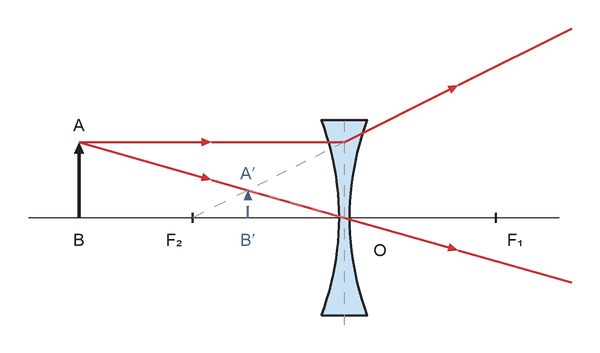
(ii) Draw a ray diagram to show the formation of this image.
Solve with AIWritten solution
Solution:
Concept: A concave (diverging) lens spreads light out. A ray parallel to the principal axis bends away from the axis, as if it came from the focus on the object's side, and a ray aimed at the optical centre O goes straight through. The refracted rays never meet; produced backwards they appear to meet between and O. So a concave lens always forms a virtual, erect and diminished image, between the object and the lens, wherever the object stands.
Given: A lens forms a virtual image between the object and the lens.
Step 1 — Part (i): decide which lens it is.
A convex lens forms a virtual image only when the object is inside its focus, and that image is always farther from the lens than the object (it is magnified). An image lying between the object and the lens must therefore come from a concave (diverging) lens, which always forms a virtual, erect, diminished image on the object's side.
Step 2 — Part (ii): draw the ray parallel to the axis.
Draw the object AB on the principal axis. From A, draw a ray parallel to the axis. After refraction it bends away from the axis; produce it backwards as a dashed line, which passes through the focus on the object's side.
Step 3 — Part (ii): draw the ray through the optical centre.
From A, draw a ray towards the optical centre O. It passes through the lens without bending.
Step 4 — Part (ii): locate the image.
The two refracted rays spread apart and never meet. Their backward extensions (the dashed line and the ray AO) cross at A′. Drop a dashed perpendicular A′B′ onto the axis: A′B′ is the image.
Watch out: Draw the refracted rays as solid lines and their backward extensions as dashed lines; a virtual image is drawn dashed.
Therefore, (i) the lens is a concave (diverging) lens; (ii) the image A′B′ is virtual, erect and diminished, between the object and the lens.
- 23 marks
Question 2
A lens forms an upright and diminished image of an object when the object is placed at the focal point of the given lens.
(i) Name the lens.
(ii) Draw a ray diagram to show the image formation.
Solve with AIWritten solution
Solution:
Concept: A concave (diverging) lens spreads light out. A ray parallel to the principal axis bends away from the axis, as if it came from the focus on the object's side, and a ray aimed at the optical centre O goes straight through. The refracted rays never meet; produced backwards they appear to meet between and O. So a concave lens always forms a virtual, erect and diminished image, between the object and the lens, wherever the object stands.
Given: The image is upright and diminished with the object at the focus.
Step 1 — Part (i): decide which lens it is.
For a convex lens an object at the focus sends out parallel rays, so its image is at infinity and highly magnified, never diminished. An upright, diminished image therefore comes from a concave (diverging) lens, which gives such an image for every position of the object.
Step 2 — Part (ii): draw the two rays.
Place the object AB at the focus on the object's side. From A, draw a ray parallel to the axis: after refraction it bends away from the axis, and its backward extension (dashed) passes through . From A, draw a second ray towards O: it goes straight through.
Step 3 — Part (ii): locate the image.
The backward extension and the ray AO cross at A′. Drop the dashed perpendicular A′B′: the image is virtual, erect and diminished, midway between and O.

Step 4 — Check with the lens formula.
For a concave lens of focal length f, put u = −f and focal length −f in the lens formula:
So the image is at half the focal length from the lens and half as tall as the object, as drawn.
Watch out: For a concave lens the focus on the object's side is (parallel rays appear to come from it); is on the far side.
Therefore, (i) the lens is a concave (diverging) lens; (ii) the image is virtual, erect, half the size of the object, at f/2 from the lens.
- 32 marks
Question 3
The power of a lens is –5D.
(i) Find its focal length.
(ii) Name the type of lens.
Solve with AIWritten solution
Solution:
Concept: Power of a lens: with f in metres; its unit is the dioptre (D). Power is positive for a convex lens and negative for a concave lens.
Given: P = −5 D.
Step 1 — Part (i): write the formula.
Power is the reciprocal of the focal length in metres, so the focal length is the reciprocal of the power:
Step 2 — Part (i): put in the value.
We substitute P = −5 D:
Step 3 — Part (ii): read the sign.
The power (and so the focal length) is negative. A negative focal length belongs to a concave (diverging) lens: parallel rays spread out after passing through it and appear to come from its focus, 20 cm in front of it.

Watch out: Keep the minus sign: it is what tells you the lens is concave.
Therefore, (i) f = −0.2 m (−20 cm), a focal length of 20 cm; (ii) the lens is a concave (diverging) lens.
- 42 marks
Question 4
State the position of the object in front of a converging lens if:
(i) It produces a real and same size image of the object.
(ii) It is used as a magnifying lens.
Solve with AIWritten solution
Solution:
Concept: A convex lens forms these images as the object comes closer: object beyond → real, inverted, diminished, between and ; at → real, inverted, same size, at ; between and → real, inverted, magnified, beyond ; at → at infinity; between and O → virtual, erect, magnified, on the object's side.
Step 1 — Part (i): real image of the same size.
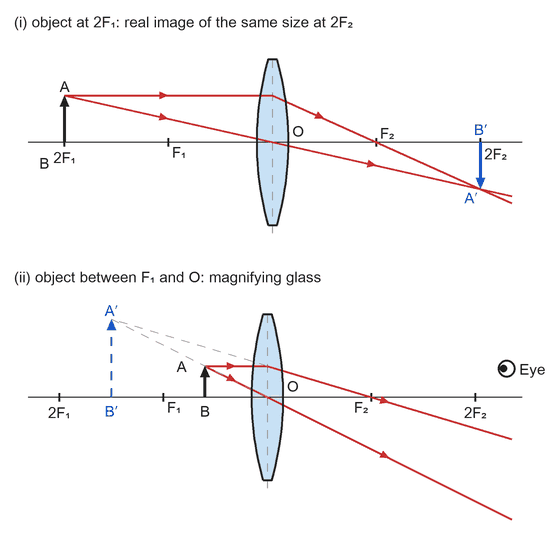
A convex lens gives a real image of the same size only when the object is at , at twice the focal length (2f) from the lens. The rays then meet at on the other side, giving a real, inverted image of the same size.
Step 2 — Part (ii): used as a magnifying lens.
A magnifying lens must give an erect, enlarged image. This happens only when the object is between the focus and the optical centre O, that is, within the focal length. The image is then virtual, erect and magnified, on the same side as the object, and is seen by looking through the lens.
Watch out: A "same size" image needs the object at 2F₁, not at F₁; an object at F₁ sends its image to infinity.
Therefore, (i) at (a distance 2f from the lens); (ii) between and O (within the focal length).
- 53 marks
Question 5
An object AB is placed between O and on the principal axis of a converging lens as shown in the diagram.
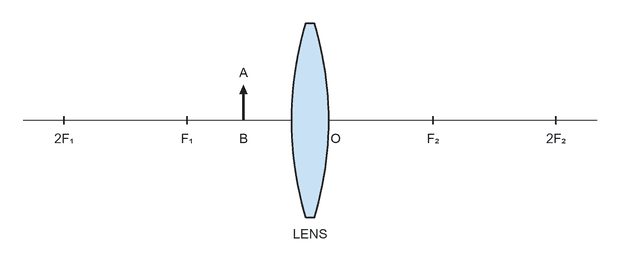
Copy the diagram and by using three standard rays starting from point A, obtain an image of the object AB.
Solve with AIWritten solution
Solution:
Concept: For a convex (converging) lens three standard rays locate an image: (1) a ray parallel to the principal axis passes through the second focus ; (2) a ray through the optical centre O goes straight on; (3) a ray through, or in line with, the first focus emerges parallel to the axis.
Given: Object AB between O and of a converging lens.
Step 1 — Ray 1: parallel to the axis.
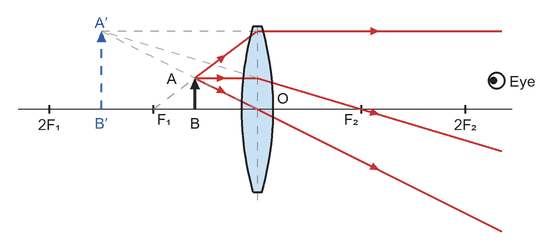
From A, draw a ray parallel to the principal axis. After refraction it passes through the second focus .
Step 2 — Ray 2: through the optical centre.
From A, draw a ray towards the optical centre O. It passes through the lens without bending.
Step 3 — Ray 3: in line with the first focus.
Join to A and extend this line (dashed from to A) until it meets the lens. This ray travels as if it came from , so after refraction it emerges parallel to the principal axis.
Step 4 — Locate the image.
The three refracted rays spread apart, so they never meet on the far side. Produce them backwards as dashed lines: they meet at A′. Draw the dashed perpendicular A′B′ to the axis. A′B′ is the image: virtual, erect and magnified, on the same side as the object and farther from the lens. It is seen by looking into the lens from the other side.
Watch out: With the object inside the third ray does not pass through ; it only lies on the line from through A. draw the refracted rays as solid lines and their backward extensions as dashed lines; a virtual image is drawn dashed.
Therefore, the image A′B′ is virtual, erect and magnified, on the same side of the lens as the object.
- 64 marks
Question 6
An object is placed at a distance of 12 cm from a convex lens of focal length 8 cm.
Find:
(i) the position of the image
(ii) nature of the image
Solve with AIWritten solution
Solution:
Concept: Sign convention (new Cartesian): every distance is measured from the optical centre O. Distances in the direction of the incident light are positive and distances against it are negative. So the object distance u is negative; the image distance v is positive for a real image (on the far side) and negative for a virtual image (on the object's side); f is positive for a convex lens and negative for a concave lens.
Lens formula: .
Magnification: ; it is also the image height divided by the object height. A negative m means a real, inverted image; a positive m means a virtual, erect image.
Given: Object distance u = −12 cm, focal length f = +8 cm (convex lens).
Step 1 — Write the data with signs.
The object is in front of the lens, so u is negative; the lens is convex, so f is positive:
Step 2 — Find the image distance.
From the lens formula, . We substitute the values:
Step 3 — Find the magnification.
The magnification tells us whether the image is erect or inverted, and its size:
Step 4 — State the nature.
The image distance v is positive, so the image is on the far side where the rays really meet: it is real. m is negative, so it is inverted; its size is 2, so it is magnified (twice as tall). This fits the rule: the object (12 cm) lies between (8 cm) and (16 cm), so the image lies beyond .

Watch out: The object distance u is always negative; forgetting its minus sign turns a real image into a virtual one.
Therefore, (i) the image is 24 cm behind the lens (v = +24 cm); (ii) it is real, inverted and magnified (m = −2).
- 72 marks
Question 7
(i) If the lens is placed in water instead of air, how does its focal length change?
(ii) Which lens, thick or thin has greater focal length?
Solve with AIWritten solution
Solution:
Concept: How strongly a lens bends light depends on (1) the refractive index of its material compared with the medium around it and (2) how curved its surfaces are. Less bending means the rays meet farther away, that is, a longer focal length.
Step 1 — Part (i): compare the bending in air and in water.
A lens bends light because light changes speed at its surfaces, and the amount of bending depends on the refractive index of the glass relative to the surrounding medium. For glass of refractive index 1.5:
Step 2 — Part (i): conclude.
The relative index in water is much closer to 1, so the lens bends light less in water. The refracted rays meet farther from the lens, so the focal length increases (and the power decreases).
Step 3 — Part (ii): thick or thin lens.
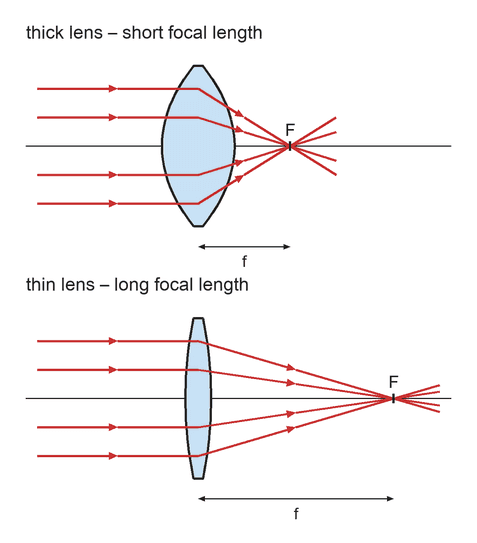
A thin lens has gently curved surfaces (large radii of curvature), so it bends light less and brings it to a focus farther away. A thick lens has strongly curved surfaces, bends light more and has a short focal length. So the thin lens has the greater focal length.
Watch out: A lens in water still converges (glass is denser than water); it only converges less strongly.
Therefore, (i) the focal length increases in water; (ii) a thin lens has the greater focal length.
- 83 marks
Question 8
A virtual, diminished image is formed when an object is placed between the optical centre and the principal focus of a lens.
(i) Name the type of lens which forms the above image.
(ii) Draw a ray diagram to show the formation of the image with the above stated characteristics.
Solve with AIWritten solution
Solution:
Concept: A concave (diverging) lens spreads light out. A ray parallel to the principal axis bends away from the axis, as if it came from the focus on the object's side, and a ray aimed at the optical centre O goes straight through. The refracted rays never meet; produced backwards they appear to meet between and O. So a concave lens always forms a virtual, erect and diminished image, between the object and the lens, wherever the object stands.
Given: A virtual, diminished image with the object between O and the focus.
Step 1 — Part (i): decide which lens it is.
With the object between O and the focus, a convex lens gives a virtual image that is magnified. A virtual, diminished image can only come from a concave (diverging) lens.
Step 2 — Part (ii): draw the two rays.
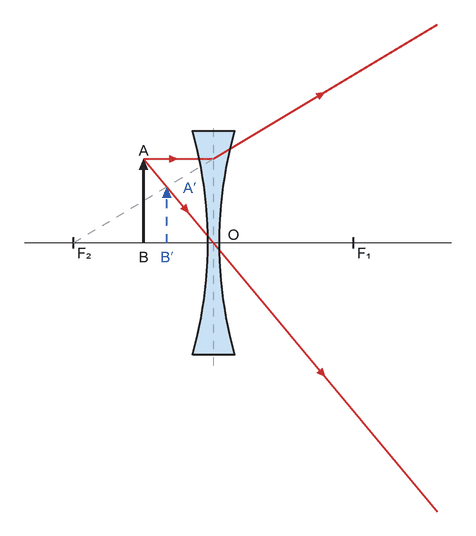
Place the object AB between O and the focus of the concave lens. From A, draw a ray parallel to the axis: after refraction it bends away from the axis, and its backward extension (dashed) passes through . From A, draw a ray towards O: it goes straight through.
Step 3 — Part (ii): locate the image.
The backward extension and the ray AO cross at A′. Drop the dashed perpendicular A′B′: the image is virtual, erect and diminished, between the object and the lens.
Watch out: For a concave lens the focus on the object's side is (parallel rays appear to come from it); is on the far side.
Therefore, (i) concave (diverging) lens; (ii) the image A′B′ is virtual, erect and diminished, between the object and the lens.
- 94 marks
Question 9
An object is placed at a distance 24 cm in front of a convex lens of focal length 8 cm.
(i) What is the nature of the image so formed ?
(ii) Calculate the distance of the image from the lens.
(iii) Calculate the magnification of the image.
Solve with AIWritten solution
Solution:
Concept: Sign convention (new Cartesian): every distance is measured from the optical centre O. Distances in the direction of the incident light are positive and distances against it are negative. So the object distance u is negative; the image distance v is positive for a real image (on the far side) and negative for a virtual image (on the object's side); f is positive for a convex lens and negative for a concave lens.
Lens formula: .
Magnification: ; it is also the image height divided by the object height. A negative m means a real, inverted image; a positive m means a virtual, erect image.
Given: Object distance u = −24 cm, focal length f = +8 cm (convex lens).
Step 1 — Part (i): predict the nature.
The object (24 cm) is farther than (2 × 8 cm = 16 cm). A convex lens then forms a real, inverted and diminished image between and . Parts (ii) and (iii) confirm it.
Step 2 — Part (ii): write the data with signs.
The object is in front of the lens and the lens is convex:
Step 3 — Part (ii): find the image distance.
From the lens formula, :
Step 4 — Part (iii): find the magnification.
Magnification is the image distance divided by the object distance:
The minus sign shows an inverted image, and 0.5 shows it is half the height of the object.

Watch out: The object distance u is always negative; forgetting its minus sign turns a real image into a virtual one.
Therefore, (i) real, inverted and diminished; (ii) 12 cm behind the lens (v = +12 cm); (iii) m = −0.5.
- 102 marks
Question 10
Where should an object be placed in front of a convex lens in order to get:
(i) an enlarged real image,
(ii) enlarged virtual image?
Solve with AIWritten solution
Solution:
Concept: A convex lens forms these images as the object comes closer: object beyond → real, inverted, diminished, between and ; at → real, inverted, same size, at ; between and → real, inverted, magnified, beyond ; at → at infinity; between and O → virtual, erect, magnified, on the object's side.
Step 1 — Part (i): enlarged real image.
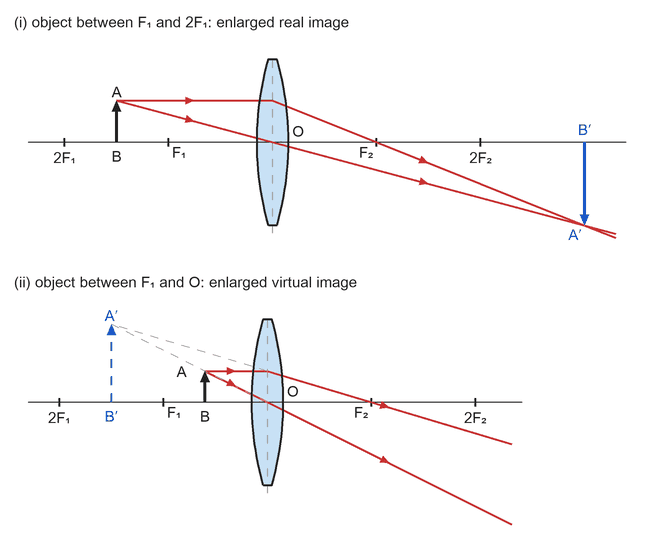
A real image needs the object beyond the focus, and an enlarged one needs it closer than . So place the object between and . The image forms beyond : real, inverted and enlarged.
Step 2 — Part (ii): enlarged virtual image.
A virtual image needs the object inside the focus. So place the object between and the optical centre O. The image is virtual, erect and enlarged, on the object's side, as in a magnifying glass.
Watch out: The object exactly at gives an image at infinity, so itself is not the answer to either part.
Therefore, (i) between and ; (ii) between and the optical centre O.
- 114 marks
Question 11
A lens of focal length 20 cm forms an inverted image at a distance 60 cm from the lens.
(i) Identify the lens.
(ii) How far is the lens present in front of the object?
(iii) Calculate the magnification of the image.
Solve with AIWritten solution
Solution:
Concept: Sign convention (new Cartesian): every distance is measured from the optical centre O. Distances in the direction of the incident light are positive and distances against it are negative. So the object distance u is negative; the image distance v is positive for a real image (on the far side) and negative for a virtual image (on the object's side); f is positive for a convex lens and negative for a concave lens.
Lens formula: .
Magnification: ; it is also the image height divided by the object height. A negative m means a real, inverted image; a positive m means a virtual, erect image.
Given: Focal length 20 cm; inverted image 60 cm from the lens.
Step 1 — Part (i): identify the lens.
An inverted image is always a real image, and only a convex lens forms real images (a concave lens always forms a virtual, erect image). So the lens is a convex (converging) lens.
Step 2 — Part (ii): write the data with signs.
A real image forms on the far side, so v is positive; f is positive for a convex lens:
Step 3 — Part (ii): find the object distance.
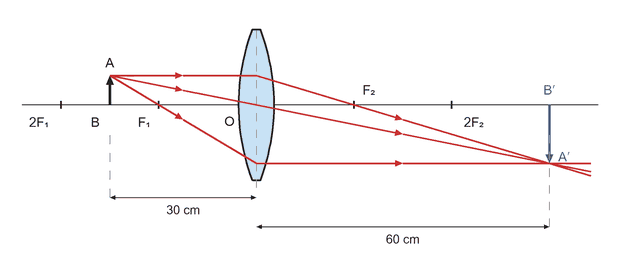
Rearranging the lens formula gives . We substitute:
The minus sign only says that the object is on the side from which the light comes: the object is 30 cm from the lens.
Step 4 — Part (iii): find the magnification.
Magnification is v divided by u:
The image is inverted and twice as tall as the object.
Watch out: The object distance u is always negative; forgetting its minus sign turns a real image into a virtual one.
Therefore, (i) convex (converging) lens; (ii) the object is 30 cm in front of the lens (u = −30 cm); (iii) m = −2.
- 121 mark
Question 12
A concave lens produces only ............... image.
Solve with AIAnswer
(A) real, enlarged
(B) virtual, enlarged
- Correct
(C) virtual, diminished
(D) real, diminished
Answer: (C) virtual, diminished
Concept: A concave (diverging) lens spreads light out. A ray parallel to the principal axis bends away from the axis, as if it came from the focus on the object's side, and a ray aimed at the optical centre O goes straight through. The refracted rays never meet; produced backwards they appear to meet between and O. So a concave lens always forms a virtual, erect and diminished image, between the object and the lens, wherever the object stands.
Step 1 — Virtual.
Rays from the object spread out after passing through a concave lens. They only appear to meet when produced backwards, on the object's side, so the image is virtual (and erect).
Step 2 — Diminished.
The image always lies between the lens and its focus, closer to the lens than the object, so it is smaller than the object, whether the object is far away or close to the lens.

Watch out: A concave lens never forms a real image and never an enlarged one, for any object position.
Why the other options are wrong:
- (A) real, enlarged: a concave lens cannot form a real image, and its image is never larger than the object; a real, enlarged image needs a convex lens with the object between and .
- (B) virtual, enlarged: the image is virtual, but always smaller than the object; a virtual, enlarged image is made by a convex lens used as a magnifying glass.
- (D) real, diminished: a real, diminished image is formed by a convex lens with the object beyond ; a concave lens cannot form a real image.
Therefore, a concave lens produces only a virtual, diminished image, option (C).
- 132 marks
Question 13
(a) Is it possible for a concave lens to form an image of size two times that of the object? Write Yes or No.
(b) What will happen to the focal length of the lens if a part of the lens is covered with an opaque paper?
Solve with AIWritten solution
Solution:
Concept: A concave lens always gives a smaller image. The focal length of a lens is fixed by the curvature of its surfaces and its material, not by how much of it is uncovered.
Step 1 — Part (a): size of a concave lens image.
A concave lens always forms a virtual, erect and diminished image, whatever the position of the object. Its magnification always lies between 0 and 1, so it can never form an image twice the size of the object. The answer is No.
Step 2 — Part (b): what decides the focal length.
The focal length depends only on the curvature of the lens surfaces and the material of the lens. Covering part of the lens with opaque paper changes neither, so the focal length does not change.
Step 3 — Part (b): what happens to the image.
Rays from every point of the object still pass through the uncovered part and are bent exactly as before, so the complete image still forms at the same place. Less light reaches it, so it is less bright. The figure shows this for a convex lens with its lower half covered; the same is true for a concave lens.

Watch out: Covering half the lens does not cut off half the image; it only makes the whole image dimmer.
Therefore, (a) No; (b) the focal length does not change (the complete image forms at the same place, only less bright).
- 143 marks
Question 14
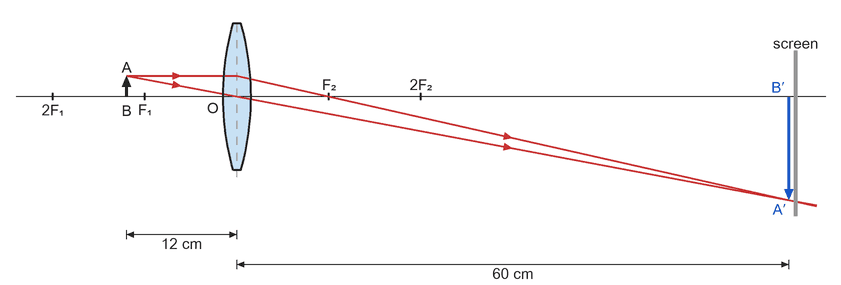
A convex lens of focal length 10 cm is placed at a distance of 60 cm from a screen. How far from the lens should an object be placed so as to obtain a real image on the screen?
Solve with AIWritten solution
Solution:
Concept: Sign convention (new Cartesian): every distance is measured from the optical centre O. Distances in the direction of the incident light are positive and distances against it are negative. So the object distance u is negative; the image distance v is positive for a real image (on the far side) and negative for a virtual image (on the object's side); f is positive for a convex lens and negative for a concave lens.
Lens formula: .
Magnification: ; it is also the image height divided by the object height. A negative m means a real, inverted image; a positive m means a virtual, erect image.
Given: Focal length f = +10 cm (convex lens); the screen, and so the image, is 60 cm from the lens.
Step 1 — Write the data with signs.
An image on a screen is real and forms on the far side of the lens, so the image distance is the lens-to-screen distance and is positive. The lens is convex, so f is positive:
Step 2 — Find the object distance.
Rearranging the lens formula gives . We substitute:
Step 3 — Check the result.
The object distance, 12 cm, lies between (10 cm) and (20 cm), so the lens forms a real, inverted, magnified image beyond , which is where the screen is. The magnification is:
So the image on the screen is 5 times as tall as the object and inverted.
Watch out: The object distance u is always negative; forgetting its minus sign turns a real image into a virtual one.
Therefore, the object should be placed 12 cm in front of the lens (u = −12 cm).
- 151 mark
Question 15
Linear magnification(m) produced by a concave lens is :
Solve with AIAnswer
- Correct
(A) m < 1
(B) m > 1
(C) m = 1
(D) m = 2
Answer: (A) m < 1
Concept: Linear magnification m is the image height divided by the object height; it also equals .
A concave (diverging) lens spreads light out. A ray parallel to the principal axis bends away from the axis, as if it came from the focus on the object's side, and a ray aimed at the optical centre O goes straight through. The refracted rays never meet; produced backwards they appear to meet between and O. So a concave lens always forms a virtual, erect and diminished image, between the object and the lens, wherever the object stands.
Step 1 — Sign of m.
A concave lens always forms an erect (virtual) image, so its magnification is positive.
Step 2 — Size of m.
The image is always smaller than the object, so the magnification is less than 1. Together, 0 < m < 1 for every position of the object, which is option (A).
Watch out: The answer m < 1 here also carries m > 0: the image of a concave lens is erect, so m is never negative.
Why the other options are wrong:
- (B) m > 1: m > 1 means a magnified image, which a concave lens never forms.
- (C) m = 1: this value means an image of the same size; a concave lens image is always smaller than the object.
- (D) m = 2: this value means an erect image twice as tall; that comes from a convex lens used as a magnifying glass, not a concave lens.
Therefore, the linear magnification of a concave lens is m < 1, option (A).
- 162 marks
Question 16
(a) In a reading glass what is the position of the object with respect to the convex lens used?
(b) Why can we not use concave lens for the same purpose?
Solve with AIWritten solution
Solution:
Concept: A reading glass is a magnifying glass: a convex lens that gives an erect, enlarged image of the letters.
Step 1 — Part (a): what a reading glass must do.
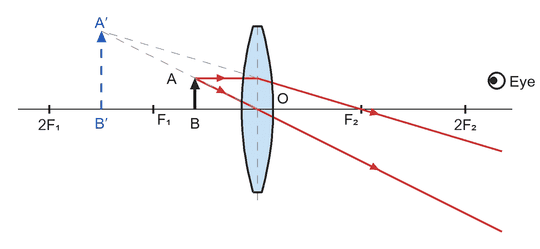
A reading glass must make the letters look bigger and the right way up, so it needs a virtual, erect and magnified image.
Step 2 — Part (a): position of the object.
A convex lens gives such an image only when the object is between the optical centre O and the principal focus , that is, within its focal length. The image forms on the same side as the object and is seen by the eye through the lens.
Step 3 — Part (b): why not a concave lens.
A concave lens always forms a virtual, erect and diminished image, wherever the object is placed. The letters would look smaller, not larger, so a concave lens cannot magnify and cannot be used as a reading glass.
Watch out: With the page beyond a convex lens gives a real, inverted image, which is no use for reading.
Therefore, (a) the object is between the optical centre and the focus (within the focal length); (b) a concave lens always gives a diminished image, so it cannot magnify.
- 173 marks
Question 17
The image of a candle flame placed at a distance of 36 cm from a spherical lens, is formed on a screen placed at a distance of 72 cm from the lens. Calculate the focal length of the lens and its power.
Solve with AIWritten solution
Solution:
Concept: Sign convention (new Cartesian): every distance is measured from the optical centre O. Distances in the direction of the incident light are positive and distances against it are negative. So the object distance u is negative; the image distance v is positive for a real image (on the far side) and negative for a virtual image (on the object's side); f is positive for a convex lens and negative for a concave lens.
Lens formula: .
Magnification: ; it is also the image height divided by the object height. A negative m means a real, inverted image; a positive m means a virtual, erect image.
Power of a lens: with f in metres; its unit is the dioptre (D). Power is positive for a convex lens and negative for a concave lens.
Given: Object 36 cm from the lens; image on a screen 72 cm from the lens.
Step 1 — Write the data with signs.
The flame's image is caught on a screen, so it is real and on the far side of the lens: v is positive. The object is in front, so u is negative:
Step 2 — Find the focal length.
We put the values into the lens formula :
f is positive, so the lens is convex (only a convex lens can form a real image on a screen).
Step 3 — Find the power.
Power is the reciprocal of the focal length in metres, and 24 cm = 0.24 m:

Watch out: Change 24 cm to 0.24 m before taking the reciprocal; 1/24 would give a power 100 times too small.
Therefore, f = +24 cm (a convex lens) and P ≈ +4.17 D.
- 181 mark
Question 18
For a real image formed by a convex lens, the ratio of I : O = 2 : 5, then the object is :
(I is the height of the image and O is the height of the object)
Solve with AIAnswer
(A) between O and F
- Correct
(B) beyond 2F
(C) at F
(D) between F and 2F
Answer: (B) beyond 2F
Concept: Lens formula: .
Magnification: ; it is also the image height divided by the object height. A negative m means a real, inverted image; a positive m means a virtual, erect image. A convex lens forms these images as the object comes closer: object beyond → real, inverted, diminished, between and ; at → real, inverted, same size, at ; between and → real, inverted, magnified, beyond ; at → at infinity; between and O → virtual, erect, magnified, on the object's side.
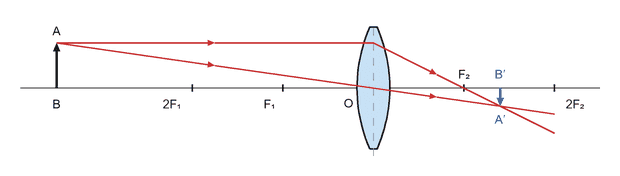
Step 1 — Write the magnification.
The image is real, so it is inverted and m is negative:
Step 2 — Write v in terms of u.
Since , the image distance is times the object distance:
Step 3 — Use the lens formula.
We substitute this v into the lens formula and simplify, one step per line:
Step 4 — Place the object.
The object is 3.5 focal lengths from the lens, which is farther than 2f, so it is beyond 2F.
Watch out: I : O = 2 : 5 means a smaller image; a real, diminished image needs the object beyond 2F.
Why the other options are wrong:
- (A) between O and F: with the object between O and F the image is virtual, erect and magnified, not real.
- (C) at F: with the object at F the refracted rays are parallel, so the image is at infinity and highly magnified.
- (D) between F and 2F: with the object between F and 2F the image is real but magnified (larger than the object), formed beyond 2F on the other side.
Therefore, the object is beyond 2F, option (B).
- 194 marks
Question 19
(a) An object is placed at 2F position of a convex lens. Draw a ray diagram showing the formation of the image.
(b) How will the size of the image change if we, ONLY replace the lens in the above arrangement with another lens of a greater focal length?
Solve with AIWritten solution
Solution:
Concept: For a convex (converging) lens three standard rays locate an image: (1) a ray parallel to the principal axis passes through the second focus ; (2) a ray through the optical centre O goes straight on; (3) a ray through, or in line with, the first focus emerges parallel to the axis. A convex lens forms these images as the object comes closer: object beyond → real, inverted, diminished, between and ; at → real, inverted, same size, at ; between and → real, inverted, magnified, beyond ; at → at infinity; between and O → virtual, erect, magnified, on the object's side.
Step 1 — Part (a): draw the three rays.
Place the object AB at . From A, draw (1) a ray parallel to the axis, which passes through after refraction; (2) a ray through O, which goes straight on; (3) a ray through , which emerges parallel to the axis.
Step 2 — Part (a): locate the image.
The three refracted rays meet at A′, at . Draw A′B′ perpendicular to the axis: the image is real, inverted and of the same size as the object.

Step 3 — Part (b): compare the object distance with the new 2F.
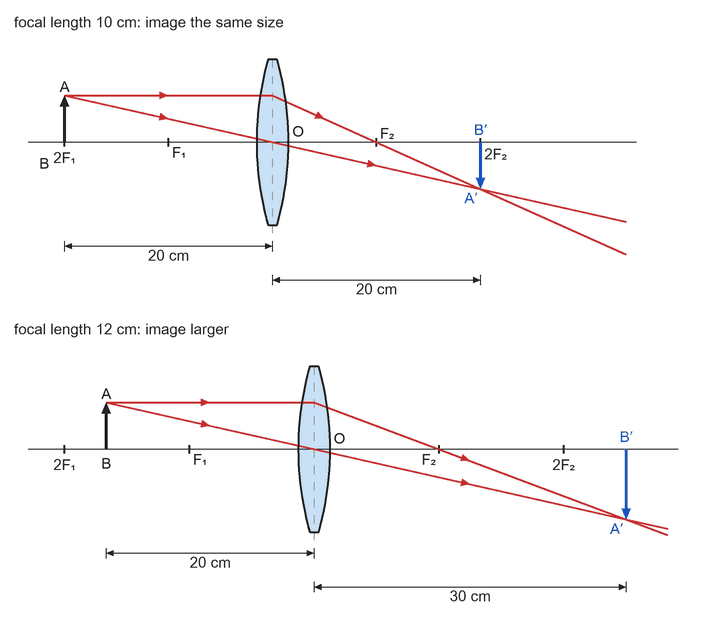
The object stays at the old distance 2f. The new lens has a greater focal length f′, so its own 2F′ is farther away and the object (at 2f, less than 2f′) now lies inside the new . If f′ is less than 2f, the object is between the new and , so the image is real, inverted and magnified, formed beyond the new .
Step 4 — Part (b): a hypothetical example.
Take f = 10 cm with the object at 20 cm (its 2F): the image is the same size at 20 cm. Now use a lens of focal length 12 cm, with the object still at u = −20 cm:
The image is now 1.5 times as tall as the object.
Watch out: The object did not move; only the lens changed, so compare the same object distance with the NEW focal points.
Note: If the new focal length were more than twice the old one, the object would lie inside the new focus; the lens would then give a virtual, magnified image, which is still larger than the object.
Therefore, (a) the image is at : real, inverted, same size; (b) the image becomes larger (magnified).
- 203 marks
Question 20
An object is placed in front of a concave lens at a distance of 45 cm from it. If its image is formed at a distance of 30 cm from the lens, calculate the focal length of the lens.
Solve with AIWritten solution
Solution:
Concept: Sign convention (new Cartesian): every distance is measured from the optical centre O. Distances in the direction of the incident light are positive and distances against it are negative. So the object distance u is negative; the image distance v is positive for a real image (on the far side) and negative for a virtual image (on the object's side); f is positive for a convex lens and negative for a concave lens.
Lens formula: .
Magnification: ; it is also the image height divided by the object height. A negative m means a real, inverted image; a positive m means a virtual, erect image.
Given: Concave lens; object 45 cm away; image 30 cm away.
Step 1 — Write the data with signs.
A concave lens forms a virtual image on the object's side, so both u and v are negative:
Step 2 — Find the focal length.
We put the values into :
Step 3 — Check the result.
The minus sign confirms a diverging (concave) lens. The image is as tall as the object: virtual, erect and diminished, as a concave lens always gives.

Watch out: The image of a concave lens is virtual, so v is negative too; taking v = +30 cm gives a wrong, positive f.
Therefore, the focal length of the lens is 90 cm (f = −90 cm).
- 211 mark
Question 21
Which of the following values can represent the magnification of a simple microscope?
Solve with AIAnswer
(A) +1
(B) –1
- Correct
(C) +2
(D) –2
Answer: (C) +2
Concept: A simple microscope (magnifying glass) is a convex lens with the object within its focal length. It forms a virtual, erect and magnified image, so its magnification m is positive and greater than 1.
Step 1 — Sign.
A simple microscope gives an erect (virtual) image, so its magnification is positive.
Step 2 — Size.
The image is magnified, so the magnification is more than 1. Of the options only +2 is positive and greater than 1.
Watch out: A minus sign on m always means an inverted, real image.
Why the other options are wrong:
- (A) +1: +1 means an erect image of the same size; there is no magnification at all.
- (B) –1: −1 means a real, inverted image of the same size (object at 2F of a convex lens), not what a microscope gives.
- (D) –2: −2 means a real, inverted, magnified image (object between F and 2F, as in a projector); a simple microscope gives an erect image, so m cannot be negative.
Therefore, the magnification of a simple microscope can be +2, option (C).
- 221 mark
Question 22
An object placed at a distance 30 cm in front of a lens produces clear inverted image at a distance 60 cm from the lens. If the object is placed at 60 cm from the lens, then it produces a clear inverted image at a distance of ............... from the lens.
Solve with AIAnswer
(A) 20 cm
- Correct
(B) 30 cm
(C) 60 cm
(D) 90 cm
Answer: (B) 30 cm
Concept: Sign convention (new Cartesian): every distance is measured from the optical centre O. Distances in the direction of the incident light are positive and distances against it are negative. So the object distance u is negative; the image distance v is positive for a real image (on the far side) and negative for a virtual image (on the object's side); f is positive for a convex lens and negative for a concave lens. Lens formula: .
Magnification: ; it is also the image height divided by the object height. A negative m means a real, inverted image; a positive m means a virtual, erect image.
Step 1 — Find the focal length.
The inverted image is real, so u = −30 cm and v = +60 cm.
Now we use the lens formula in the form :
Step 2 — Find the new image distance.
Now the object is 60 cm away, so u = −60 cm.
The lens formula gives , so:
This also follows from the reversibility of light: the object and image positions simply swap.
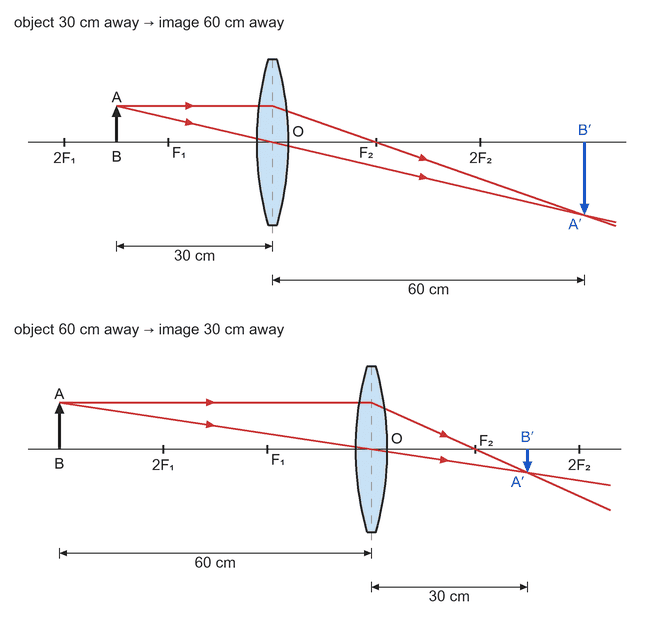
Watch out: Find f from the first set-up first; the second image distance is not found by adding or subtracting distances.
Why the other options are wrong:
- (A) 20 cm: 20 cm is the focal length; the image forms at the focus only when the object is very far away.
- (C) 60 cm: 60 cm is the old image distance, which belongs to the object at 30 cm.
- (D) 90 cm: 90 cm is just 30 cm + 60 cm added together; the lens formula does not give it.
Therefore, the image forms 30 cm from the lens, option (B).
- 234 marks
Question 23
Answer the following with respect to a concave lens (L).

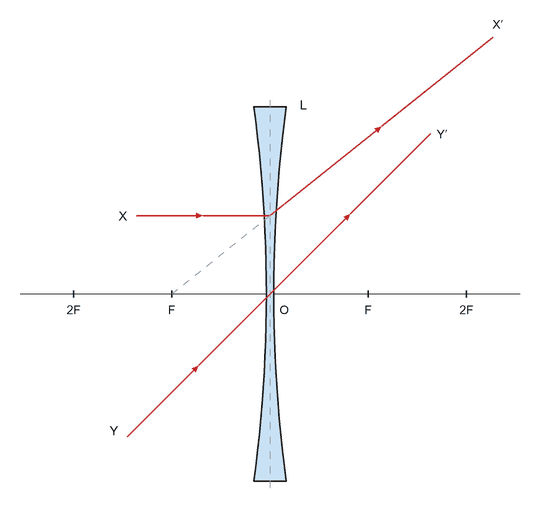
(a) Describe the path of the rays X and Y through the lens.
(b) Give one use of this lens.
(c) Calculate its power if the focal length of this lens is 20 cm.
Solve with AIWritten solution
Solution:
Concept: A concave (diverging) lens spreads light out. A ray parallel to the principal axis bends away from the axis, as if it came from the focus on the object's side, and a ray aimed at the optical centre O goes straight through. The refracted rays never meet; produced backwards they appear to meet between and O. So a concave lens always forms a virtual, erect and diminished image, between the object and the lens, wherever the object stands. Power of a lens: with f in metres; its unit is the dioptre (D). Power is positive for a convex lens and negative for a concave lens.
Given: Concave lens L; focal length 20 cm.
Step 1 — Part (a): ray X.
Ray X travels parallel to the principal axis. After refraction it bends away from the axis, so that, produced backwards (dashed), it appears to come from the focus F on the side of the incident light (the second focus of the concave lens).
Step 2 — Part (a): ray Y.
Ray Y is directed towards the optical centre O, so it passes through the lens undeviated.
Step 3 — Part (b): one use.
A concave lens is used in spectacles to correct short sight (myopia): it diverges the light a little so that the eye focuses a distant object on the retina.
Step 4 — Part (c): power.
For a concave lens f is negative, so f = −20 cm, or −0.2 m. Power is the reciprocal of f in metres:
Watch out: The power of a concave lens is negative; writing +5 D describes a convex lens.
Therefore, (a) X diverges as if from the focus on the incident side; Y passes undeviated through O; (b) spectacles for short sight (myopia); (c) P = −5 D.
- 243 marks
Question 24
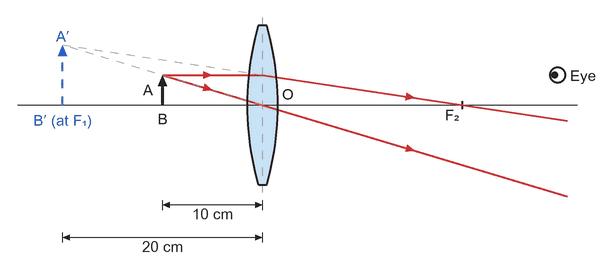
An object is placed at a distance of 10 cm from a convex lens of focal length 20 cm.
(a) Find the position of the image.
(b) What is the nature of the image?
Solve with AIWritten solution
Solution:
Concept: Sign convention (new Cartesian): every distance is measured from the optical centre O. Distances in the direction of the incident light are positive and distances against it are negative. So the object distance u is negative; the image distance v is positive for a real image (on the far side) and negative for a virtual image (on the object's side); f is positive for a convex lens and negative for a concave lens.
Lens formula: .
Magnification: ; it is also the image height divided by the object height. A negative m means a real, inverted image; a positive m means a virtual, erect image.
Given: Object distance u = −10 cm, focal length f = +20 cm (convex lens).
Step 1 — Write the data with signs.
The object is in front of a convex lens:
Step 2 — Part (a): find the image distance.
From the lens formula, :
The minus sign puts the image 20 cm from the lens on the same side as the object, exactly at the focus .
Step 3 — Part (b): find the magnification.
Magnification is v divided by u:
The image distance v is negative, so the image is virtual; m is positive, so it is erect; m = 2, so it is magnified (twice as tall). This is the magnifying-glass case: the object is inside the focal length.
Watch out: The object distance u is always negative; forgetting its minus sign turns a real image into a virtual one.
Therefore, (a) the image is 20 cm from the lens on the object's side (v = −20 cm, at ); (b) it is virtual, erect and magnified (m = +2).
- 251 mark
Question 25
The distance (V) of a virtual image formed by a lens of focal length 15 cm never exceeds a certain finite value, then this value will be:
Solve with AIAnswer
(A) less than 15 cm
(B) between 15 cm to 30 cm
(C) less than or equal to 30 cm
- Correct
(D) less than or equal to 15 cm
Answer: (D) less than or equal to 15 cm
Concept: A concave (diverging) lens spreads light out. A ray parallel to the principal axis bends away from the axis, as if it came from the focus on the object's side, and a ray aimed at the optical centre O goes straight through. The refracted rays never meet; produced backwards they appear to meet between and O. So a concave lens always forms a virtual, erect and diminished image, between the object and the lens, wherever the object stands.
Step 1 — Rule out a convex lens.
A convex lens forms a virtual image when the object is inside its focus. As the object moves towards the focus the image moves farther and farther away, without any limit. So the lens must be concave.
Step 2 — Where a concave lens forms its image.
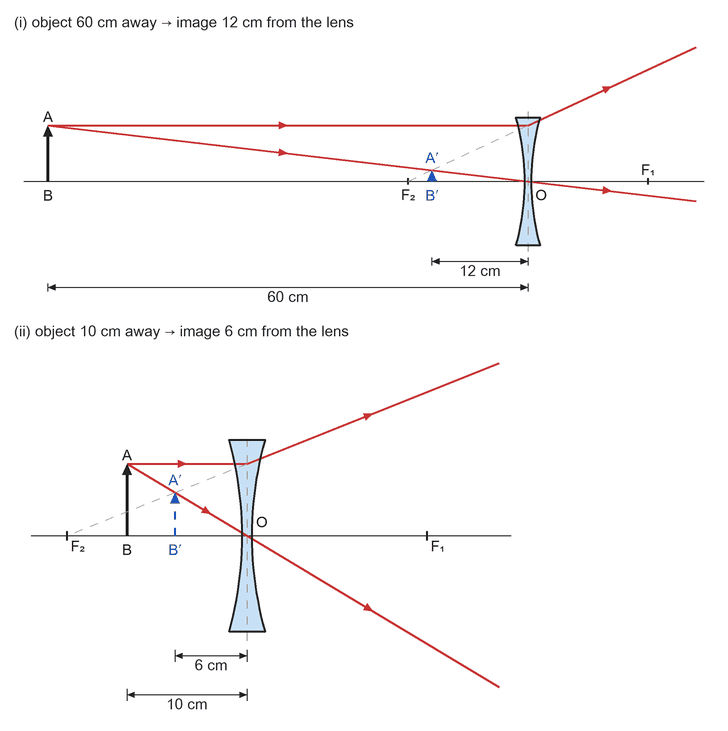
The image of a concave lens always lies between O and the focus on the object's side. With f = −15 cm, for example:
Step 3 — Find the limit.
Moving the object very far away (to infinity) moves the image up to the focus itself, 15 cm from the lens. So the image distance never goes beyond 15 cm: V ≤ 15 cm.
Watch out: The limit is reached when the object is at infinity, so the value 15 cm itself is included.
Why the other options are wrong:
- (A) less than 15 cm: "less than 15 cm" leaves out the object at infinity, whose image forms at the focus, exactly 15 cm away; "less than or equal to" is the complete answer.
- (B) between 15 cm to 30 cm: a concave lens never forms its image beyond its focus, so the image is never 15 cm to 30 cm away.
- (C) less than or equal to 30 cm: 30 cm is twice the focal length; this would allow images beyond the focus, which a concave lens does not form.
Therefore, the image distance is less than or equal to 15 cm, option (D).
- 262 marks
Question 26
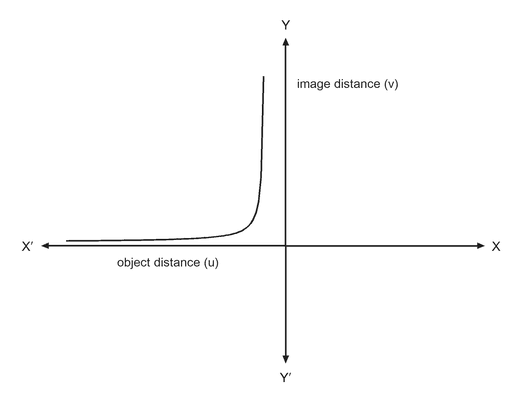
The graph below shows the variation of image distance (v) with the object distance (u) when an object is kept in front of a lens.
(a) Identify the type of lens used.
(b) What would be the magnification (more than 1 / less than 1 / equal to 1) if the object is placed between F and 2F of the above lens?
Solve with AIWritten solution
Solution:
Concept: Sign convention (new Cartesian): every distance is measured from the optical centre O. Distances in the direction of the incident light are positive and distances against it are negative. So the object distance u is negative; the image distance v is positive for a real image (on the far side) and negative for a virtual image (on the object's side); f is positive for a convex lens and negative for a concave lens. A convex lens forms these images as the object comes closer: object beyond → real, inverted, diminished, between and ; at → real, inverted, same size, at ; between and → real, inverted, magnified, beyond ; at → at infinity; between and O → virtual, erect, magnified, on the object's side.
Step 1 — Part (a): read the signs on the graph.
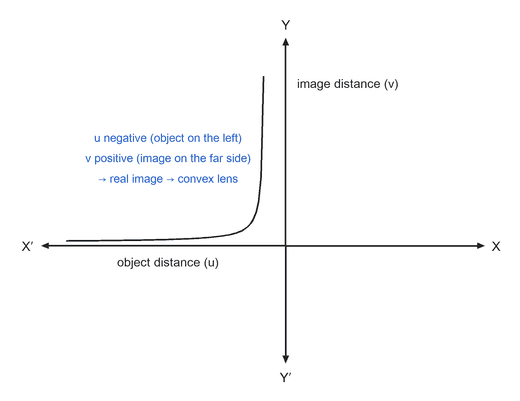
By the sign convention, u is negative for a real object (the curve lies to the left of the v-axis). On the graph v is positive: the image forms on the far side of the lens, where the rays really meet, so it is a real image.
Step 2 — Part (a): identify the lens.
Only a convex lens forms real images; a concave lens always forms a virtual image on the object's side, so its v would be negative and its curve would lie below the u-axis. The curve also rises steeply as the object is brought towards the lens: the image runs off to infinity as the object reaches the focus, which happens only with a convex lens. So the lens is a convex (converging) lens.
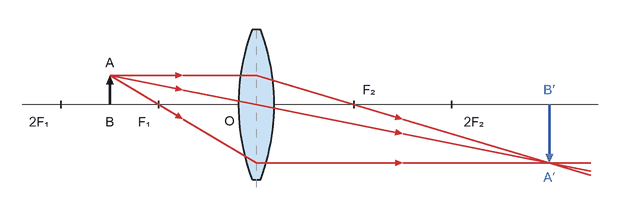
Step 3 — Part (b): object between F and 2F.
With the object between F and 2F, a convex lens forms a real, inverted and magnified image beyond 2F on the other side. The image is larger than the object, so the size of the magnification is more than 1 (its sign is negative, because the image is inverted).
Watch out: The phrase "more than 1" here is about the size of m; the value itself is negative (for example −2).
Therefore, (a) a convex (converging) lens; (b) the magnification is more than 1.
- 273 marks
Question 27
An object placed in front of a convex lens, forms an image of same size on a screen. Moving the object 12 cm closer to the lens results in the formation of a real image which is three times the size of the object. Calculate the focal length of the lens.
Solve with AIWritten solution
Solution:
Concept: Sign convention (new Cartesian): every distance is measured from the optical centre O. Distances in the direction of the incident light are positive and distances against it are negative. So the object distance u is negative; the image distance v is positive for a real image (on the far side) and negative for a virtual image (on the object's side); f is positive for a convex lens and negative for a concave lens.
Lens formula: .
Magnification: ; it is also the image height divided by the object height. A negative m means a real, inverted image; a positive m means a virtual, erect image. A convex lens forms a real image of the same size only with the object at (a distance 2f).
Given: Same-size image on a screen; object moved 12 cm closer gives a real image 3 times as tall.
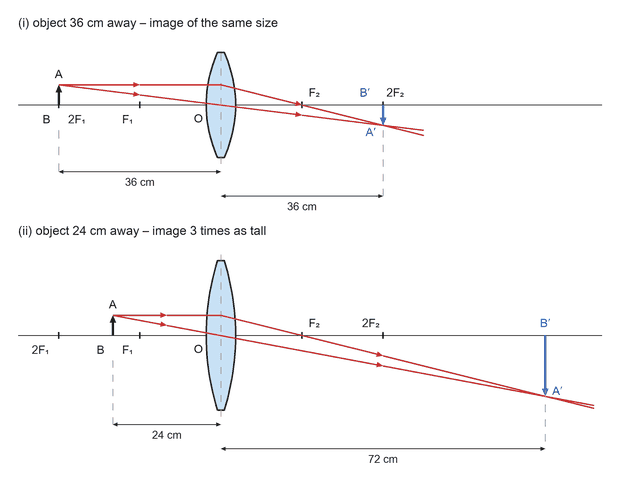
Step 1 — First position: same-size image.
A convex lens forms a real image of the same size only when the object is at , so the object is 2f from the lens.
Step 2 — Second position: write u and v in terms of f.
The object moves 12 cm closer, so its distance is (2f − 12) cm, and u = −(2f − 12).
The image is real and three times as tall, so it is inverted, with m = −3.
Since , the image distance is:
Step 3 — Use the lens formula.
We put u and v into , one step per line:
Step 4 — Check the answer.
First the object is at 2f = 36 cm and the same-size image is at 36 cm. Then the object is at 36 − 12 = 24 cm, so u = −24 cm:
The image is 72 cm away and three times as tall, as stated.
Watch out: A real image that is three times as tall has m = −3, not +3.
Therefore, the focal length of the lens is 18 cm.
- 281 mark
Question 28
The magnification produced by a lens is +2. Then the image is:
Solve with AIAnswer
(A) real and magnified
(B) virtual and diminished
(C) real and diminished
- Correct
(D) virtual and magnified
Answer: (D) virtual and magnified
Concept: The sign of the magnification tells whether the image is erect (+, virtual) or inverted (−, real); its size tells whether the image is larger (more than 1) or smaller (less than 1) than the object.
Step 1 — Sign of m.
The value m = +2 is positive, so the image is erect. For a lens an erect image is a virtual image.
Step 2 — Size of m.
Its size, 2, is more than 1, so the image is magnified (twice the height of the object). Such an image comes from a convex lens with the object within its focal length, as in a magnifying glass.
Watch out: The sign and the size give two separate facts; read both.
Why the other options are wrong:
- (A) real and magnified: a real image is inverted, so its magnification would be negative (for example −2), not +2.
- (B) virtual and diminished: a diminished image has a magnification of size less than 1, not 2.
- (C) real and diminished: a real, diminished image has a negative magnification of size less than 1 (for example −0.5).
Therefore, the image is virtual and magnified, option (D).
- 292 marks
Question 29
An upright lens is divided horizontally into a number of parts and the diagram given below shows the magnified view of its lowest part.

(a) Identify the lens.
(b) Justify your answer in (a) above.
Solve with AIWritten solution
Solution:
Concept: A convex lens is thicker in the middle and thinner at the edges; a concave lens is thinner in the middle and thicker at the edges. Each small part of a lens acts like a prism, which bends light towards its base.
Step 1 — Part (a): compare the two edges of the part.
In the lowest part of an upright lens, the top edge faces the centre of the lens and the bottom edge is the rim. In the figure the top edge is narrower and the bottom edge is wider, so the lens gets thicker from its middle towards its rim. A lens that is thinner in the middle than at the edges is a concave (diverging) lens.
Step 2 — Part (b): justify with the prism idea.
This part acts like a prism whose base is away from the principal axis (at the rim). A prism bends light towards its base, so a ray passing through this part bends away from the principal axis: the lens spreads light out, which is what a concave lens does.
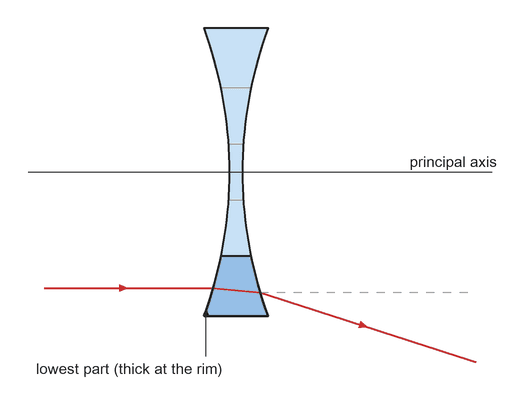
Watch out: In the lowest part the rim is at the BOTTOM; a part that widens downwards widens towards the rim.
Therefore, (a) the lens is a concave (diverging) lens; (b) it is thicker at the rim than towards the middle, so this part bends light away from the axis.
- 303 marks
Question 30
In the diagram given below, a concave (L1) and a convex (L2) lens of focal lengths 20 cm and 12 cm respectively are placed parallel to each other such that they have a common principal axis. Study the path of the ray through the lenses.

(a) Calculate the lengths of 'x' and 'y'.
(b) Define point P with respect to the concave lens (L1).
Solve with AIWritten solution
Solution:
Concept: For a convex lens, a ray parallel to the axis passes through the second focus . For a concave lens, a ray directed towards the first focus (on the far side) emerges parallel to the axis. The focal length is the distance of a focus from the lens.
Given: Concave L1 (f = 20 cm) and convex L2 (f = 12 cm) on a common axis.
Step 1 — Find x from the convex lens L2.
The ray reaches L2 parallel to the principal axis and, after refraction, passes through P. A ray parallel to the axis passes through the second focus of a convex lens, so P is the second focus of L2, and its distance from L2 is the focal length of L2:
Step 2 — Find the distance L1 to P from the concave lens L1.
The ray falling on L1 is directed towards P (dashed line) and leaves L1 parallel to the axis. For a concave lens a ray directed towards its first focus emerges parallel to the axis, so P is the first focus of L1:
Step 3 — Find y.
Subtracting x from the distance L1 to P:

Step 4 — Part (b): define point P for L1.
P is the first focal point (first principal focus, ) of the concave lens L1: the point on the principal axis such that rays of light directed towards it become parallel to the principal axis after refraction through the lens.
Watch out: For the concave lens, P is on the far side of L1, so it is the FIRST focus (rays aimed at it), not .
Therefore, (a) x = 12 cm and y = 8 cm; (b) P is the first principal focus of L1.