
Question 42 marksAsked 2018Easy
State the position of the object in front of a converging lens if:
(i) It produces a real and same size image of the object.
(ii) It is used as a magnifying lens.
Confirming your payment
Sign up now and get 250 free tokens.
Previous Year Questions · Question 4 of 30
State the position of the object in front of a converging lens if:
(i) It produces a real and same size image of the object.
(ii) It is used as a magnifying lens.
Solution:
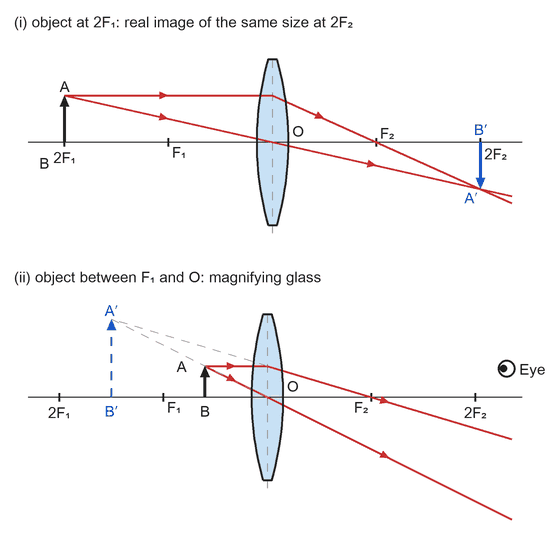
Concept: A convex lens forms these images as the object comes closer: object beyond → real, inverted, diminished, between and ; at → real, inverted, same size, at ; between and → real, inverted, magnified, beyond ; at → at infinity; between and O → virtual, erect, magnified, on the object's side.
Step 1 — Part (i): real image of the same size.
A convex lens gives a real image of the same size only when the object is at , at twice the focal length (2f) from the lens. The rays then meet at on the other side, giving a real, inverted image of the same size.
Step 2 — Part (ii): used as a magnifying lens.
A magnifying lens must give an erect, enlarged image. This happens only when the object is between the focus and the optical centre O, that is, within the focal length. The image is then virtual, erect and magnified, on the same side as the object, and is seen by looking through the lens.
Watch out: A "same size" image needs the object at 2F₁, not at F₁; an object at F₁ sends its image to infinity.
Therefore, (i) at (a distance 2f from the lens); (ii) between and O (within the focal length).