Solution:
Concept: Sign convention (new Cartesian): every distance is measured from the optical centre O. Distances in the direction of the incident light are positive and distances against it are negative. So the object distance u is negative; the image distance v is positive for a real image (on the far side) and negative for a virtual image (on the object's side); f is positive for a convex lens and negative for a concave lens. A convex lens forms these images as the object comes closer: object beyond 2F1 → real, inverted, diminished, between F2 and 2F2; at 2F1 → real, inverted, same size, at 2F2; between F1 and 2F1 → real, inverted, magnified, beyond 2F2; at F1 → at infinity; between F1 and O → virtual, erect, magnified, on the object's side.
Step 1 — Part (a): read the signs on the graph.
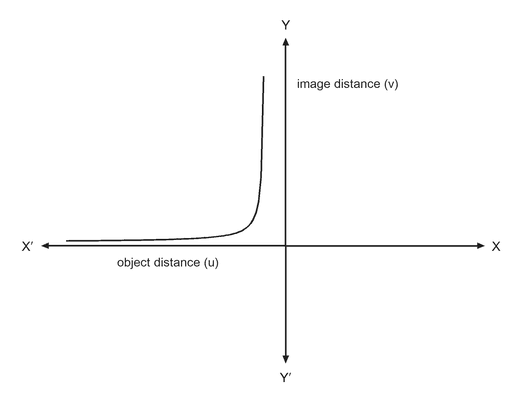
By the sign convention, u is negative for a real object (the curve lies to the left of the v-axis). On the graph v is positive: the image forms on the far side of the lens, where the rays really meet, so it is a real image.
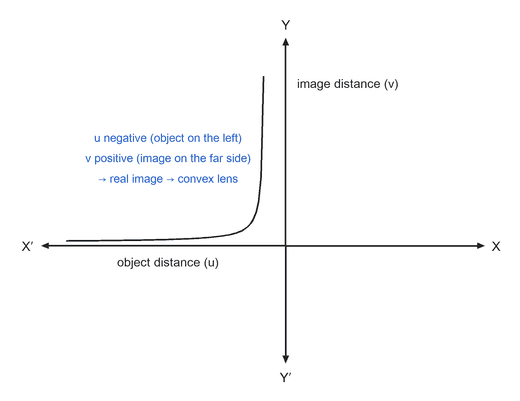
Step 2 — Part (a): identify the lens.
Only a convex lens forms real images; a concave lens always forms a virtual image on the object's side, so its v would be negative and its curve would lie below the u-axis. The curve also rises steeply as the object is brought towards the lens: the image runs off to infinity as the object reaches the focus, which happens only with a convex lens. So the lens is a convex (converging) lens.
Step 3 — Part (b): object between F and 2F.
With the object between F and 2F, a convex lens forms a real, inverted and magnified image beyond 2F on the other side. The image is larger than the object, so the size of the magnification is more than 1 (its sign is negative, because the image is inverted).
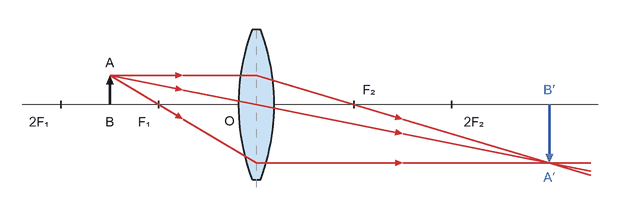
Watch out: The phrase "more than 1" here is about the size of m; the value itself is negative (for example −2).
Therefore, (a) a convex (converging) lens; (b) the magnification is more than 1.