Solution:
Concept: Sign convention (new Cartesian): every distance is measured from the optical centre O. Distances in the direction of the incident light are positive and distances against it are negative. So the object distance u is negative; the image distance v is positive for a real image (on the far side) and negative for a virtual image (on the object's side); f is positive for a convex lens and negative for a concave lens.
Lens formula: v1−u1=f1.
Magnification: m=uv; it is also the image height divided by the object height. A negative m means a real, inverted image; a positive m means a virtual, erect image. A convex lens forms a real image of the same size only with the object at 2F1 (a distance 2f).
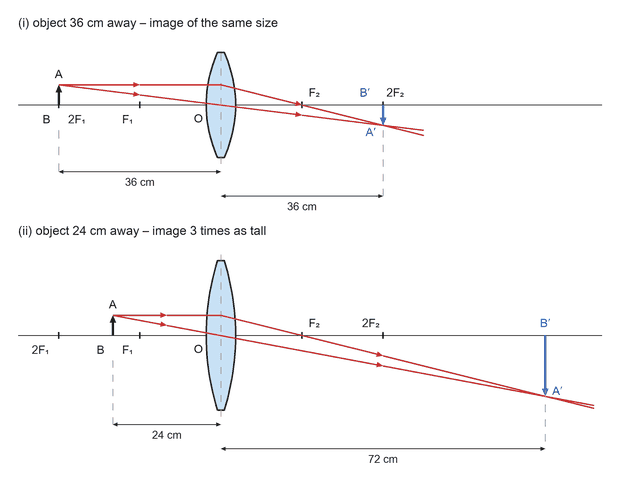
Given: Same-size image on a screen; object moved 12 cm closer gives a real image 3 times as tall.
Step 1 — First position: same-size image.
A convex lens forms a real image of the same size only when the object is at 2F1, so the object is 2f from the lens.
Step 2 — Second position: write u and v in terms of f.
The object moves 12 cm closer, so its distance is (2f − 12) cm, and u = −(2f − 12).
The image is real and three times as tall, so it is inverted, with m = −3.
Since m=uv, the image distance is:
v=−3u
v=3(2f−12)
Step 3 — Use the lens formula.
We put u and v into v1−u1=f1, one step per line:
3(2f−12)1+2f−121=f1
3(2f−12)1+3=f1
4f=3(2f−12)
4f=6f−36
2f=36
f=18 cm
Step 4 — Check the answer.
First the object is at 2f = 36 cm and the same-size image is at 36 cm. Then the object is at 36 − 12 = 24 cm, so u = −24 cm:
v1=181−241=721
m=−2472=−3
The image is 72 cm away and three times as tall, as stated.
Watch out: A real image that is three times as tall has m = −3, not +3.
Therefore, the focal length of the lens is 18 cm.
