
Question 72 marksAsked 2019Easy
(i) If the lens is placed in water instead of air, how does its focal length change?
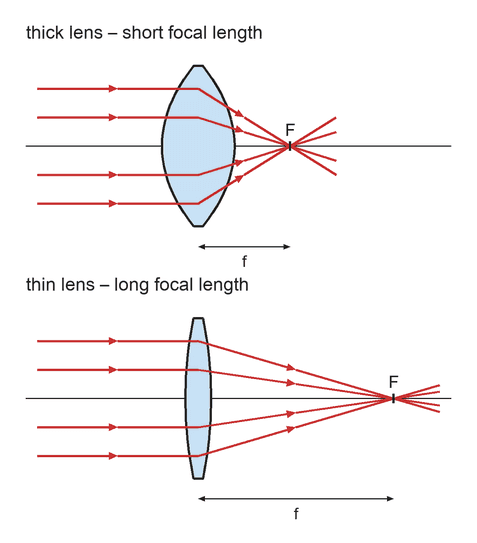
(ii) Which lens, thick or thin has greater focal length?
Confirming your payment
Sign up now and get 250 free tokens.
Previous Year Questions · Question 7 of 30
(i) If the lens is placed in water instead of air, how does its focal length change?
(ii) Which lens, thick or thin has greater focal length?
Solution:
Concept: How strongly a lens bends light depends on (1) the refractive index of its material compared with the medium around it and (2) how curved its surfaces are. Less bending means the rays meet farther away, that is, a longer focal length.
Step 1 — Part (i): compare the bending in air and in water.
A lens bends light because light changes speed at its surfaces, and the amount of bending depends on the refractive index of the glass relative to the surrounding medium. For glass of refractive index 1.5:
Step 2 — Part (i): conclude.
The relative index in water is much closer to 1, so the lens bends light less in water. The refracted rays meet farther from the lens, so the focal length increases (and the power decreases).
Step 3 — Part (ii): thick or thin lens.
A thin lens has gently curved surfaces (large radii of curvature), so it bends light less and brings it to a focus farther away. A thick lens has strongly curved surfaces, bends light more and has a short focal length. So the thin lens has the greater focal length.
Watch out: A lens in water still converges (glass is denser than water); it only converges less strongly.
Therefore, (i) the focal length increases in water; (ii) a thin lens has the greater focal length.