Solution:
Concept: A concave (diverging) lens spreads light out. A ray parallel to the principal axis bends away from the axis, as if it came from the focus F2 on the object's side, and a ray aimed at the optical centre O goes straight through. The refracted rays never meet; produced backwards they appear to meet between F2 and O. So a concave lens always forms a virtual, erect and diminished image, between the object and the lens, wherever the object stands.
Given: A virtual, diminished image with the object between O and the focus.
Step 1 — Part (i): decide which lens it is.
With the object between O and the focus, a convex lens gives a virtual image that is magnified. A virtual, diminished image can only come from a concave (diverging) lens.
Step 2 — Part (ii): draw the two rays.
Place the object AB between O and the focus F2 of the concave lens. From A, draw a ray parallel to the axis: after refraction it bends away from the axis, and its backward extension (dashed) passes through F2. From A, draw a ray towards O: it goes straight through.
Step 3 — Part (ii): locate the image.
The backward extension and the ray AO cross at A′. Drop the dashed perpendicular A′B′: the image is virtual, erect and diminished, between the object and the lens.
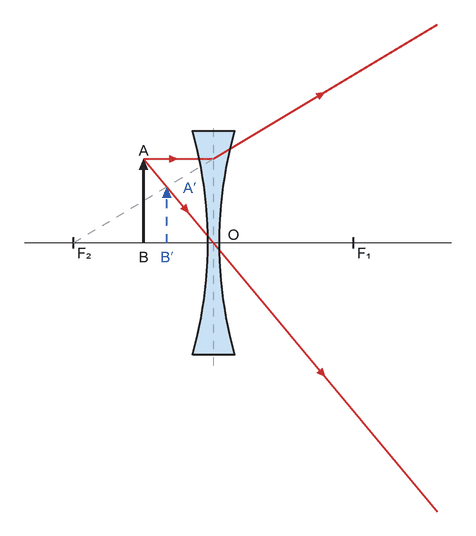
Watch out: For a concave lens the focus on the object's side is F2 (parallel rays appear to come from it); F1 is on the far side.
Therefore, (i) concave (diverging) lens; (ii) the image A′B′ is virtual, erect and diminished, between the object and the lens.
