
Question 234 marksAsked 2025Medium
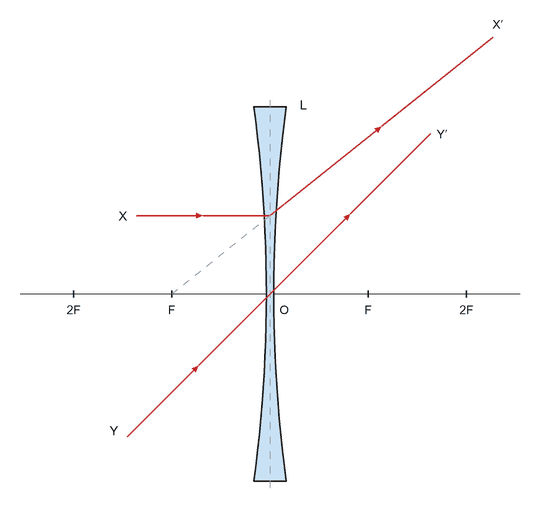
Answer the following with respect to a concave lens (L).

(a) Describe the path of the rays X and Y through the lens.
(b) Give one use of this lens.
(c) Calculate its power if the focal length of this lens is 20 cm.
Confirming your payment
Sign up now and get 250 free tokens.
Previous Year Questions · Question 23 of 30
Answer the following with respect to a concave lens (L).
(a) Describe the path of the rays X and Y through the lens.
(b) Give one use of this lens.
(c) Calculate its power if the focal length of this lens is 20 cm.
Solution:
Concept: A concave (diverging) lens spreads light out. A ray parallel to the principal axis bends away from the axis, as if it came from the focus on the object's side, and a ray aimed at the optical centre O goes straight through. The refracted rays never meet; produced backwards they appear to meet between and O. So a concave lens always forms a virtual, erect and diminished image, between the object and the lens, wherever the object stands. Power of a lens: with f in metres; its unit is the dioptre (D). Power is positive for a convex lens and negative for a concave lens.
Given: Concave lens L; focal length 20 cm.
Step 1 — Part (a): ray X.
Ray X travels parallel to the principal axis. After refraction it bends away from the axis, so that, produced backwards (dashed), it appears to come from the focus F on the side of the incident light (the second focus of the concave lens).
Step 2 — Part (a): ray Y.
Ray Y is directed towards the optical centre O, so it passes through the lens undeviated.
Step 3 — Part (b): one use.
A concave lens is used in spectacles to correct short sight (myopia): it diverges the light a little so that the eye focuses a distant object on the retina.
Step 4 — Part (c): power.
For a concave lens f is negative, so f = −20 cm, or −0.2 m. Power is the reciprocal of f in metres:
Watch out: The power of a concave lens is negative; writing +5 D describes a convex lens.
Therefore, (a) X diverges as if from the focus on the incident side; Y passes undeviated through O; (b) spectacles for short sight (myopia); (c) P = −5 D.