Answer: (B) 30 cm
Concept: Sign convention (new Cartesian): every distance is measured from the optical centre O. Distances in the direction of the incident light are positive and distances against it are negative. So the object distance u is negative; the image distance v is positive for a real image (on the far side) and negative for a virtual image (on the object's side); f is positive for a convex lens and negative for a concave lens. Lens formula: v1−u1=f1.
Magnification: m=uv; it is also the image height divided by the object height. A negative m means a real, inverted image; a positive m means a virtual, erect image.
Step 1 — Find the focal length.
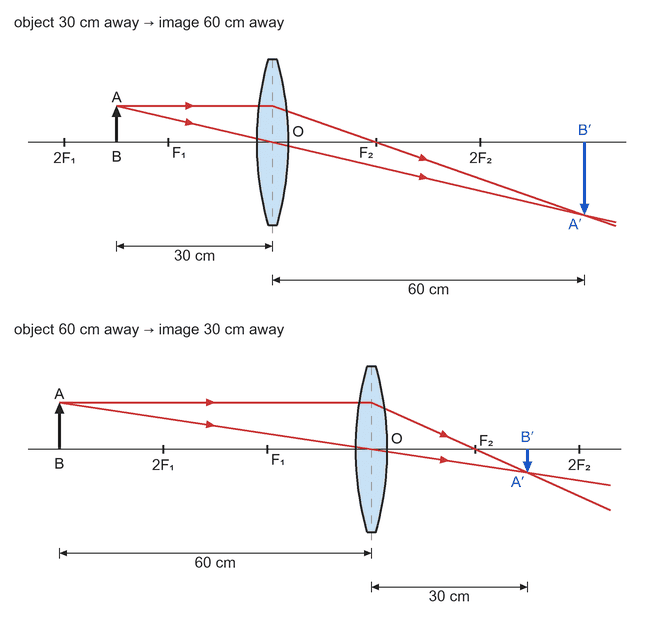
The inverted image is real, so u = −30 cm and v = +60 cm.
Now we use the lens formula in the form f1=v1−u1:
f1=601+301=603=201
f=+20 cm
Step 2 — Find the new image distance.
Now the object is 60 cm away, so u = −60 cm.
The lens formula gives v1=f1+u1, so:
v1=201−601=602=301
v=+30 cm
This also follows from the reversibility of light: the object and image positions simply swap.
Watch out: Find f from the first set-up first; the second image distance is not found by adding or subtracting distances.
Why the other options are wrong:
- (A) 20 cm: 20 cm is the focal length; the image forms at the focus only when the object is very far away.
- (C) 60 cm: 60 cm is the old image distance, which belongs to the object at 30 cm.
- (D) 90 cm: 90 cm is just 30 cm + 60 cm added together; the lens formula does not give it.
Therefore, the image forms 30 cm from the lens, option (B).
