
Question 243 marksAsked 2025Medium
An object is placed at a distance of 10 cm from a convex lens of focal length 20 cm.
(a) Find the position of the image.
(b) What is the nature of the image?
Confirming your payment
Sign up now and get 250 free tokens.
Previous Year Questions · Question 24 of 30
An object is placed at a distance of 10 cm from a convex lens of focal length 20 cm.
(a) Find the position of the image.
(b) What is the nature of the image?
Solution:
Concept: Sign convention (new Cartesian): every distance is measured from the optical centre O. Distances in the direction of the incident light are positive and distances against it are negative. So the object distance u is negative; the image distance v is positive for a real image (on the far side) and negative for a virtual image (on the object's side); f is positive for a convex lens and negative for a concave lens.
Lens formula: .
Magnification: ; it is also the image height divided by the object height. A negative m means a real, inverted image; a positive m means a virtual, erect image.
Given: Object distance u = −10 cm, focal length f = +20 cm (convex lens).
Step 1 — Write the data with signs.
The object is in front of a convex lens:
Step 2 — Part (a): find the image distance.
From the lens formula, :
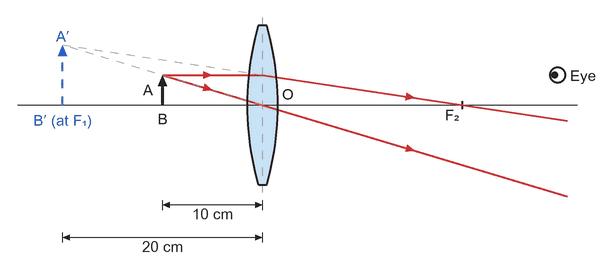
The minus sign puts the image 20 cm from the lens on the same side as the object, exactly at the focus .
Step 3 — Part (b): find the magnification.
Magnification is v divided by u:
The image distance v is negative, so the image is virtual; m is positive, so it is erect; m = 2, so it is magnified (twice as tall). This is the magnifying-glass case: the object is inside the focal length.
Watch out: The object distance u is always negative; forgetting its minus sign turns a real image into a virtual one.
Therefore, (a) the image is 20 cm from the lens on the object's side (v = −20 cm, at ); (b) it is virtual, erect and magnified (m = +2).