
Question 181 markMCQAsked 2025Medium
For a real image formed by a convex lens, the ratio of I : O = 2 : 5, then the object is :
(I is the height of the image and O is the height of the object)
Confirming your payment
Sign up now and get 250 free tokens.
Previous Year Questions · Question 18 of 30
For a real image formed by a convex lens, the ratio of I : O = 2 : 5, then the object is :
(I is the height of the image and O is the height of the object)
(A) between O and F
(B) beyond 2F
(C) at F
(D) between F and 2F
Answer: (B) beyond 2F
Concept: Lens formula: .
Magnification: ; it is also the image height divided by the object height. A negative m means a real, inverted image; a positive m means a virtual, erect image. A convex lens forms these images as the object comes closer: object beyond → real, inverted, diminished, between and ; at → real, inverted, same size, at ; between and → real, inverted, magnified, beyond ; at → at infinity; between and O → virtual, erect, magnified, on the object's side.
Step 1 — Write the magnification.
The image is real, so it is inverted and m is negative:
Step 2 — Write v in terms of u.
Since , the image distance is times the object distance:
Step 3 — Use the lens formula.
We substitute this v into the lens formula and simplify, one step per line:
Step 4 — Place the object.
The object is 3.5 focal lengths from the lens, which is farther than 2f, so it is beyond 2F.
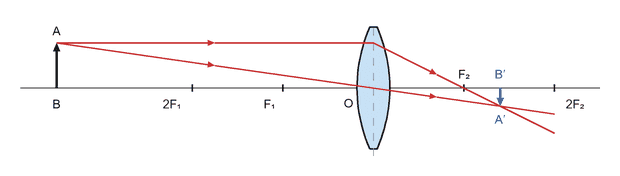
Watch out: I : O = 2 : 5 means a smaller image; a real, diminished image needs the object beyond 2F.
Why the other options are wrong:
Therefore, the object is beyond 2F, option (B).