
Question 13 marksAsked 2016Medium
A lens produces a virtual image between the object and the lens.
(i) Name the lens.
(ii) Draw a ray diagram to show the formation of this image.
Confirming your payment
Sign up now and get 250 free tokens.
Previous Year Questions · Question 1 of 30
A lens produces a virtual image between the object and the lens.
(i) Name the lens.
(ii) Draw a ray diagram to show the formation of this image.
Solution:
Concept: A concave (diverging) lens spreads light out. A ray parallel to the principal axis bends away from the axis, as if it came from the focus on the object's side, and a ray aimed at the optical centre O goes straight through. The refracted rays never meet; produced backwards they appear to meet between and O. So a concave lens always forms a virtual, erect and diminished image, between the object and the lens, wherever the object stands.
Given: A lens forms a virtual image between the object and the lens.
Step 1 — Part (i): decide which lens it is.
A convex lens forms a virtual image only when the object is inside its focus, and that image is always farther from the lens than the object (it is magnified). An image lying between the object and the lens must therefore come from a concave (diverging) lens, which always forms a virtual, erect, diminished image on the object's side.
Step 2 — Part (ii): draw the ray parallel to the axis.
Draw the object AB on the principal axis. From A, draw a ray parallel to the axis. After refraction it bends away from the axis; produce it backwards as a dashed line, which passes through the focus on the object's side.
Step 3 — Part (ii): draw the ray through the optical centre.
From A, draw a ray towards the optical centre O. It passes through the lens without bending.
Step 4 — Part (ii): locate the image.
The two refracted rays spread apart and never meet. Their backward extensions (the dashed line and the ray AO) cross at A′. Drop a dashed perpendicular A′B′ onto the axis: A′B′ is the image.
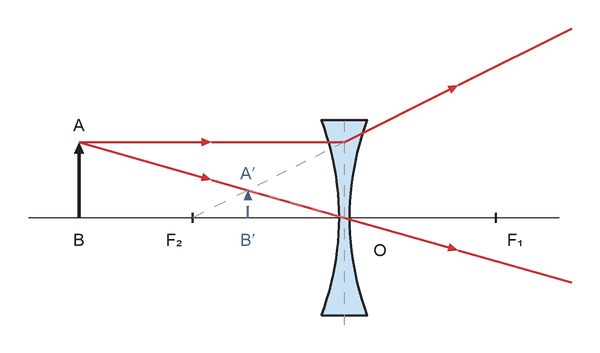
Watch out: Draw the refracted rays as solid lines and their backward extensions as dashed lines; a virtual image is drawn dashed.
Therefore, (i) the lens is a concave (diverging) lens; (ii) the image A′B′ is virtual, erect and diminished, between the object and the lens.