
Question 292 marksAsked 2026Medium
An upright lens is divided horizontally into a number of parts and the diagram given below shows the magnified view of its lowest part.

(a) Identify the lens.
(b) Justify your answer in (a) above.
Confirming your payment
Sign up now and get 250 free tokens.
Previous Year Questions · Question 29 of 30
An upright lens is divided horizontally into a number of parts and the diagram given below shows the magnified view of its lowest part.
(a) Identify the lens.
(b) Justify your answer in (a) above.
Solution:
Concept: A convex lens is thicker in the middle and thinner at the edges; a concave lens is thinner in the middle and thicker at the edges. Each small part of a lens acts like a prism, which bends light towards its base.
Step 1 — Part (a): compare the two edges of the part.
In the lowest part of an upright lens, the top edge faces the centre of the lens and the bottom edge is the rim. In the figure the top edge is narrower and the bottom edge is wider, so the lens gets thicker from its middle towards its rim. A lens that is thinner in the middle than at the edges is a concave (diverging) lens.
Step 2 — Part (b): justify with the prism idea.
This part acts like a prism whose base is away from the principal axis (at the rim). A prism bends light towards its base, so a ray passing through this part bends away from the principal axis: the lens spreads light out, which is what a concave lens does.
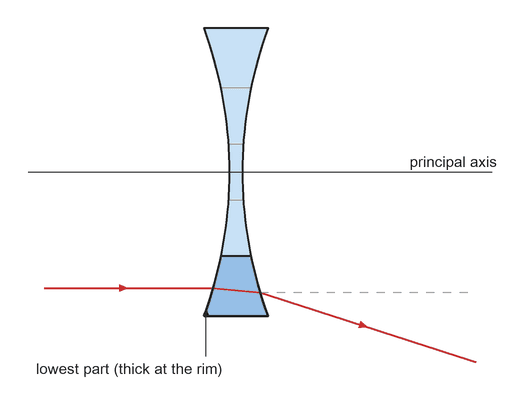
Watch out: In the lowest part the rim is at the BOTTOM; a part that widens downwards widens towards the rim.
Therefore, (a) the lens is a concave (diverging) lens; (b) it is thicker at the rim than towards the middle, so this part bends light away from the axis.