Solution:
Concept: Sign convention (new Cartesian): every distance is measured from the optical centre O. Distances in the direction of the incident light are positive and distances against it are negative. So the object distance u is negative; the image distance v is positive for a real image (on the far side) and negative for a virtual image (on the object's side); f is positive for a convex lens and negative for a concave lens.
Lens formula: v1−u1=f1.
Magnification: m=uv; it is also the image height divided by the object height. A negative m means a real, inverted image; a positive m means a virtual, erect image.
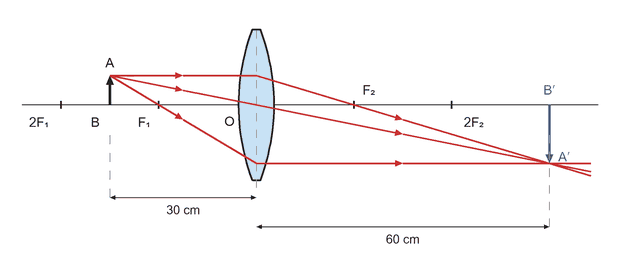
Given: Focal length 20 cm; inverted image 60 cm from the lens.
Step 1 — Part (i): identify the lens.
An inverted image is always a real image, and only a convex lens forms real images (a concave lens always forms a virtual, erect image). So the lens is a convex (converging) lens.
Step 2 — Part (ii): write the data with signs.
A real image forms on the far side, so v is positive; f is positive for a convex lens:
v=+60 cm,f=+20 cm
Step 3 — Part (ii): find the object distance.
Rearranging the lens formula gives u1=v1−f1. We substitute:
u1=601−201=601−3=−301
u=−30 cm
The minus sign only says that the object is on the side from which the light comes: the object is 30 cm from the lens.
Step 4 — Part (iii): find the magnification.
Magnification is v divided by u:
m=uv=−30+60=−2
The image is inverted and twice as tall as the object.
Watch out: The object distance u is always negative; forgetting its minus sign turns a real image into a virtual one.
Therefore, (i) convex (converging) lens; (ii) the object is 30 cm in front of the lens (u = −30 cm); (iii) m = −2.
