
Question 162 marksAsked 2024Easy
(a) In a reading glass what is the position of the object with respect to the convex lens used?
(b) Why can we not use concave lens for the same purpose?
Confirming your payment
Sign up now and get 250 free tokens.
Previous Year Questions · Question 16 of 30
(a) In a reading glass what is the position of the object with respect to the convex lens used?
(b) Why can we not use concave lens for the same purpose?
Solution:
Concept: A reading glass is a magnifying glass: a convex lens that gives an erect, enlarged image of the letters.
Step 1 — Part (a): what a reading glass must do.
A reading glass must make the letters look bigger and the right way up, so it needs a virtual, erect and magnified image.
Step 2 — Part (a): position of the object.
A convex lens gives such an image only when the object is between the optical centre O and the principal focus , that is, within its focal length. The image forms on the same side as the object and is seen by the eye through the lens.
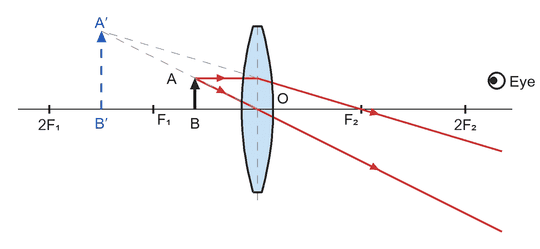
Step 3 — Part (b): why not a concave lens.
A concave lens always forms a virtual, erect and diminished image, wherever the object is placed. The letters would look smaller, not larger, so a concave lens cannot magnify and cannot be used as a reading glass.
Watch out: With the page beyond a convex lens gives a real, inverted image, which is no use for reading.
Therefore, (a) the object is between the optical centre and the focus (within the focal length); (b) a concave lens always gives a diminished image, so it cannot magnify.