Solution:
Concept: A lens has two principal foci. Rays from (or aimed at) the first focus F1 emerge parallel to the principal axis; rays incident parallel to the axis pass through (convex lens) or appear to come from (concave lens) the second focus F2. In Selina's labelling, F1 is on the object side of a convex lens, but on the far side of a concave lens.
Step 1 — (a) Draw the ray diagram.
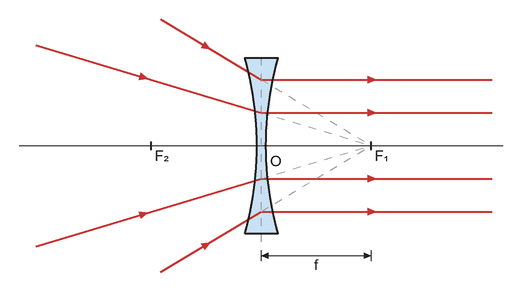
Draw the incident ray aimed at the focus on the far side of the concave lens. After refraction at the lens it bends away from the axis and emerges parallel to the principal axis. The dashed part shows where the incident ray would have gone.
Step 2 — (b) Name the point F.
The incident ray, produced, meets the axis at the first focus F1 of the concave lens. The ray never actually reaches F; it is only directed towards it, so this focus is virtual.
Watch out: For a concave lens the first focus is on the FAR side of the lens.
Therefore, (a) the ray is drawn aimed at F and emerging parallel, and (b) F is the first focus F1 of the concave lens.
