
Opening your dashboard
Class 10 Physics Chapter 5 Refraction through a Lens: Practice Questions
41 questions on Chapter 5, each worked through on its own page with the AI tutor. Class 10 Physics, ICSE 2026-27.
41 questions
1–5 marks · Mixed difficulty
- 11 mark
Question 1
Bloom's level: Remember
An optician labels a spectacle lens "+1 D". The focal length of this lens is :
- 21 mark
Question 2
Bloom's level: Remember
The straight line passing through the centres of curvature of the two surfaces of a lens is called its :
- 31 mark
Question 3
Bloom's level: Understand
A lens has two principal foci, while a spherical mirror has only one. The best reason is that :
- 41 mark
Question 4
Bloom's level: Understand
A ray from the top of an object falls on a thin lens and passes through its optical centre. It emerges :
- 51 mark
Question 5
Bloom's level: Apply
A toy car stands 15 cm in front of a convex lens of focal length 10 cm. Which option correctly describes where its image is and what it is like ?
- 61 mark
Question 6
Bloom's level: Apply
A convex lens of focal length 12 cm forms a real image of an object kept 20 cm in front of it. The image is formed at a distance of :
- 71 mark
Question 7
Bloom's level: Apply
A concave lens of focal length 15 cm forms the image of an object kept 30 cm in front of it. The linear magnification is :
- 81 mark
Question 8
Bloom's level: Analyse
Three lenses have powers P : +4 D, Q : −2.5 D and R : +10 D. Which lens is the best choice for a magnifying glass, and why ?
- 91 mark
Question 9
Bloom's level: Evaluate
Meera wants a real image of a candle flame, of the same size as the flame, on a screen using a convex lens of focal length 15 cm. She says, "I must keep the candle 15 cm in front of the lens and the screen 15 cm behind it." Which is the best judgement of her plan ?
- 101 mark
Question 10
Bloom's level: Understand
Read the Assertion (A) and the Reason (R) and choose the correct option.
Assertion (A): The power of a concave lens is written with a negative sign.
Reason (R): A concave lens has a diverging action, and by the sign convention its focal length is negative.
- 111 mark
Question 11
Bloom's level: Understand
Read the Assertion (A) and the Reason (R) and choose the correct option.
Assertion (A): A convex lens can form an image whose magnification is +3.
Reason (R): A convex lens always forms a real image.
- 121 mark
Question 12
Bloom's level: Apply
Read the Assertion (A) and the Reason (R) and choose the correct option.
Assertion (A): When a candle is kept 10 cm in front of a convex lens of focal length 10 cm, no sharp image can be obtained on a screen, however far the screen is moved.
Reason (R): Rays from an object at the first focus of a convex lens emerge parallel to one another after refraction, so the image is at infinity.
- 131 mark
Question 13
Bloom's level: Remember
A distant tower is seen through a concave lens of focal length 20 cm. Where is its image formed ? State its nature.
- 141 mark
Question 14
Bloom's level: Remember
In the method of finding the approximate focal length of a convex lens by focusing a distant object, name (a) a suitable object, and (b) the distance that is measured.
- 152 marks
Question 15
Bloom's level: Understand
A round, transparent glass bottle completely filled with water is laid on its side on a printed page. The letters seen through it look larger. Explain what kind of lens the water-filled bottle behaves like, and why.
- 162 marks
Question 16
Bloom's level: Understand
Three principal rays are usually drawn from the top of an object to construct the image formed by a lens. Explain why any two of them are enough, and why the ray through the optical centre is the most convenient one to draw.
- 172 marks
Question 17
Bloom's level: Understand
A stamp collector holds her reading lens a few centimetres above a stamp. Explain why the stamp must lie within the focal length of the lens; what would she see if she lifted the lens until the stamp was beyond its focus ?
- 182 marks
Question 18
Bloom's level: Apply
In an eye-testing trial frame, an optician slips a +5 D lens and a −2 D lens into the same slot so that they touch. Treating them as thin lenses, work out the single lens that could replace the pair: its power, its focal length and whether it converges or diverges light.
- 192 marks
Question 19
Bloom's level: Apply
A slide 2 cm tall is projected by a convex lens on to a screen 2.5 m from the lens. The sharp image on the screen is 50 cm tall. Find (a) the magnification, with sign, and (b) the distance of the slide from the lens.
- 202 marks
Question 20
Bloom's level: Apply
A diverging lens of focal length 20 cm forms a virtual image of a pencil 12 cm from the lens. Find how far the pencil is from the lens.
- 212 marks
Question 21
Bloom's level: Analyse
A student moves a candle towards a convex lens and each time finds the sharp image on a screen. Her readings are :
Object distance (in cm) 60 40 30 25 Image distance (in cm) 30 40 60 100 (a) Use one reading to find the focal length of the lens without using the lens formula.
(b) How do the position and the size of the image change as the candle comes closer ?
- 222 marks
Question 22
Bloom's level: Analyse
An object is moved towards a concave lens of focal length 15 cm. The image distances are recorded (all images are on the same side as the object):
Object distance (in cm) 60 30 15 Image distance (in cm) 12 10 7.5 (a) Between which two points do all the images lie ?
(b) Find the magnification in each case and state how the size of the image changes.
- 233 marks
Question 23
Bloom's level: Apply
An object 2 cm tall stands on the principal axis 6 cm in front of a convex lens of focal length 4 cm.
(a) Draw a ray diagram to scale (full scale) using two principal rays.
(b) From your diagram, find the position and height of the image.
(c) Check your answer to (b) with the lens formula.
- 244 marks
Question 24
Bloom's level: Apply
Case study: A watch repairer uses a small eye-lens of power +12.5 D to look at a tiny screw. She adjusts the lens so that the enlarged image of the screw is formed at 25 cm from the lens, the least distance of distinct vision.
(a) Find the focal length of the lens and name its kind.
(b) How far from the lens must the screw be held ?
(c) Find the magnifying power, and say whether a lens of power +20 D would make the screw look bigger or smaller.
- 255 marks
Question 25
Bloom's level: Analyse
Case study: A simple camera has a convex lens of focal length 5 cm. Rohan, 1.6 m tall, stands 4 m in front of the camera to have his photograph taken.
(a) State the nature of the image formed on the film.
(b) How far behind the lens must the film be for a sharp picture ?
(c) Find the height of Rohan's image on the film.
(d) Rohan now walks up to 1 m from the camera. Should the film be moved towards the lens or away from it to keep the picture sharp, and by about how much ?
- 264 marks
Question 26
Bloom's level: Evaluate
A student was asked: An object 3 cm tall is placed 20 cm in front of a concave lens of focal length 10 cm. Find the position, size and nature of the image. The student wrote :
cm, cm. , so cm. The image is real, 6.67 cm behind the lens. , so the image is 1 cm tall and inverted.
Check the solution. Point out each mistake, then give the correct solution. Explain why the student's final numbers look almost right but the conclusion is wrong.
- 274 marks
Question 27
Bloom's level: Evaluate
Riya and Kabir find the focal length of the same convex lens.
- Riya focuses a tree 8 m away on a screen and measures the lens-to-screen distance as 20.5 cm.
- Kabir uses a plane mirror behind the lens and a pin, and finds the pin's position where its image coincides with it (no parallax) at 20.0 cm from the lens.
(a) Assuming Kabir's value is the true focal length, use the lens formula to show that Riya's reading is what you would expect.
(b) Explain why Riya's method gives a slightly larger value.
(c) Which method would you trust more for an accurate value? Justify, and suggest how Riya could improve her result.
- 284 marks
Question 28
Bloom's level: Analyse
A thin lens is fixed in the right-hand wall of a closed box. A parallel beam of light 4 cm wide, travelling along the principal axis, enters the box. On a screen kept 10 cm beyond the lens, the patch of light is 6 cm wide, as shown.
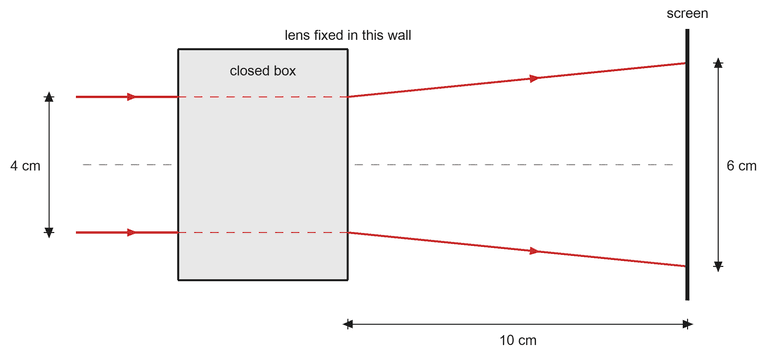
(a) Is the hidden lens convex or concave ? Give a reason from the figure.
(b) Find the focal length of the lens.
(c) Find its power with sign.
- 295 marks
Question 29
Bloom's level: Create
You are given a convex lens on a stand, a lit candle, a white screen and a metre scale. Plan an experiment to find the focal length of the lens using the lens formula. In your plan include :
(a) how you will arrange the apparatus and what you will adjust,
(b) a table with the columns you will record (fill in three sample rows that a lens of focal length 15 cm would give),
(c) how you will calculate the focal length from each row and get the final result,
(d) two precautions.
- 304 marks
Question 30
Bloom's level: Create
Case study: Your science club wants to build a simple slide projector using a convex lens of focal length 10 cm. The picture on the screen must be 20 times as tall as the slide.
(a) Decide in which region (relative to and ) the slide must be placed, and why.
(b) Work out how far from the lens the slide and the screen must be placed.
(c) Plan how the slide should be put in so that the picture is upright, and say how you would change the set-up to get an even larger picture with the same lens.
- 311 mark
Question 31
A thin lens of power +4 D is kept in contact with another thin lens of power −1.5 D. The combination behaves as a :
- 321 mark
Question 32
An object kept on the principal axis of a convex lens is moved slowly from towards . The image formed by the lens :
- 331 mark
Question 33
Assertion (A): The image of a lighted candle formed by a concave lens cannot be obtained on a screen.
Reason (R): The image of a lighted candle formed by a concave lens is always smaller than the candle.
- 342 marks
Question 34
A convex lens is held facing the Sun with its principal axis pointing towards the Sun. The rays are brought to a sharp bright spot on a sheet of paper held 12 cm behind the lens.
(i) Name the point on the principal axis at which the bright spot is formed, and state the focal length of the lens.
(ii) The lens is now turned round so that its other surface faces the Sun. Will the distance of the bright spot from the lens change ? Give a reason.
- 352 marks
Question 35
A ray of light falls on a thin concave lens. State how the ray travels after refraction through the lens when it is incident
(i) parallel to the principal axis,
(ii) in a direction passing through the optical centre of the lens.
- 362 marks
Question 36
A small pin is placed on the principal axis of a convex lens of focal length 15 cm, at a distance of 10 cm from the lens.
(i) Use the lens formula to find the position of the image.
(ii) State two characteristics of the image.
- 372 marks
Question 37
Two convex lenses, A of focal length 10 cm and B of focal length 2.5 cm, are available for use as a magnifying glass. Take the least distance of distinct vision as 25 cm.
(i) Calculate the magnifying power of lens A.
(ii) Which of the two lenses gives the greater magnifying power ? Support your answer by calculation.
- 384 marks
Question 38
A convex lens forms on a screen an image of a candle flame which is three times the size of the flame. The candle is 16 cm from the lens.
(i) Calculate the distance of the screen from the lens.
(ii) Calculate the focal length of the lens.
(iii) At what distance from this lens must the candle be placed so that its image on a screen is of the same size as the flame ?
- 394 marks
Question 39
The diagram shows an object AB placed on the principal axis of a thin lens L, and the image A′B′ of the object formed by the lens. The object is 30 cm from the lens and the image is 12 cm from the lens, on the same side as the object.
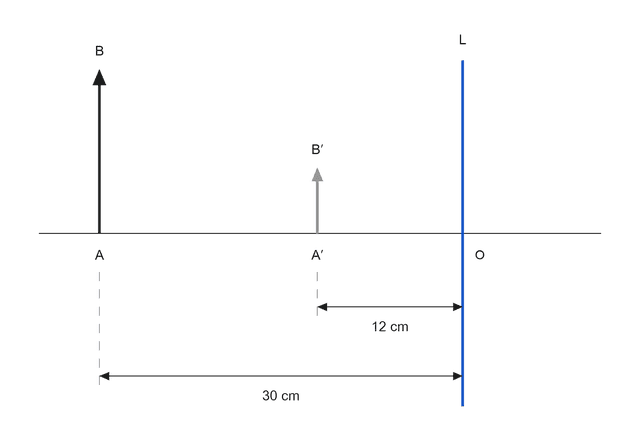
(i) Is the lens L convex or concave ? Give a reason for your answer.
(ii) Calculate the focal length of the lens.
(iii) The object AB is 5 cm high. Calculate the height of the image.
- 403 marks
Question 40
To find the focal length of a thin convex lens, a student places the lens on a plane mirror lying on a table. A pin is clamped horizontally above the lens with its tip on the principal axis, and it is moved up and down until there is no parallax between the pin and its image.

(i) State two characteristics of the image of the pin seen in this position.
(ii) In this position the pin is 18.5 cm above the lens. State the focal length of the lens and explain why the image is formed at the pin itself.
(iii) The student checks the result by focusing a distant tree on a screen with the same lens. The screen has to be kept slightly more than 18.5 cm from the lens. Give a reason.
- 414 marks
Question 41
The diagram below shows an object OA and its image IB formed by a lens. The lens is not shown.
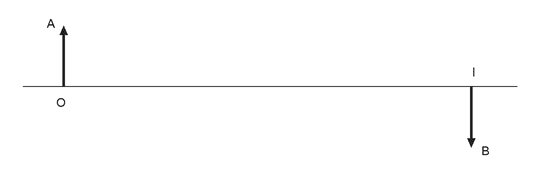
(i) Copy the diagram and complete it to show how the image is formed. Mark the position of the lens.
(ii) Locate a focus of the lens and label it.
(iii) State the type of the lens used.