Solution:
Concept: An image obtained on a screen is real, so it is inverted and its height is negative. The lens formula is v1−u1=f1, and the magnification is m=uv.
Given: Height of candle O = 3 cm; height of image I = 6 cm (on a screen); image distance = 30 cm behind the lens.
Step 1 — Write the data with signs.
By the sign convention, distances are measured from O: positive along the incident light, negative against it. The candle is upright, so O = +3 cm; its image on the screen is real and inverted, so I = −6 cm; the screen is 30 cm behind the lens, so v = +30 cm.
Step 2 — (a) Find the magnification.
Divide the image height by the object height.
m=OI=+3−6=−2
Step 3 — (a) Find the object distance.
Since m = v/u, the object distance is v divided by m.
u=mv=−2+30 cm=−15 cm
The minus sign means the candle is in front of the lens.
Step 4 — (b) Find the focal length.
Put u and v into the lens formula (all distances in cm).
f1=v1−u1=301−−151=301+2=101
So f = +10 cm, positive as for a convex lens.
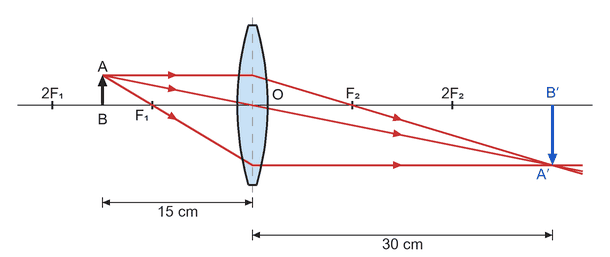
Step 5 — Check.
The candle (15 cm) is between F1 (10 cm) and 2F1 (20 cm), so the image is real, inverted and magnified beyond 2F2, just as the screen shows.
Watch out: An image on a screen is inverted, so its height is −6 cm, not +6 cm; with +6 cm you would get a virtual image that no screen can catch.
Therefore, (a) the candle must be placed 15 cm in front of the lens, and (b) the focal length of the lens is 10 cm.
