
Question 1083 marksEasy
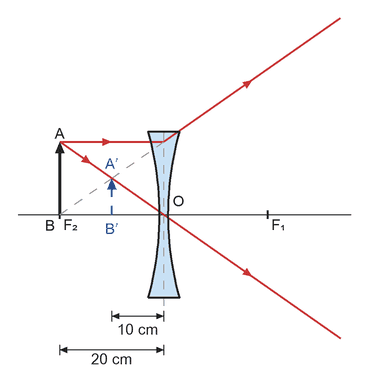
A concave lens forms the image of an object kept at a distance 20 cm in front of it, at a distance 10 cm on the side of the object. (a) What is the nature of the image ? (b) Find the focal length of the lens.
Confirming your payment
Sign up now and get 250 free tokens.
Refraction through a Lens · Question 108 of 142
A concave lens forms the image of an object kept at a distance 20 cm in front of it, at a distance 10 cm on the side of the object. (a) What is the nature of the image ? (b) Find the focal length of the lens.
Solution:
Concept: An image on the same side as the object is formed where the refracted rays only appear to meet, so it is virtual and v is negative. The lens formula is , and the magnification is .
Given: Concave lens; object distance = 20 cm; image distance = 10 cm on the side of the object.
Step 1 — Write the data with signs.
By the sign convention, distances are measured from O: positive along the incident light, negative against it. The object is 20 cm in front of the lens and the image 10 cm on the same side, so u = −20 cm and v = −10 cm.
Step 2 — (a) Find the nature of the image.
The image is on the object's side, so it is virtual. Its magnification confirms this.
m is positive and less than 1, so the image is virtual, erect and diminished (half the size of the object).
Step 3 — (b) Find the focal length.
Put u and v into the lens formula (all distances in cm).
So f = −20 cm; the minus sign confirms a concave (diverging) lens.
Step 4 — Check.
The object stands exactly at the focus (20 cm), and the image forms midway between and the lens, as it should.
Watch out: An image 'on the side of the object' has a NEGATIVE v.
Therefore, (a) the image is virtual, erect and diminished, and (b) the focal length of the lens is 20 cm (f = −20 cm).