
Question 1153 marksEasy
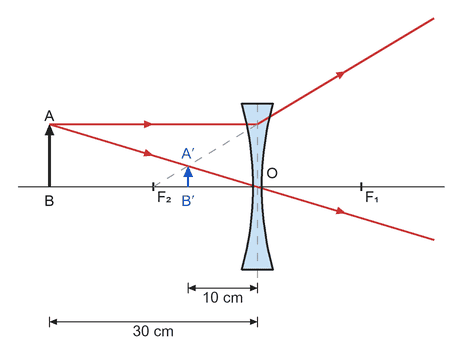
A concave lens forms an erect image of rd the size of the object which is placed at a distance 30 cm in front of the lens. Find :
(a) the position of the image, and
(b) the focal length of the lens.
Confirming your payment
Sign up now and get 250 free tokens.
Refraction through a Lens · Question 115 of 142
A concave lens forms an erect image of rd the size of the object which is placed at a distance 30 cm in front of the lens. Find :
(a) the position of the image, and
(b) the focal length of the lens.
Solution:
Concept: An erect image has a positive magnification, so m = +1/3; then v = m × u gives the image position, and the lens formula gives f; the lens formula is , and the magnification is .
Given: Concave lens; object distance = 30 cm; erect image one-third the size of the object.
Step 1 — Write the data with signs.
By the sign convention, distances are measured from O: positive along the incident light, negative against it. The object is 30 cm in front, so u = −30 cm; the image is erect and one-third the size, so m = +1/3.
Step 2 — (a) Find the image position.
Multiply the magnification by the object distance.
The image is 10 cm in front of the lens, on the same side as the object (a virtual image).
Step 3 — (b) Find the focal length.
Put u and v into the lens formula (all distances in cm).
So f = −15 cm; the minus sign confirms a concave lens.
Step 4 — Check.
The image (10 cm) lies between the lens and the focus (15 cm), as it always does for a concave lens.
Therefore, (a) the image is 10 cm in front of the lens, and (b) the focal length of the lens is 15 cm (f = −15 cm).