
Question 1143 marksEasy
A convex lens forms an inverted image of size same as that of the object which is placed at a distance 60 cm in front of the lens. Find :
(a) the position of the image, and
(b) the focal length of the lens
Confirming your payment
Sign up now and get 250 free tokens.
Refraction through a Lens · Question 114 of 142
A convex lens forms an inverted image of size same as that of the object which is placed at a distance 60 cm in front of the lens. Find :
(a) the position of the image, and
(b) the focal length of the lens
Solution:
Concept: An inverted image of the same size has m = −1; since m = v/u, this gives v = −u, so the image is as far behind the lens as the object is in front; the lens formula is , and the magnification is .
Given: Convex lens; object distance = 60 cm; inverted image of the same size.
Step 1 — Write the data with signs.
By the sign convention, distances are measured from O: positive along the incident light, negative against it. The object is 60 cm in front, so u = −60 cm; the image is inverted and the same size, so m = −1.
Step 2 — (a) Find the image position.
Multiply the magnification by the object distance.
The image is 60 cm behind the lens, on the other side.
Step 3 — (b) Find the focal length.
Put u and v into the lens formula (all distances in cm).
So f = +30 cm.
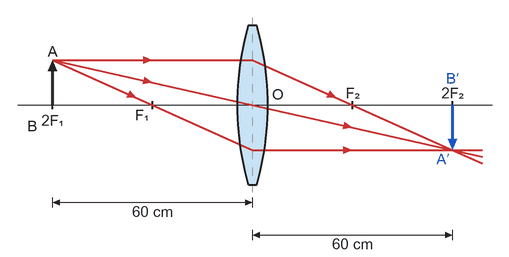
Step 4 — Check.
The object is at twice the focal length () and the image at , the one position where a convex lens gives a same-size real image.
Therefore, (a) the image is 60 cm behind the lens, and (b) the focal length of the lens is 30 cm.