
Question 1124 marksEasy
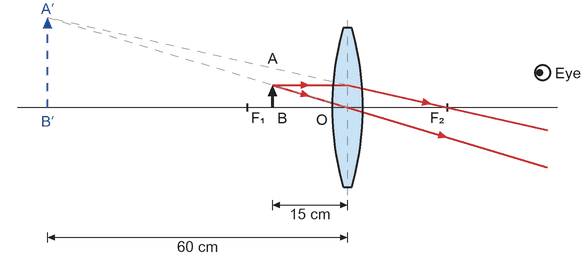
A lens forms the image of an object placed at a distance of 15 cm from it, at a distance of 60 cm in front of it. Find : (i) the focal length, (ii) the magnification, and (iii) the nature of image.
Confirming your payment
Sign up now and get 250 free tokens.
Refraction through a Lens · Question 112 of 142
A lens forms the image of an object placed at a distance of 15 cm from it, at a distance of 60 cm in front of it. Find : (i) the focal length, (ii) the magnification, and (iii) the nature of image.
Solution:
Concept: An image 'in front of' the lens is on the same side as the object, so it is virtual and v is negative. The sign of f found from the lens formula then tells the kind of lens. The lens formula is , and the magnification is .
Given: Object distance = 15 cm; image distance = 60 cm in front of the lens.
Step 1 — Write the data with signs.
By the sign convention, distances are measured from O: positive along the incident light, negative against it. The object is 15 cm in front of the lens and the image 60 cm in front of it, so u = −15 cm and v = −60 cm.
Step 2 — (i) Find the focal length.
Put u and v into the lens formula (all distances in cm).
So f = +20 cm; it is positive, so the lens is convex.
Step 3 — (ii) Find the magnification.
Divide the image distance by the object distance.
Step 4 — (iii) Nature of the image.
m is positive and more than 1, so the image is virtual, erect and magnified (four times the size of the object).
Step 5 — Check.
The object (15 cm) is within the focal length (20 cm) of the convex lens, so the lens acts as a magnifying glass.
Therefore, (i) the focal length is +20 cm (a convex lens), (ii) the magnification is +4, and (iii) the image is virtual, erect and magnified.