Solution:
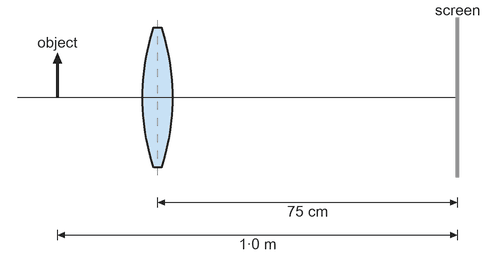
Concept: The lens stands between the object and the screen, so the object-to-lens distance is the object-to-screen distance minus the lens-to-screen distance. The image on the screen is real, so v is positive. The lens formula is v1−u1=f1, and the magnification is m=uv.
Given: Object to screen = 1·0 m; lens to screen = 75 cm; image formed on the screen.
Step 1 — Find the object distance.
The object is 1.0 m (100 cm) from the screen and the lens is 75 cm from the screen, so subtract to find the distance of the object from the lens.
object to lens=100 cm−75 cm=25 cm
Step 2 — Write the data with signs.
By the sign convention, distances are measured from O: positive along the incident light, negative against it. So u = −25 cm and v = +75 cm.
Step 3 — (i) Find the focal length.
Put u and v into the lens formula (all distances in cm).
f1=v1−u1=751−−251=751+3=754
Take the reciprocal to get f.
f=475 cm=+18.75 cm
Step 4 — (ii) Find the magnification.
Divide the image distance by the object distance.
m=uv=−25+75=−3

Step 5 — Check.
The image is real, inverted and three times as tall as the object. The object (25 cm) lies between F1 (18.75 cm) and 2F1 (37.5 cm), as expected for a magnified real image.
Watch out: 75 cm is the lens-to-screen distance (v), not the object distance; subtract it from 100 cm to get u.
Therefore, (i) the focal length of the lens is 18.75 cm, and (ii) the magnification is −3.