
Question 1103 marksEasy
Where should an object be placed in front of a convex lens of focal length 0·12 m to obtain a real image of size three times the size of the object, on the screen ?
Confirming your payment
Sign up now and get 250 free tokens.
Refraction through a Lens · Question 110 of 142
Where should an object be placed in front of a convex lens of focal length 0·12 m to obtain a real image of size three times the size of the object, on the screen ?
Solution:
Concept: An image on a screen is real, so it is inverted and m is negative: m = −3, which gives v = −3u; the lens formula is , and the magnification is .
Given: Convex lens, focal length 0·12 m; real image three times the size of the object, on a screen.
Step 1 — Write the data with signs.
By the sign convention, distances are measured from O: positive along the incident light, negative against it. The lens is convex with f = +0.12 m (+12 cm); the real image is three times the size and inverted, so m = −3.
Step 2 — Relate v and u.
Since m = v/u, the image distance is −3 times the object distance.
Step 3 — Use the lens formula.
Put v = −3u into the lens formula and combine the fractions (all distances in cm).
Step 4 — Solve for u.
Cross-multiply to find u.
So the object is 16 cm (0.16 m) in front of the lens, and the screen is 48 cm (0.48 m) behind it (v = +48 cm).
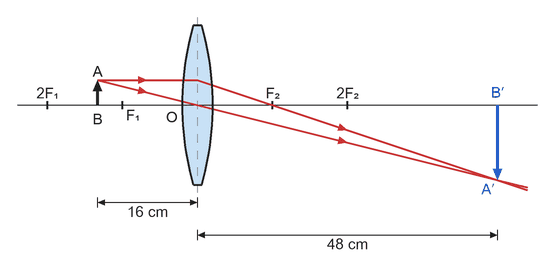
Step 5 — Check.
16 cm is between (12 cm) and (24 cm), the position that gives a real, inverted, magnified image beyond .
Watch out: Change 0·12 m to 12 cm (or work wholly in metres) before using the formula.
Therefore, the object should be placed 0.16 m (16 cm) in front of the lens.