
Question 1261 markMCQEasy
A magnifying glass forms :
Confirming your payment
Sign up now and get 250 free tokens.
Refraction through a Lens · Question 126 of 142
A magnifying glass forms :
(A) a real and diminished image
(B) a real and magnified image
(C) a virtual and magnified image
(D) a virtual and diminished image
Answer: (C) a virtual and magnified image
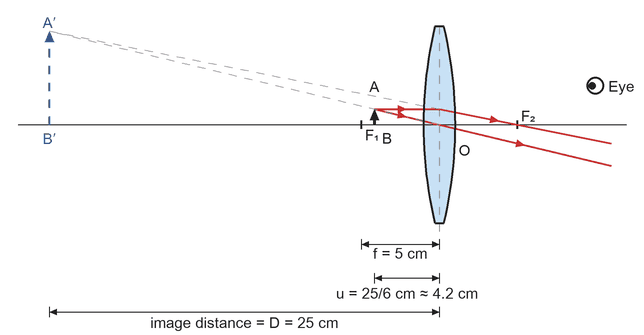
Concept: A magnifying glass (simple microscope) is a convex lens of short focal length. The object is placed between its focus and the lens, so it forms a virtual, erect, magnified image; when this image is at the least distance of distinct vision D (25 cm), the magnifying power is .
Step 1 — Follow the rays.
With the object between and the lens, the refracted rays spread out after the lens.
Step 2 — Find the image.
Produced backwards, the rays appear to meet behind the object, so the image is virtual, erect and magnified.
Why the other options are wrong:
Therefore, a magnifying glass forms a virtual and magnified image, option (C).