
Question 672 marksEasy
In each of the following cases, where must an object be placed in front of a convex lens so that the image formed is
(a) at infinity,
(b) of the same size as the object,
(c) inverted and enlarged,
(d) upright and enlarged ?
Confirming your payment
Sign up now and get 250 free tokens.
Refraction through a Lens · Question 67 of 142
In each of the following cases, where must an object be placed in front of a convex lens so that the image formed is
(a) at infinity,
(b) of the same size as the object,
(c) inverted and enlarged,
(d) upright and enlarged ?
Solution:
Concept: For a convex lens the image depends on where the object is compared with (one focal length away) and (two focal lengths away): beyond diminished, at same size, between and magnified (all real and inverted); at the image is at infinity; between and O it is virtual, erect and magnified.
Step 1 — (a) Image at infinity.
Place the object at the first focus . The refracted rays come out parallel, so they meet only at infinity.
Step 2 — (b) Image of the same size.
Place the object at , twice the focal length from the lens; the image forms at .
Step 3 — (c) Inverted and enlarged image.
Place the object between and ; the real image forms beyond .
Step 4 — (d) Upright and enlarged image.
Place the object between and the optical centre O; the image is virtual, on the same side as the object.
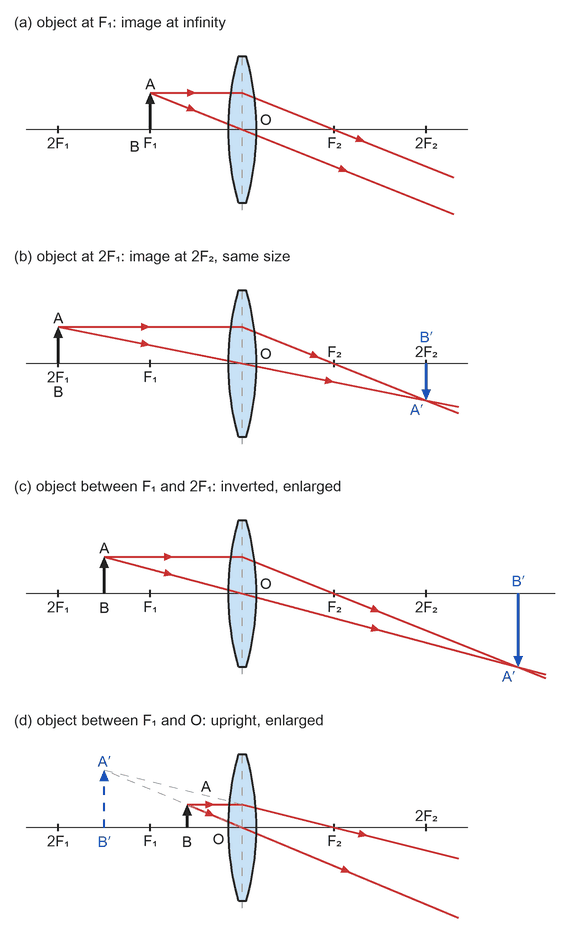
Therefore, (a) at , (b) at , (c) between and , and (d) between and O.