Solution:
Concept: Only a convex lens can form a magnified image, and its image is erect and virtual only when the object lies within its focus.
Step 1 — (a) Kind of lens.
The lens is a convex (converging) lens.
Step 2 — (b) Position of the object.
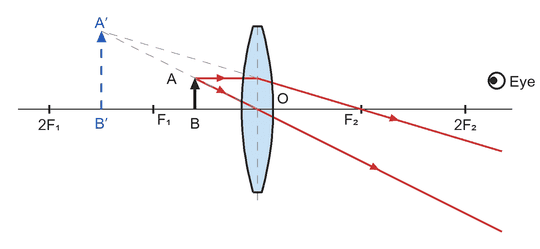
The object is placed between the first focus F1 and the optical centre O of the lens, that is, within its focal length.
Step 3 — (c) Ray diagram.
Ray 1 from A goes parallel to the axis and passes through F2; Ray 2 goes through O undeviated. The refracted rays diverge. Produced backwards (dashed), they meet at A′ on the object's side, so A′B′ is virtual, erect and magnified.
Step 4 — (d) Device.
This principle is used in a magnifying glass (simple microscope), for example to read very small print.
Therefore, (a) convex lens, (b) between F1 and O, (c) as drawn, and (d) a magnifying glass.
