
Opening your dashboard
Class 10 Physics Chapter 5 Refraction through a Lens: Competency-Based Questions (CBQ)
40 questions on Chapter 5, each worked through on its own page with the AI tutor. Class 10 Physics, ICSE 2026-27.
40 questions
1–5 marks · Mixed difficulty
- 11 mark
Question 1
Competency: Analysis
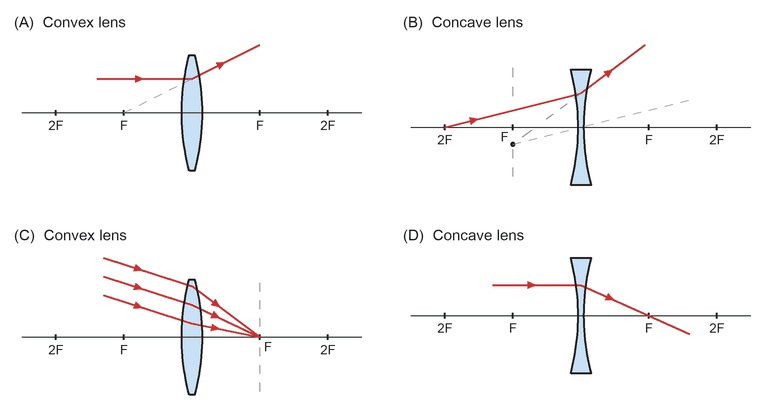
Which of the following diagrams shows the correct path of light through the lens?
- 21 mark
Question 2
Competency: Analysis
You want to register your name for an examination. For registration purposes, you need a passport-size photograph of yourself. When you went to a studio, the photographer told you to sit on a chair in front of a white screen in the room.
Assertion (A): This is purposefully done so that you as an object should stand beyond the centre of curvature of the camera lens, but surely not at an infinite distance.
Reason (R): The characteristics of the image formed are that it can be taken on a screen and is also diminished in size.
- 32 marks
Question 3
Competency: Recall & Understanding
AB is an object and PQ is its real, inverted image. The lengths of AB and PQ are equal. This is possible when a lens is present between the object and its image.
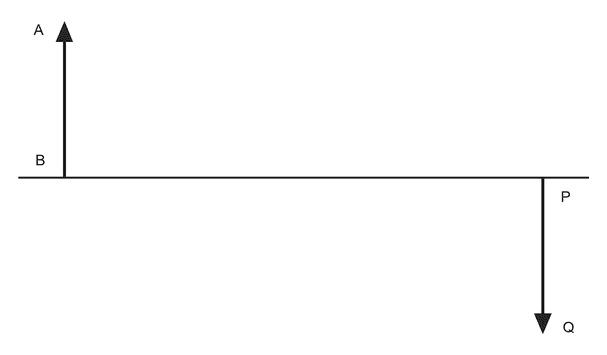
(a) What kind of lens is used here? Also, state the position of the lens and where it is to be placed.
(b) Name a device where this lens action is used.
- 43 marks
Question 4
Competency: Recall & Evaluation
A convex lens of power +5 D has an object placed at a distance of 50 cm in front of the lens.
(a) State the nature of the image formed.
(b) What is the definite distance, towards or away from the lens, the object should move so that the image is not seen?
- 51 mark
Question 5
Competency: Analysis
Riya finds three unlabelled round pieces of glass, X, Y and Z, in a laboratory drawer. She looks through each piece at the print of a book held close to it, and then holds each piece at arm's length and looks at a distant tree. The table shows what she sees.
Piece Print of the book (glass held close to the page) Distant tree (glass held at arm's length) X erect, smaller than the print erect, smaller Y erect, larger than the print inverted, smaller Z erect, same size erect, same size Which conclusion is correct ?
- 61 mark
Question 6
Competency: Application
A torch maker wants the light from a small LED to leave the torch as a beam parallel to the principal axis of the lens fitted in front of it. The lens has a power of +20 D. How far from the optical centre of the lens, on its principal axis, should the LED be fixed ?
- 71 mark
Question 7
Competency: Application & Analysis
The lens of a phone camera forms a sharp image of a child 1.5 m tall, who is standing 3 m in front of the lens. The image on the sensor of the camera is 6 mm tall. How far behind the lens is the sensor ?
- 81 mark
Question 8
Competency: Understanding & Analysis
Assertion (A): As an object is brought from a large distance towards a concave lens, its image moves away from the lens, towards the focus.
Reason (R): For every position of a real object, a concave lens forms a virtual, erect and diminished image between its focus and its optical centre, on the same side as the object.
- 92 marks
Question 9
Competency: Analysis & Evaluation
An object is placed 30 cm in front of a convex lens of focal length 20 cm. To find the image, Arjun writes
and concludes that a real image is formed 12 cm from the lens.
(a) Identify the mistake in Arjun's working.
(b) Find the correct position of the image, and state whether the image is larger or smaller than the object.
- 102 marks
Question 10
Competency: Application & Evaluation
Meena has to find the focal length of a convex lens in the evening, when no distant object can be seen from the laboratory. She places a lighted lamp 60 cm from the lens and moves a screen on the other side until the image of the lamp is sharp. The screen is then 15 cm from the lens. She records: "focal length = 15 cm".
(a) Is the true focal length of the lens more than, equal to or less than 15 cm ? Give a reason.
(b) Calculate the true focal length of the lens from her readings.
- 114 marks
Question 11
Competency: Analysis
Case study: A group of students places a lighted candle at different distances from a convex lens on an optical bench. Each time they move a screen until the image is sharp, and note the distance of the screen from the lens. The table shows their readings.
Reading Distance of candle from lens (cm) Distance of screen from lens (cm) 1 20 60 2 25 40 3 30 30 4 45 22.5 5 60 20 (a) In which reading is the candle at ? Use this reading to find the focal length of the lens.
(b) Use the lens formula with reading 1 to check the focal length found in part (a).
(c) One of the five readings was noted down wrongly. Find out which one, showing your reasoning, and work out what the distance of the screen should have been.
- 124 marks
Question 12
Competency: Application & Analysis
Case study: In a practical class, Kabir draws the ray diagram below to scale for a lens L. AB is the object and A′B′ is its image. Each square of the grid is 5 cm long and 5 cm high.

(a) Name the kind of lens. Use one of the two rays in the diagram to find its focal length, and say why you chose that ray.
(b) Read the object distance and the image distance from the diagram, and find the magnification. Show that these readings agree with the lens formula.
(c) The object AB is now moved to 5 cm from the lens. Find the position of the new image, and state two ways in which it differs from the image A′B′.
- 133 marks
Question 13
Competency: Application & Evaluation
Case study: A tray in an optician's shop holds four spectacle lenses. Only their powers are marked.
Lens Power P +2.0 D Q −1.25 D R +4.0 D S −0.5 D (a) Which of these lenses are converging ? Find the focal length of lens R.
(b) A customer wants to pick the lens that will focus sunlight to a sharp spot on a paper held 50 cm from the lens. Which lens should he pick ? Support your answer with a calculation.
(c) The shop assistant says, "Lens S has the longest focal length of the four, so it bends light the most." Is the assistant right ? Give a reason.
- 144 marks
Question 14
Competency: Application & Analysis
Case study: A stamp collector has two magnifying glasses: lens X of focal length 5 cm and lens Y of focal length 10 cm. She holds the lens close to her eye and adjusts the stamp until its image is at the least distance of distinct vision, cm.
(a) Calculate the magnifying power of each lens. Which lens will show finer details of the stamp ?
(b) For lens X, calculate how far from the lens the stamp must be held so that its image is 25 cm from the lens.
(c) When she holds the stamp 7 cm from lens X, she can no longer see an erect image of it through the lens. Explain why, with a calculation.
- 154 marks
Question 15
Competency: Application & Creation
A science club wants to make a simple projector from a shoebox, a convex lens of focal length 20 cm and a mobile phone. The lens is to be fixed in a hole at one end of the box, with the phone inside the box facing it. The picture on the wall must be 5 times as tall as the picture on the phone screen.
(a) Work out how far from the lens the phone must be placed, and how far the wall must be from the lens.
(b) State how the phone must be held so that the picture on the wall is the right way up. Give the reason.
(c) Suggest two other features of the design that will make the picture on the wall clear and bright. Give the reason for each.
- 161 mark
Question 16
Competency: Analysis
The figure shows a thin convex lens. Light falls first on surface 1, on the left. is the centre of curvature of surface 1 and is the centre of curvature of surface 2. O is the optical centre, and the distances cm and cm are marked.
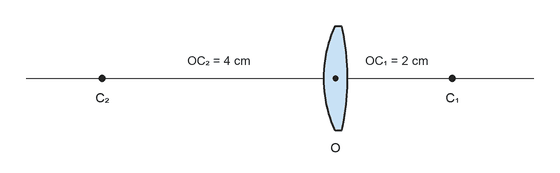
Which statement about the lens is correct ?
- 171 mark
Question 17
Competency: Analysis
A convex lens of focal length 10 cm is used in four different ways, and four students describe what happens. Use the lens formula to find which description is correct.
- 181 mark
Question 18
Competency: Application
Rafiq takes a lens marked +4 D from an old pair of spectacles and holds it so that a lighted lamp is 30 cm in front of the lens. Which option correctly gives the position of the image and how it compares with the lamp ?
- 191 mark
Question 19
Competency: Understanding
Assertion (A): The image of a printed word seen through a magnifying glass cannot be caught on a screen.
Reason (R): A magnifying glass is a convex lens of short focal length.
- 201 mark
Question 20
Competency: Analysis
Assertion (A): A lens of power −5 D bends light less strongly than a lens of power +2 D.
Reason (R): The size of the power of a lens tells how strongly the lens bends light, while its sign tells only whether the lens converges or diverges light.
- 211 mark
Question 21
Competency: Analysis
Four students work with four different thin lenses and report their readings in the Cartesian sign convention. Only one student's readings obey the lens formula.
Student (cm) (cm) (cm) P −20 +20 +20 Q −10 +20 +20 R −30 +15 +10 S −30 −15 +10 Which student's readings are correct ?
- 221 mark
Question 22
Competency: Analysis
A student measures the object distance and the linear magnification of the image for one thin lens, with a real object, and notes the readings.
(cm) −8 −18 −24 −36 +3 −2 −1 −0.5 Which conclusion is supported by the readings ?
- 231 mark
Question 23
Competency: Understanding
A thin plano-convex lens, which we treat as an ideal thin lens, has a focal length of 20 cm. Rohit holds it with its curved face towards a distant tree and finds a sharp image of the tree on a card 20 cm from the lens. He now turns the lens round so that its flat face is towards the tree, and holds it at the same place. What must he do to get a sharp image of the tree ?
- 241 mark
Question 24
Competency: Analysis
A concave lens forms a virtual image A′B′ of the object AB. The scale diagram is drawn on a grid in which each square is 2 cm long and 2 cm high.
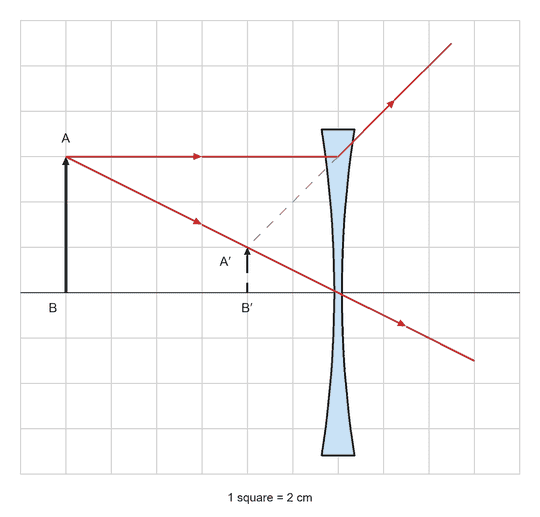
What is the focal length of the lens ?
- 251 mark
Question 25
Competency: Evaluation
For a concave lens, is the focus on the same side of the lens as the object, and is the focus on the other side. Which statement about the three principal rays drawn from the top of an object is not correct ?
- 262 marks
Question 26
Competency: Understanding
Three thin convex lenses P, Q and R are made of the same glass. The table gives the radius of curvature of each of their two surfaces.
Lens Radius of surface 1 (cm) Radius of surface 2 (cm) P 15 15 Q 15 30 R 6 6 (a) Which of the lenses are equi-convex ? Give a reason.
(b) Which lens has the shortest focal length ? Give a reason.
- 272 marks
Question 27
Competency: Application
In the plane-mirror method for the focal length of a convex lens, the lens rests on a plane mirror and a pin is moved up and down until there is no parallax between the pin and its image. The distance of the tip of the pin from the top of the lens is 19.4 cm, and the distance of the tip of the pin from the mirror is 20.6 cm. (Hypothetical data.)
(a) Use to find the focal length of the lens.
(b) Why is larger than ? Find the thickness of the lens from the readings.
- 282 marks
Question 28
Competency: Application
A botany student's hand lens is marked 5×. This means that its magnifying power is 5 when the final image is formed at the least distance of distinct vision, cm.
(a) Find the focal length of the lens.
(b) Find the power of the lens, with its sign.
- 292 marks
Question 29
Competency: Application
Ravi's spectacle lens has a power of −10 D. He holds it 5 cm above a printed page and looks at a letter on the page through the lens.
(a) Find the position of the image of the letter.
(b) State the nature of the image, and say whether the letter looks bigger or smaller.
- 302 marks
Question 30
Competency: Analysis
A convex lens of focal length 10 cm forms a sharp image of a lighted candle on a screen when the candle is 30 cm from the lens. Pooja now interchanges the positions of the candle and the screen without moving the lens.
(a) Will a sharp image of the candle be formed on the screen again ? Use the lens formula to explain.
(b) How many times as large as the first image is the new image ?
- 312 marks
Question 31
Competency: Evaluation
Imran says: "A convex lens always makes an object look bigger, and a concave lens always makes it look smaller." Is Imran right ? Give an example for each lens to support your answer.
- 323 marks
Question 32
Competency: Application
A grandfather is long-sighted. He can see an object clearly only if it is at least 100 cm from his eyes. He wants to read a newspaper held 25 cm from his eyes, so his spectacle lens must form a virtual, erect image of the newspaper at 100 cm from the lens. Take the lens to be very close to his eye. (Hypothetical data.)
(a) Write the values of and with their signs.
(b) Find the focal length of the lens.
(c) Find the power of the lens, and say whether the lens is convex or concave.
- 333 marks
Question 33
Competency: Evaluation
A convex lens has a focal length of 15 cm. Three students make claims about it.
- Asha: "An object 25 cm from the lens gives an image larger than the object."
- Bilal: "An object 10 cm from the lens gives an image that can be caught on a screen."
- Chitra: "When the object is moved from 25 cm to 45 cm from the lens, the image moves farther from the lens."
Use the lens formula to decide whether each student is right or wrong.
- 343 marks
Question 34
Competency: Analysis
On an optical bench, a lighted candle and a screen are fixed 50 cm apart. A convex lens of focal length 12 cm is moved between them.
(a) Show that a sharp image is obtained on the screen when the lens is 20 cm from the candle.
(b) Find the other position of the lens, between the candle and the screen, that gives a sharp image.
(c) Compare the sizes of the two images.
- 353 marks
Question 35
Competency: Analysis
A student draws a graph of the linear magnification of a thin lens against the object distance (the distance of the object from the lens, in cm). She finds the six readings marked by dots.

(a) Use the graph to find the object distance for which the image is the same size as the object. Hence find the focal length of the lens.
(b) Use the graph to find for cm. State the nature of the image, and find the image distance.
(c) Use the graph to find the object distance for which the image is real and 3 times as tall as the object, and check it with the lens formula.
- 363 marks
Question 36
Competency: Application
The figure shows a convex lens, an object AB 6 cm tall on its principal axis, and the real image A′B′ formed by the lens. The distances from the lens are marked.

(a) Write down , and the sign of , using the Cartesian sign convention.
(b) Find the focal length and the power of the lens.
(c) Find the height of the image, with its sign.
- 374 marks
Question 37
Competency: Analysis
Case study: In the school laboratory, Farida fixes a convex lens at the 50.0 cm mark of a 100 cm optical bench. She places a lighted candle at different marks on the left of the lens and moves a screen on the right of the lens until the image is sharp. She is careful that the flame, the centre of the lens and the centre of the screen are at the same height. She reads the marks on the bench and records them. (Hypothetical data.)
Reading Candle mark (cm) Screen mark (cm) 1 20.0 92.0 2 10.0 81.0 3 5.0 78.5 (a) Find the object distance and the image distance for each reading.
(b) Use the lens formula to find the focal length from each reading, and give the mean focal length of the lens.
(c) Find the magnification for each reading. In which reading is the image larger than the flame ? Explain this using the positions of and of the lens.
- 384 marks
Question 38
Competency: Application
Case study: Zoya's eye lens behaves like a single thin convex lens that forms a real, inverted image on her retina. The retina is 2.0 cm behind the eye lens, and this distance does not change. To see objects at different distances clearly, the eye lens changes its shape, and with it its focal length. Treat the eye as one thin convex lens. (Hypothetical data.)
(a) Zoya looks at a very distant tree. Find the focal length of her eye lens and its power.
(b) She now reads a book held 25 cm from her eye lens. Find the focal length of her eye lens and its power.
(c) By how many dioptre does the power increase when she looks from the tree to the book ? Does the eye lens become thicker or thinner ? Give a reason.
- 395 marks
Question 39
Competency: Analysis
Case study: In a demonstration, Mr Singh fixes a convex lens of focal length 10 cm at the 50 cm mark of a 100 cm optical bench. He places a lighted candle at the marks A, B, C and D, one at a time, as shown, and tries to catch its image on a screen kept on the right of the lens. The foci and of the lens are marked on the bench.

(a) For the candle at A and at B, find the mark at which the screen must be placed, and say how the height of the image compares with the height of the candle.
(b) For the candle at C, find the screen mark and the magnification. How does the image differ from the image for B ?
(c) For the candle at D, Mr Singh finds no position of the screen that gives an image. Explain why, and find where the image is and how many times as tall as the candle it is.
- 404 marks
Question 40
Competency: Creativity
Case study: For Science Day, your class builds a Lens Corner for visitors from Class 6. You have a convex lens of focal length 10 cm, a concave lens of focal length 10 cm, a candle, a screen and a metre scale on a table. You want the visitors to see how the image changes with the position of the candle, and to see that the two lenses behave differently. You must give the visitors the positions to use.
(a) With the convex lens, give the object distance and the image distance that will show (i) a real image as tall as the candle, and (ii) a real image 3 times as tall as the candle.
(b) With the concave lens, a visitor puts the candle 30 cm from the lens and tries to catch the image on the screen. Find the position of the image, say what the visitor sees, and say how tall the image is compared with the candle.
(c) Write one sentence for the display card that tells a visitor where to put the candle so that the convex lens gives a real image smaller than the candle. Check your card with the candle 35 cm from the convex lens: find where the screen must be and how tall the image is compared with the candle.