
Question 1404 marksEasy
Describe in brief how would you determine the approximate focal length of a convex lens.
Confirming your payment
Sign up now and get 250 free tokens.
Refraction through a Lens · Question 140 of 142
Describe in brief how would you determine the approximate focal length of a convex lens.
Solution:
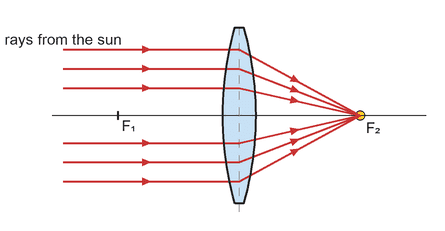
Concept: Rays from a very distant object are almost parallel. A convex lens brings a parallel beam to a focus in its focal plane, so the sharp image of a distant object forms at (almost) one focal length from the lens.
Step 1 — Apparatus.
We need the convex lens, a white wall (or white screen) and a metre rule.
Step 2 — Choose a distant object.
In an open space, choose a very distant object, such as a tree or an electric pole far away.
Step 3 — Set up the rule.
Place a metre rule horizontally with its 0 cm end touching a white wall and its other end pointing towards the distant object.
Step 4 — Focus the image.
Hold the lens vertically on the metre rule, facing the object, and move it to and fro until a sharp, inverted and diminished image of the object is formed on the wall.
Step 5 — Read the distance.
Read the distance between the lens and the wall on the metre rule. This distance is the approximate focal length of the lens.
Step 6 — Why only approximate.
The object is very far away but not at infinity, so its image forms just beyond the focus. For example (hypothetical), for a lens of focal length 20 cm and a tree 40 m (4000 cm) away, the lens formula puts the image at 4000/199 cm, about 20.1 cm, very close to f.
Step 7 — Using the sun.
The image of the sun can be used in the same way: the distance from the lens to the smallest, brightest spot is the focal length.
Watch out: Never look at the sun through the lens.
Therefore, the distance from the lens to the sharp image of a distant object on the wall gives the approximate focal length of the convex lens.