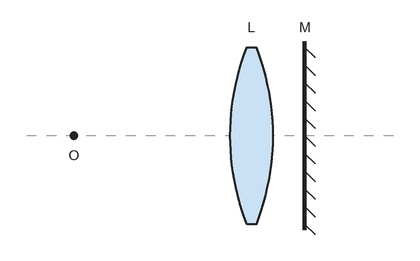
Solution:
Concept: If O is at the focus of the convex lens, its rays leave the lens parallel to the principal axis, fall normally on the plane mirror and come straight back. The image is then formed at O itself; this is how the plane-mirror method finds the focal length.
Step 1 — (i) Draw two rays from O.
Draw two rays from O to the upper and lower parts of the lens. O is at the focus, so after refraction each ray travels parallel to the principal axis. Each ray strikes the mirror M normally: the angle of incidence is 0°, so the angle of reflection is also 0° and the ray goes back along the same path. The rays re-enter the lens as a parallel beam and meet again at O, so the image I is formed at O itself.

Step 2 — (ii) Size of the image.
The image I is of the same size as the object O, because the returning rays retrace the paths of the outgoing rays and meet at the same distance from the lens.
Step 3 — (iii) Two more characteristics.
The image is real (the rays actually meet there) and inverted. With an upright object pin whose tip is at the axis, the image is seen hanging upside down just above it, tip to tip.
Step 4 — (iv) Name the distance.
The distance of O from the optical centre is the focal length (f) of the lens, because O lies in the focal plane.
Step 5 — (v) Mirror moved away by f.
The rays return to O itself. Between the lens and the mirror the rays are parallel to the principal axis, so moving the mirror along the axis does not change their path: they still strike it normally and retrace their path to O. The mirror is kept close to the lens only so that the image is bright and clearly seen.
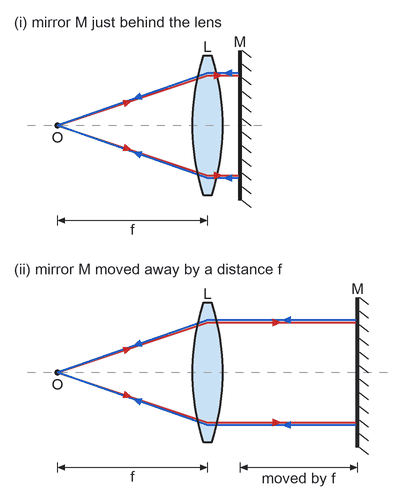
Therefore, the image I is formed at O itself; it is of the same size, real and inverted; the distance of O is the focal length; and the rays still return to O when the mirror is moved.