
Question 101 markMCQEasy
If a lens is placed in water instead of air, its focal length :
Confirming your payment
Sign up now and get 250 free tokens.
Refraction through a Lens · Question 10 of 142
If a lens is placed in water instead of air, its focal length :
(A) increases
(B) decreases
(C) remains the same
(D) can both increase or decrease
Answer: (A) increases
Concept: The focal length of a lens depends on the refractive index of its material relative to the surrounding medium and on the radii of curvature of its surfaces: more bending (larger relative refractive index, more curved surfaces) gives a shorter focal length. The bending depends on how different the refractive index of the glass is from that of the medium around it.
Step 1 — Compare the media.
Glass (about 1.5) compared with air has a relative refractive index of about 1.5. Compared with water (about 1.33) it is only about 1.5 ÷ 1.33.
Step 2 — Decide the effect.
The relative refractive index is much closer to 1 in water, so the lens bends light less and the rays meet farther away. The focal length increases (for ordinary glass, to about four times its value in air).
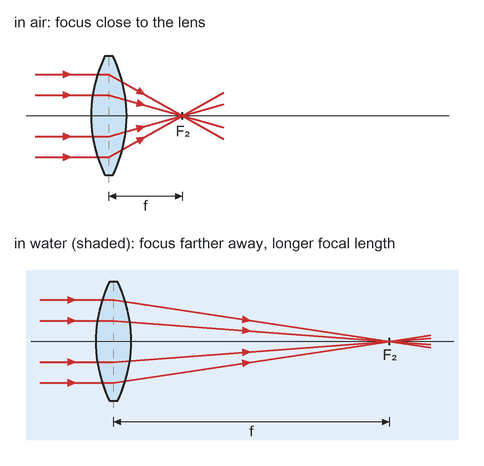
Watch out: The lens itself does not change; only the medium around it does, and that changes how much the light bends.
Why the other options are wrong:
Therefore, the focal length increases, option (A).