
Question 531 markMCQEasy
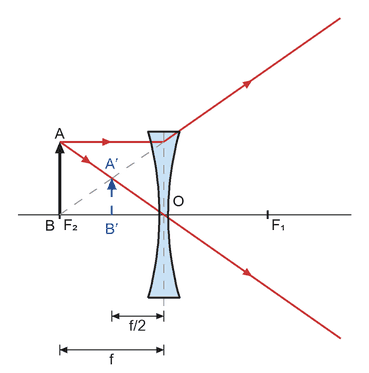
For a concave lens, when the object is at a distance equal to the focal length of the lens, the image is formed at :
Confirming your payment
Sign up now and get 250 free tokens.
Refraction through a Lens · Question 53 of 142
For a concave lens, when the object is at a distance equal to the focal length of the lens, the image is formed at :
(A) optical centre
(B) second focus
(C) first focus
(D) mid point between the optical centre and second focus of the lens
Answer: (D) mid point between the optical centre and second focus of the lens
Concept: The lens formula is , and the magnification is . A concave lens has a negative focal length.
Step 1 — Write the data.
Let the size of the focal length be . Then f = − (concave lens), and the object is at the focus, so u = −.
Step 2 — Use the lens formula.
Solve the lens formula for 1/v.
Step 3 — Read off the image.
So v = −/2; the image is half the focal length from the lens, on the object's side, midway between O and . Its magnification follows from m = v/u.
So the image is virtual, erect and half the size.
Why the other options are wrong:
Therefore, the image is at the mid point between the optical centre and the second focus, option (D).