
Question 41 markMCQEasy
A convex lens in its upper part has a prism with its base .............. and a concave lens in its upper part has a prism with its base .............. .
Confirming your payment
Sign up now and get 250 free tokens.
Refraction through a Lens · Question 4 of 142
A convex lens in its upper part has a prism with its base .............. and a concave lens in its upper part has a prism with its base .............. .
(A) downward, upward
(B) upward, downward
(C) upward, upward
(D) downward, downward
Answer: (A) downward, upward
Concept: A lens can be treated as a set of small prisms, and a prism always bends a ray towards its base. In a convex lens the prisms have their bases towards the principal axis; in a concave lens their bases face away from it.
Step 1 — Upper part of a convex lens.
A convex lens bends a ray in its upper part downward, towards the axis. A prism bends light towards its base, so the base of this prism must point downward.
Step 2 — Upper part of a concave lens.
A concave lens bends a ray in its upper part upward, away from the axis, so the base of this prism must point upward.
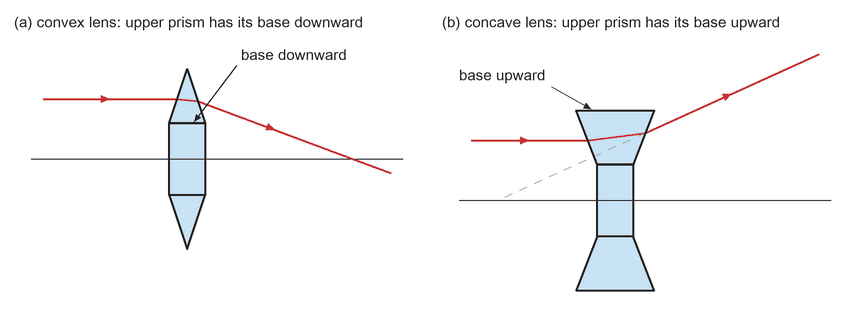
Watch out: The base points the way the ray is bent: towards the axis for a convex lens, away from it for a concave lens.
Why the other options are wrong:
Therefore, the blanks are 'downward, upward', option (A).