
Question 861 markMCQEasy
Identify the wrong statement.
Confirming your payment
Sign up now and get 250 free tokens.
Refraction through a Lens · Question 86 of 142
Identify the wrong statement.
(A) For a convex lens, u is always negative.
(B) For a convex lens, f is always positive.
(C) For a convex lens, v is positive for a virtual image and negative for a real image.
(D) For a concave lens, u, v and f all are negative.
Answer: (C) For a convex lens, v is positive for a virtual image and negative for a real image.
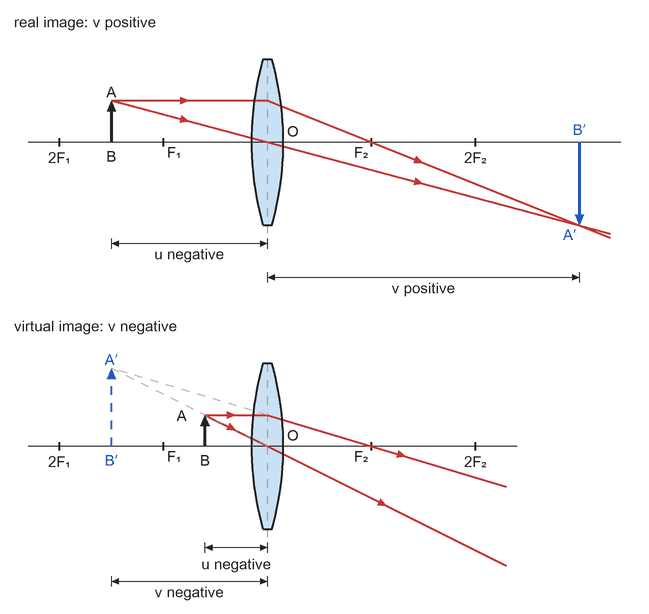
Concept: We use the new Cartesian sign convention: every distance is measured from the optical centre O; distances in the direction of the incident light (to the right) are positive and distances against it (to the left) are negative. So a real object has u negative, a real image (on the far side) has v positive and a virtual image (on the object's side) has v negative. With this convention f is positive for a convex lens and negative for a concave lens.
Step 1 — Sign of v for a real image.
A real image of a convex lens lies on the other side of the lens, in the direction of the incident light, so v is positive for a real image.
Step 2 — Sign of v for a virtual image.
A virtual image lies on the same side as the object, against the incident light, so v is negative for a virtual image.
Step 3 — Judge statement (C).
Statement (C) has these the wrong way round, so it is the wrong statement.
Watch out: The question asks for the WRONG statement; the other three are true.
Why the other options are wrong:
Therefore, the wrong statement is (C).