
Question 324 marksEasy
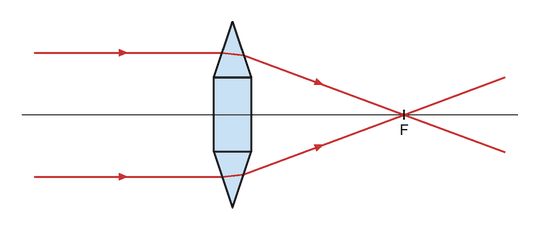
Show by a diagram the refraction of two light rays incident parallel to the principal axis on a convex lens by treating it as a combination of a glass slab and two triangular glass prisms.
Confirming your payment
Sign up now and get 250 free tokens.
Refraction through a Lens · Question 32 of 142
Show by a diagram the refraction of two light rays incident parallel to the principal axis on a convex lens by treating it as a combination of a glass slab and two triangular glass prisms.
Solution:
Concept: A lens can be treated as a set of small prisms, and a prism always bends a ray towards its base. In a convex lens the prisms have their bases towards the principal axis; in a concave lens their bases face away from it.
Step 1 — Model the lens.
A convex lens can be thought of as a rectangular glass slab in the middle with a triangular prism above it and another below it. Each prism has its base towards the slab, that is, towards the principal axis.
Step 2 — Upper ray.
A ray falling parallel to the axis on the upper prism bends towards that prism's base at both faces, that is, downward, towards the axis.
Step 3 — Lower ray.
A ray falling on the lower prism bends towards its base, that is, upward, towards the axis.
Step 4 — Result.
Both rays bend towards the axis and meet at a point F on the principal axis, the focus. (A ray along the axis passes through the slab without bending.) This is the converging action of a convex lens.
Watch out: A prism bends light towards its BASE, not towards its apex.
Therefore, the two parallel rays bend towards the axis and meet at the focus F, as drawn.