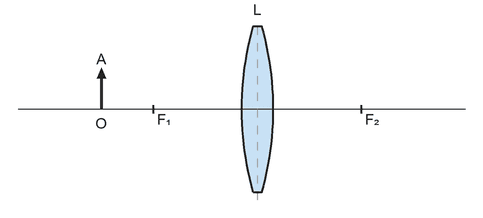
Solution:
Concept: For a convex lens the image depends on where the object is compared with F1 (one focal length away) and 2F1 (two focal lengths away): beyond 2F1 diminished, at 2F1 same size, between F1 and 2F1 magnified (all real and inverted); at F1 the image is at infinity; between F1 and O it is virtual, erect and magnified.
Step 1 — (i) Draw two rays.
Ray 1 goes from A parallel to the principal axis and, after refraction, passes through F2. Ray 2 goes from A through the optical centre of the lens, undeviated. The two refracted rays actually meet at A′, below the axis, beyond 2F2; draw A′O′ perpendicular to the axis.

Step 2 — (ii) Position of the image.
The object OA is beyond F1 but nearer than 2F1, so the image is on the other side of the lens, beyond 2F2.
Step 3 — (iii) Three characteristics.
The image is real, inverted and magnified.
Step 4 — (iv) Object moved towards F1.
The image moves farther away from the lens and becomes larger and larger. When the object reaches F1, the refracted rays become parallel and the image is at infinity, highly magnified.
Therefore, the image O′A′ is beyond 2F2 on the other side, real, inverted and magnified, and it moves away and grows as the object moves towards F1.