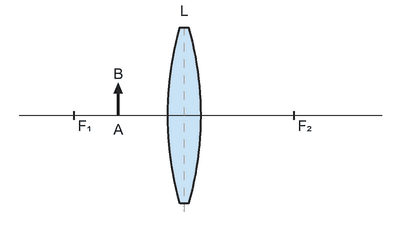
Solution:
Concept: The object AB lies between F1 and the lens (within the focal length), so the lens works as a magnifying glass: the refracted rays diverge, and the image is found by producing them backwards.
Step 1 — (a) Draw two rays.
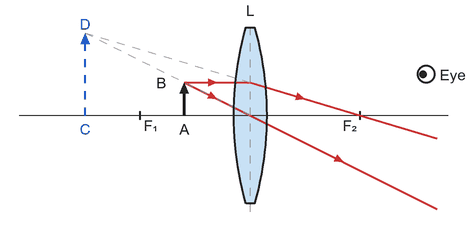
Ray 1 goes from B parallel to the principal axis and, after refraction, passes through F2. Ray 2 goes from B through the optical centre of the lens, undeviated.
Step 2 — (a) Locate the image CD.
The two refracted rays diverge. Produced backwards (dashed), they meet at D on the object's side; draw DC perpendicular to the axis. CD is the image.
Step 3 — (a) Position of the eye.
The eye is placed on the other side of the lens (the side of F2), looking through the lens towards the object. The diverging rays enter the eye and appear to come from D.
Step 4 — (b) Three characteristics.
The image is virtual, erect and magnified; it lies farther from the lens than the object, on the same side.
Therefore, (a) the image CD and the eye are as drawn, and (b) the image is virtual, erect and magnified.