
Question 901 markMCQEasy
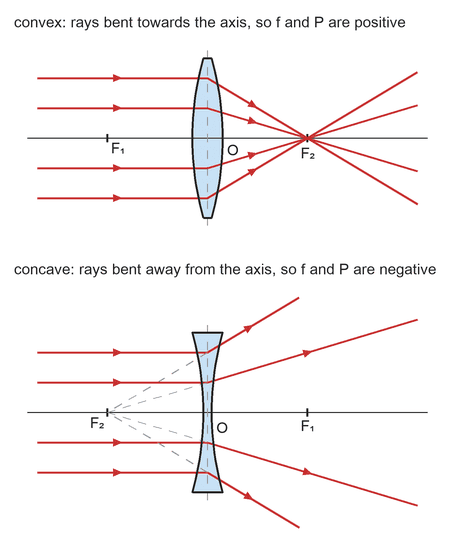
If a lens deviates a ray towards its centre, its power is ........... and if it deviates the ray away from its centre, its power is .........
Confirming your payment
Sign up now and get 250 free tokens.
Refraction through a Lens · Question 90 of 142
If a lens deviates a ray towards its centre, its power is ........... and if it deviates the ray away from its centre, its power is .........
(A) positive, positive
(B) negative, negative
(C) negative, positive
(D) positive, negative
Answer: (D) positive, negative
Concept: The power of a lens is the reciprocal of its focal length in metres: , measured in dioptre (D); 1 D = 1 m⁻¹. A convex lens has positive power and a concave lens negative power. The deviation a lens produces is a measure of its power.
Step 1 — Deviation towards the centre.
A lens that deviates a ray towards its centre (the principal axis) is a converging (convex) lens. Its focal length is positive, so its power is positive.
Step 2 — Deviation away from the centre.
A lens that deviates a ray away from its centre is a diverging (concave) lens. Its focal length is negative, so its power is negative.
Why the other options are wrong:
Therefore, the blanks are 'positive, negative', option (D).