
Question 71 markMCQEasy
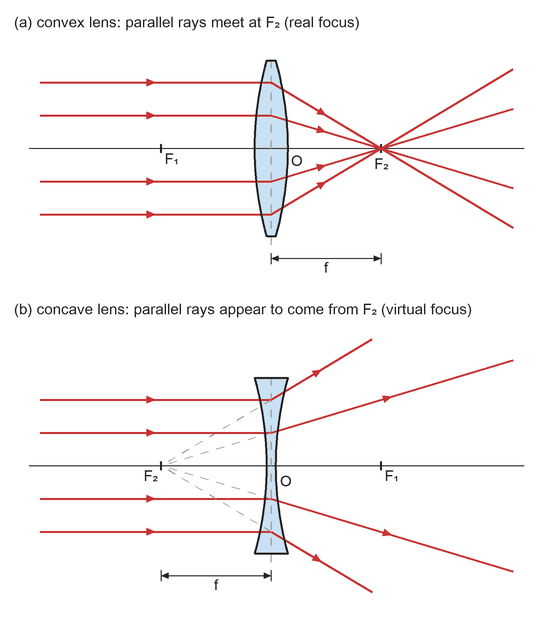
A ray of light incident on a lens parallel to its principal axis, after refraction passes through or appears to come from :
Confirming your payment
Sign up now and get 250 free tokens.
Refraction through a Lens · Question 7 of 142
A ray of light incident on a lens parallel to its principal axis, after refraction passes through or appears to come from :
(A) its first focus
(B) its optical centre
(C) its second focus
(D) the centre of curvature of its second surface.
Answer: (C) its second focus
Concept: A lens has two principal foci. Rays from (or aimed at) the first focus emerge parallel to the principal axis; rays incident parallel to the axis pass through (convex lens) or appear to come from (concave lens) the second focus . In Selina's labelling, is on the object side of a convex lens, but on the far side of a concave lens.
Step 1 — Recall the definition.
The second focus is defined by rays incident parallel to the principal axis.
Step 2 — Apply it to both lenses.
After refraction such a ray passes through for a convex lens (a real focus) and appears to come from for a concave lens (a virtual focus).
Why the other options are wrong:
Therefore, the ray passes through or appears to come from the second focus, option (C).