
Question 394 marksMedium
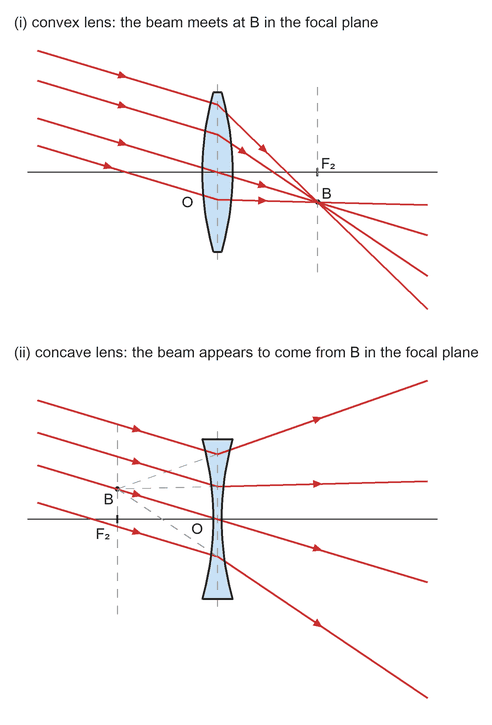
A parallel oblique beam of light falls on a (i) convex lens, (ii) concave lens. Draw a diagram in each case to show refraction of light through the lens.
Confirming your payment
Sign up now and get 250 free tokens.
Refraction through a Lens · Question 39 of 142
A parallel oblique beam of light falls on a (i) convex lens, (ii) concave lens. Draw a diagram in each case to show refraction of light through the lens.
Solution:
Concept: A parallel beam that is not parallel to the principal axis is focused at a point in the second focal plane (the plane through perpendicular to the axis). That point lies on the ray of the beam that passes undeviated through the optical centre O.
Step 1 — How to draw it.
First draw the ray of the beam that goes through O; it goes straight on. Where it crosses the focal plane is the point B. Then draw every other ray of the beam to (or from) B.
Step 2 — (i) Convex lens.
The oblique parallel rays converge and actually meet at a point B in the second focal plane, on the other side of the lens.
Step 3 — (ii) Concave lens.
The oblique parallel rays diverge. Produced backward (dashed lines), they appear to come from a point B in the focal plane on the same side as the incident light.
Watch out: An oblique beam is NOT focused at ; only a beam parallel to the axis is.
Therefore, (i) a convex lens brings the oblique beam to a point in its second focal plane, and (ii) a concave lens makes it appear to come from a point in its focal plane, as drawn.