Solution:
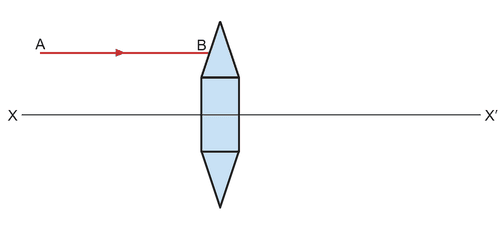
Concept: A lens can be treated as a set of small prisms, and a prism always bends a ray towards its base. In a convex lens the prisms have their bases towards the principal axis; in a concave lens their bases face away from it.
Step 1 — (i) Name the lens.
The prisms have their bases towards the slab (towards XX′), so the combination is thicker in the middle: it is a convex (converging) lens.
Step 2 — (ii) Name the line XX′.
XX′ is the principal axis of the lens.
Step 3 — (iii) Complete the ray diagram.
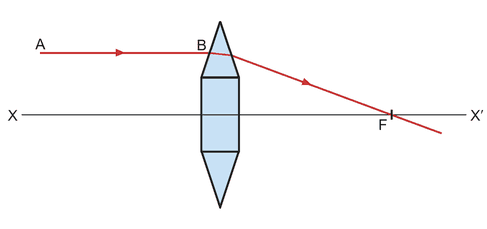
The ray AB is parallel to XX′ and falls on the upper prism at B. It bends towards the base of that prism (downward) as it enters, and again as it leaves. The emergent ray travels down to meet XX′ at a point F.
Step 4 — (iv) Name the point F.
F is the second focus F2 of the lens: the point where rays incident parallel to the principal axis meet after refraction. The rays actually meet there, so it is a real focus.
Therefore, (i) a convex lens, (ii) the principal axis, (iii) the ray bends down to meet XX′ at F, and (iv) F is the second focus.