Solution:
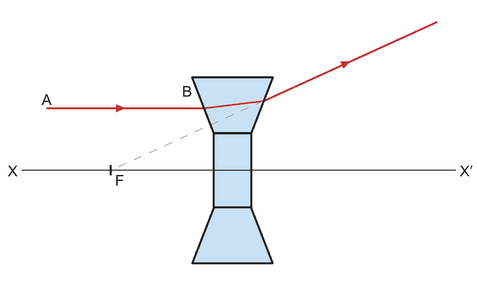
Concept: A lens can be treated as a set of small prisms, and a prism always bends a ray towards its base. In a convex lens the prisms have their bases towards the principal axis; in a concave lens their bases face away from it.
Step 1 — (i) Name the lens.
The prisms have their bases away from XX′, so the combination is thinner in the middle: it is a concave (diverging) lens.
Step 2 — (ii) Name the line XX′.
XX′ is the principal axis of the lens.
Step 3 — (iii) Complete the path.
The ray AB is parallel to XX′ and falls on the upper prism at B. It bends towards the base of that prism, that is, upward, away from XX′. Produced backward (dashed), the emergent ray meets XX′ at a point F on the incident side.
Step 4 — (iv) Name the point F.
F is the second focus F2 of the concave lens: the point from which rays incident parallel to the axis appear to diverge. It is a virtual focus.
Therefore, (i) a concave lens, (ii) the principal axis, (iii) the ray bends up, away from XX′, and (iv) F is the second focus (virtual).

