
Question 1023 marksEasy
State the sign convention to measure distances for a lens.
Confirming your payment
Sign up now and get 250 free tokens.
Refraction through a Lens · Question 102 of 142
State the sign convention to measure distances for a lens.
Solution:
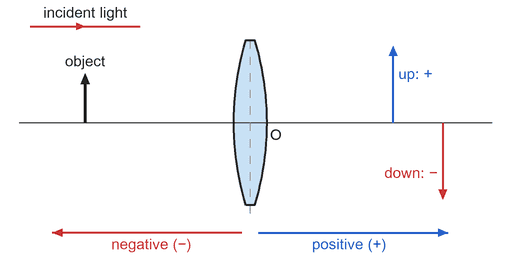
Concept: We use the new Cartesian sign convention: the optical centre of the lens is the origin and the principal axis is the x-axis, like a graph.
Step 1 — Origin.
All distances are measured from the optical centre O of the lens.
Step 2 — Direction of light.
The object is placed on the left of the lens, so the incident light travels from left to right.
Step 3 — Distances along the axis.
Distances measured in the direction of the incident light (to the right of O) are positive; distances measured against it (to the left of O) are negative.
Step 4 — Heights.
Heights measured upwards from the principal axis are positive; heights measured downwards are negative.
Step 5 — What this gives.
The object distance u is always negative; f is positive for a convex lens and negative for a concave lens; v is positive for a real image (on the right) and negative for a virtual image (on the left); an erect image has a positive height and an inverted image a negative height.
Therefore, distances are measured from O, positive along the incident light and negative against it, with heights positive upwards and negative downwards.