Solution:
Concept: The focal length of a lens depends on the refractive index of its material relative to the surrounding medium and on the radii of curvature of its surfaces: more bending (larger relative refractive index, more curved surfaces) gives a shorter focal length.
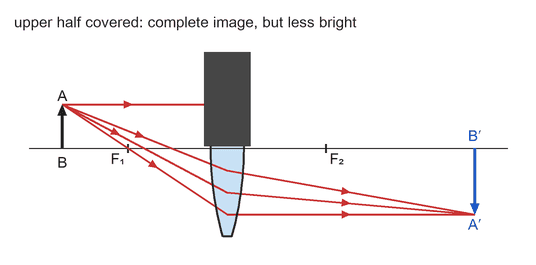
Step 1 — (a) Half the lens covered.
The shape and glass of the lens are unchanged, so the focal length does not change. Less light reaches the image, so its intensity decreases; the complete image still forms at the same place.
Step 2 — (b) Lens placed in water.
Glass relative to water (about 1.5 ÷ 1.33 ≈ 1.13) bends light less than glass relative to air (about 1.5), so the focal length will increase.
Step 3 — (c) Thin and thick lenses.
The gently curved surfaces of a thin lens bend light less, so the rays meet farther away: its focal length is more than that of a thick convex lens.
Watch out: Covering half the lens dims the image; it does not cut the image in half.
Therefore, (a) does not, decreases; (b) increase; (c) more.
