Solution:
Concept: For a convex lens the image depends on where the object is compared with F1 (one focal length away) and 2F1 (two focal lengths away): beyond 2F1 diminished, at 2F1 same size, between F1 and 2F1 magnified (all real and inverted); at F1 the image is at infinity; between F1 and O it is virtual, erect and magnified.
Step 1 — (a) Object beyond 40 cm.
The focal length is 20 cm, so 2f = 40 cm and the object is beyond 2F1. The image is real, inverted and diminished, formed between F2 and 2F2. For example, an object 60 cm away gives the image below (all distances in cm).
v1=201−601=301
So v = +30 cm, and the magnification follows from m = v/u.
m=−6030=−21
The image is half as tall as the object.
Step 2 — (b) Object at 2f.
The image is formed at 2f on the other side, and its size is equal to (the same as) that of the object.
Step 3 — (c) Object 5 cm from a lens of focal length 10 cm.
The object is within the focal length, so the image is virtual, upright and magnified. The lens formula confirms it.
v1=101−51=−101
So v = −10 cm, and the magnification follows from m = v/u.
m=−5−10=2
The image is twice as tall as the object.
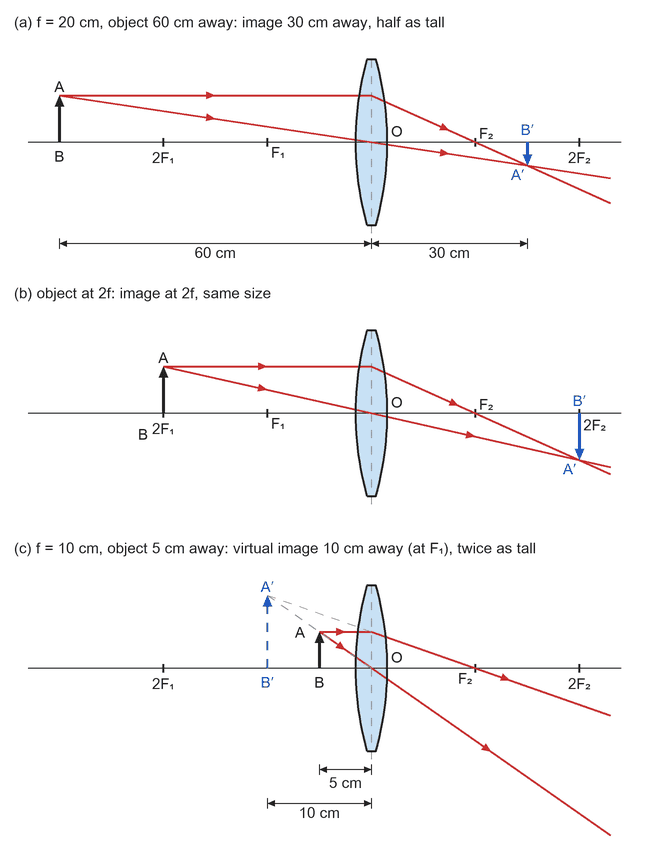
Therefore, the blanks are (a) diminished, (b) equal to, and (c) magnified.
