
Opening your dashboard
Class 10 Physics Chapter 12: Radioactivity Solutions
95 textbook questions with step-by-step answers, free to read, for ICSE 2026-27.
Get talked through Ch 12, not just shown the answer
Reading a finished solution is not the same as being able to do it. The AI tutor takes one question at a time and works it with you, in your own words, until you can.
- Ask it out loud, in your own words
- It gives you the next step, not the answer
- Stuck on part (ii)? Start there
95 questions with solutions
1–5 marks · Mixed difficulty
The first 84 solutions are on this page. This chapter is a long one, so the rest open on their own page to keep this one quick to load.
- 11 mark
Question 1
The total number of protons in a neutral atom is equal to :
Solve with AIAnswer
(A) atomic number
(B) neutrons
(C) electrons
- Correct
(D) both (a) and (c)
Answer: (D) both (a) and (c)
Concept: An atom has a tiny nucleus of protons and neutrons (together called nucleons) with electrons outside it. The atomic number Z is the number of protons; the mass number A is the number of nucleons (protons + neutrons). So the number of neutrons is A − Z, and a neutral atom has Z electrons.
Step 1 — Count the protons from the atomic number.
The atomic number Z of an element is defined as the number of protons in the nucleus of its atom, so the number of protons is always equal to the atomic number.
Step 2 — Use the word 'neutral'.
Each proton carries a charge +e and each electron a charge −e. For the atom to have no net charge, the negative charge of the electrons must cancel the positive charge of the protons exactly, so there are as many electrons as protons.
Step 3 — Put the two facts together.
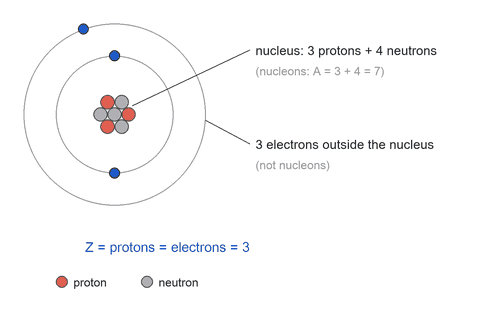
So the total number of protons equals the atomic number AND the number of electrons. Lithium-7 in the figure shows this: Z = 3, with 3 protons and 3 electrons.
Watch out: The word 'neutral' matters; in an ion the number of electrons is no longer equal to the number of protons.
Why the other options are wrong:
- (A) atomic number: The atomic number does equal the number of protons, but this option leaves out the equally true answer (C), so it is incomplete; option (D) contains it.
- (B) neutrons: The number of neutrons is A − Z and need not equal the number of protons; lithium-7 has 3 protons but 4 neutrons.
- (C) electrons: In a neutral atom the number of electrons does equal the number of protons, but this option leaves out (A), so it is incomplete.
Therefore, the number of protons in a neutral atom equals both the atomic number and the number of electrons, option (D).
- 21 mark
Question 2
By total number of nucleons, we mean :
Solve with AIAnswer
(A) the number of protons + number of electrons
(B) the number of electrons + number of neutrons
(C) the number of electrons + number of protons + number of neutrons
- Correct
(D) the number of neutrons + number of protons
Answer: (D) the number of neutrons + number of protons
Concept: Nucleons are the particles that make up the nucleus: protons and neutrons. Their total number is the mass number A. Electrons move outside the nucleus, so they are not nucleons.
Step 1 — Find what is inside the nucleus.
The nucleus of an atom is made of protons and neutrons packed together, so both of these are nucleons.
Step 2 — Leave out the electrons.
The electrons revolve around the nucleus, outside it, so they are not counted as nucleons.
Step 3 — Check with an example.
Lithium-7 has 3 protons and 4 neutrons in its nucleus, so it has 7 nucleons, which is its mass number.
Watch out: Do not add the electrons; they are outside the nucleus, so they are not nucleons.
Why the other options are wrong:
- (A) the number of protons + number of electrons: It adds the electrons, which are outside the nucleus, and leaves out the neutrons, which are nucleons.
- (B) the number of electrons + number of neutrons: It adds the electrons and leaves out the protons, which are nucleons.
- (C) the number of electrons + number of protons + number of neutrons: It wrongly counts the electrons as nucleons; for lithium-7 it would give 3 + 3 + 4 = 10 instead of 7.
Therefore, the total number of nucleons is the number of neutrons + the number of protons, option (D).
- 31 mark
Question 3
If Z is the atomic number and A is the mass number of an atom, then which of the following relations is incorrect ?
Solve with AIAnswer
(A) Number of electrons = Z
- Correct
(B) Number of protons = A – Z
(C) Number of neutrons = A – Z
(D) Number of neutrons + number of protons = A
Answer: (B) Number of protons = A – Z
Concept: An atom has a tiny nucleus of protons and neutrons (together called nucleons) with electrons outside it. The atomic number Z is the number of protons; the mass number A is the number of nucleons (protons + neutrons). So the number of neutrons is A − Z, and a neutral atom has Z electrons.
Step 1 — Write the three correct relations.
For an atom , the atomic number counts the protons, a neutral atom has as many electrons as protons, and the neutrons are the nucleons left after taking away the protons.
Step 2 — Test each option.
Options (A), (C) and (D) agree with these relations. Option (B) gives the number of protons as A − Z, which is really the number of neutrons, so (B) is the incorrect relation.
Watch out: The question asks for the INCORRECT relation, so the answer is the one that does not fit.
Why the other options are wrong:
- (A) Number of electrons = Z: This relation is correct: a neutral atom has Z electrons, one for each proton.
- (C) Number of neutrons = A – Z: This relation is correct: the neutrons are the nucleons that are not protons, A − Z.
- (D) Number of neutrons + number of protons = A: This relation is correct: protons + neutrons is the total number of nucleons, which is A.
Therefore, the incorrect relation is 'number of protons = A – Z', option (B).
- 41 mark
Question 4
A certain nucleus P has a mass number 15 and atomic number 7. The number of neutrons is :
Solve with AIAnswer
(A) 7
(B) 15
- Correct
(C) 8
(D) none of the above
Answer: (C) 8
Concept: An atom has a tiny nucleus of protons and neutrons (together called nucleons) with electrons outside it. The atomic number Z is the number of protons; the mass number A is the number of nucleons (protons + neutrons). So the number of neutrons is A − Z, and a neutral atom has Z electrons.
Step 1 — Read A and Z.
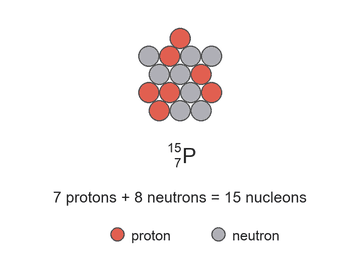
The nucleus P has mass number A = 15 (nucleons) and atomic number Z = 7 (protons).
Step 2 — Subtract the protons from the nucleons.
The neutrons are the nucleons that are not protons, so their number is A − Z.
Watch out: The mass number counts protons AND neutrons, so it is not itself the number of neutrons.
Why the other options are wrong:
- (A) 7: 7 is the atomic number, the number of protons, not of neutrons.
- (B) 15: 15 is the mass number, the total number of nucleons, not of neutrons.
- (D) none of the above: Option (C), 8, is correct, so 'none of the above' cannot be the answer.
Therefore, the number of neutrons is 8, option (C).
- 51 mark
Question 5
The atoms of the same element, having the same atomic number Z but different mass number A are called :
Solve with AIAnswer
- Correct
(A) Isotopes
(B) Isobars
(C) Isotones
(D) None of the above
Answer: (A) Isotopes
Concept: Isotopes have the same atomic number Z but different mass numbers A (same element, different numbers of neutrons). Isobars have the same A but different Z (different elements). Isotones have the same number of neutrons (A − Z) but different Z.
Step 1 — Use 'same Z'.
Atoms with the same atomic number have the same number of protons, so they are atoms of the same element and sit at the same place in the periodic table.
Step 2 — Use 'different A'.
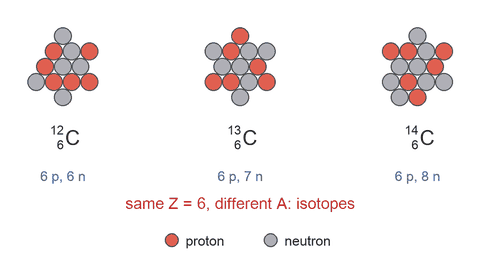
Since Z is the same, a different mass number means a different number of neutrons. Atoms of one element that differ only in their neutrons are called isotopes; for example carbon-12, carbon-13 and carbon-14.
Watch out: Isotopes (same Z) and isobars (same A) are easily mixed up; remember isoTOPEs share the same place (topos) in the periodic table.
Why the other options are wrong:
- (B) Isobars: Isobars have the same mass number but different atomic numbers, so they are atoms of different elements.
- (C) Isotones: Isotones have the same number of neutrons but different atomic numbers, so they too are different elements.
- (D) None of the above: Option (A) describes these atoms exactly, so 'none of the above' is wrong.
Therefore, atoms of the same element with the same Z but different A are called isotopes, option (A).
- 61 mark
Question 6
Out of the following, which element has the largest number of isotopes ?
Solve with AIAnswer
(A) Hydrogen
(B) Carbon
(C) Chlorine
- Correct
(D) Tin
Answer: (D) Tin
Concept: Isotopes have the same atomic number Z but different mass numbers A (same element, different numbers of neutrons). Isobars have the same A but different Z (different elements). Isotones have the same number of neutrons (A − Z) but different Z. A stable isotope does not decay; the others are radioactive.
Step 1 — Count the stable isotopes of each element.
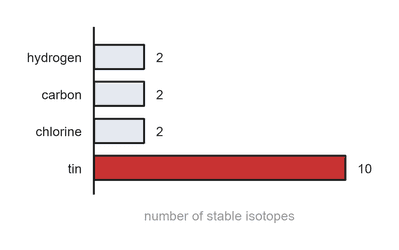
Hydrogen has 2 stable isotopes (protium and deuterium) and one well-known radioactive one, tritium. Carbon has 2 stable isotopes (carbon-12 and carbon-13) and the radioactive carbon-14. Chlorine has 2 stable isotopes, chlorine-35 and chlorine-37.
Step 2 — Compare with tin.
Tin has 10 stable isotopes, more than any other element in the periodic table.
Step 3 — Choose the largest.
Even if the radioactive isotopes of hydrogen and carbon are counted, they have only 3 each, far fewer than tin.
Watch out: Count the same kind of isotopes for every element; tin has the most stable isotopes of all the elements.
Why the other options are wrong:
- (A) Hydrogen: Hydrogen has only 3 well-known isotopes (protium, deuterium and tritium), of which 2 are stable.
- (B) Carbon: Carbon has only 3 well-known isotopes (carbon-12, carbon-13 and carbon-14), of which 2 are stable.
- (C) Chlorine: Chlorine has only 2 stable isotopes, chlorine-35 and chlorine-37.
Therefore, tin has the largest number of isotopes, option (D).
- 71 mark
Question 7
and are :
Solve with AIAnswer
(A) Isotopes
(B) Isobars
(C) Radioactive substances
- Correct
(D) Isotones
Answer: (D) Isotones
Concept: Isotopes have the same atomic number Z but different mass numbers A (same element, different numbers of neutrons). Isobars have the same A but different Z (different elements). Isotones have the same number of neutrons (A − Z) but different Z.
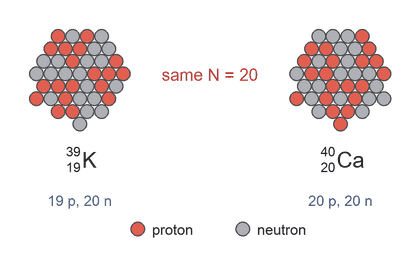
Step 1 — Find the neutrons in potassium-39.
Potassium has A = 39 and Z = 19, so its number of neutrons is A − Z.
Step 2 — Find the neutrons in calcium-40.
Calcium has A = 40 and Z = 20, so its number of neutrons is A − Z.
Step 3 — Compare.
Both nuclei have 20 neutrons, but their atomic numbers (19 and 20) and their mass numbers (39 and 40) differ. Nuclei with the same number of neutrons are isotones.
Watch out: Compare A − Z, not A or Z, to spot isotones.
Why the other options are wrong:
- (A) Isotopes: Isotopes need the same atomic number; here Z is 19 and 20.
- (B) Isobars: Isobars need the same mass number; here A is 39 and 40.
- (C) Radioactive substances: Potassium-39 and calcium-40 are both stable nuclei, so they are not radioactive substances.
Therefore, potassium-39 and calcium-40 are isotones, option (D).
- 81 mark
Question 8
Out of the following, radioactive substances are :
Solve with AIAnswer
(A) Uranium
(B) Polonium
(C) Actinium
- Correct
(D) All of the above
Answer: (D) All of the above
Concept: Radioactivity is the spontaneous disintegration of an unstable nucleus, which gives out α particles, β particles and γ radiation until a stable nucleus is formed. It is a nuclear process, so no physical or chemical change (heating, pressure, chemical combination) affects it. Every element with atomic number more than 82 is radioactive.
Step 1 — Look at the atomic numbers.
Uranium has atomic number 92, polonium 84 and actinium 89. All three lie beyond lead, whose atomic number is 82.
Step 2 — Decide whether they are radioactive.
Nuclei this heavy are unstable: they have too many nucleons, with far more neutrons than protons, so they break up on their own. Uranium, polonium and actinium are all naturally radioactive.
Step 3 — Choose the option that names all three.
Since each one is radioactive, the answer must include all three.
Watch out: When every listed item is correct, pick 'all of the above', not just one of them.
Why the other options are wrong:
- (A) Uranium: Uranium is radioactive, but so are polonium and actinium, so uranium alone is incomplete.
- (B) Polonium: Polonium is radioactive, but so are uranium and actinium, so polonium alone is incomplete.
- (C) Actinium: Actinium is radioactive, but so are uranium and polonium, so actinium alone is incomplete.
Therefore, uranium, polonium and actinium are all radioactive, option (D).
- 91 mark
Question 9
The heaviest nuclear radiation is :
Solve with AIAnswer
(A) X radiation
- Correct
(B) α radiation
(C) γ radiation
(D) β radiation
Answer: (B) α radiation
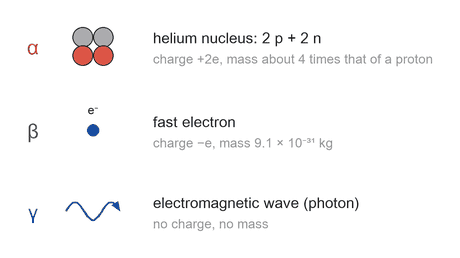
Concept: α particles are helium nuclei (charge +2e, about 4 times the mass of a proton); β particles are fast electrons (charge −e); γ radiation is an electromagnetic wave with no charge and no mass. α ionises the most and penetrates the least; γ ionises the least and penetrates the most.
Step 1 — Find the mass of an α particle.
An α particle is a helium nucleus of 2 protons and 2 neutrons, so its mass is about 4 times the mass of a proton.
Step 2 — Compare with a β particle.
A β particle is an electron of mass 9.1 × 10⁻³¹ kg, so the α particle is thousands of times heavier.
Step 3 — Compare with γ and X radiation.
γ radiation and X radiation are electromagnetic waves; their photons have no mass at all. So the α radiation is the heaviest.
Watch out: Α radiation is the heaviest but the LEAST penetrating; do not mix up mass with penetrating power.
Why the other options are wrong:
- (A) X radiation: X radiation is an electromagnetic wave, so it has no mass.
- (C) γ radiation: γ radiation is also an electromagnetic wave with no mass.
- (D) β radiation: β radiation is a stream of electrons, each about 7300 times lighter than an α particle.
Therefore, the heaviest nuclear radiation is α radiation, option (B).
- 101 mark
Question 10
To study the age of excavated materials of archeological significance, we study the rate of decay of an isotope of :
Solve with AIAnswer
(A) uranium
(B) cobalt
- Correct
(C) carbon
(D) chlorine
Answer: (C) carbon
Concept: Living things keep taking in carbon, including a small fixed share of radioactive carbon-14. After death no new carbon is taken in, and the carbon-14 left decays at a known, steady rate. Measuring what is left gives the age (carbon dating).
Step 1 — Name the isotope taken in by living things.
Every plant takes in carbon dioxide, and animals eat plants, so all living things contain carbon, a small part of which is radioactive carbon-14.
Step 2 — See what happens after death.
After death no fresh carbon-14 is taken in. The carbon-14 already there keeps decaying by β emission into nitrogen-14.
Step 3 — Find the age.
The less carbon-14 is left compared with a fresh sample, the longer ago the plant or animal died. So the age of excavated remains is found from the decay of carbon-14.

Watch out: Carbon dating works only for things that were once alive (wood, bone, cloth, seeds).
Why the other options are wrong:
- (A) uranium: Living things do not take in uranium, so its decay cannot tell when a plant or animal died; uranium is used to date very old rocks instead.
- (B) cobalt: Cobalt-60 is a radio isotope used in radiotherapy to treat cancer, not for dating remains.
- (D) chlorine: The common isotopes of chlorine, chlorine-35 and chlorine-37, are stable, so they cannot be used for dating.
Therefore, the age of excavated material is found from the rate of decay of an isotope of carbon (carbon-14), option (C).
- 111 mark
Question 11
A radioactive nucleus emits a beta particle. The position of daughter nucleus in the periodic table as compared to the parent nucleus after emitting a beta particle is :
Solve with AIAnswer
(A) at the same place
- Correct
(B) one place higher
(C) one place lower
(D) two places lower
Answer: (B) one place higher
Concept: In β emission a neutron inside the nucleus changes into a proton and an electron, and the electron is thrown out. So A stays the same and Z rises by 1: a new element, one place forward in the periodic table. The place of an element in the periodic table is fixed by its atomic number.
Step 1 — Write the β decay.
In β decay the mass number stays A and the atomic number rises from Z to Z + 1.
Step 2 — Turn the change in Z into a change of place.
Each step of 1 in atomic number is one place in the periodic table, so the daughter is one place higher (forward). For example, thorium-234 (atomic number 90) becomes protactinium-234 (atomic number 91).

Watch out: Β emission RAISES the atomic number, even though an electron (a negative particle) leaves.
Why the other options are wrong:
- (A) at the same place: The element stays at the same place only in γ emission, which does not change Z.
- (C) one place lower: Moving one place lower would need Z to fall by 1; β emission raises Z by 1.
- (D) two places lower: Moving two places lower happens in α emission, where Z falls by 2.
Therefore, after emitting a β particle the daughter nucleus is one place higher in the periodic table, option (B).
- 121 mark
Question 12
The speed of γ radiations is :
Solve with AIAnswer
(A) of the order of
(B) of the order of
- Correct
(C) equal to the speed of light, i.e.
(D) none of the above
Answer: (C) equal to the speed of light, i.e.
Concept: γ radiations are electromagnetic waves, like light and X-rays, and all electromagnetic waves travel at the speed of light, 3 × 10⁸ m s⁻¹, in vacuum (and almost the same in air).
Step 1 — Decide what γ radiation is.
γ radiation is not a stream of particles with mass; it is an electromagnetic wave of very short wavelength.
Step 2 — Give its speed.
Every electromagnetic wave travels at the speed of light, so γ radiation does too.

Step 3 — Compare with α and β.
This is faster than α particles (of the order of 10⁷ m s⁻¹) and faster than β particles, which can reach about 99% of the speed of light but never equal it.
Watch out: Β particles can be very fast, but only γ radiation travels at exactly the speed of light.
Why the other options are wrong:
- (A) of the order of : 10⁶ m s⁻¹ is slower even than α particles (of the order of 10⁷ m s⁻¹), while γ radiation travels at the speed of light.
- (B) of the order of : 10⁷ m s⁻¹ is the order of the speed of α particles, not of γ radiation.
- (D) none of the above: Option (C) is correct, so 'none of the above' cannot be the answer.
Therefore, γ radiations travel with the speed of light, 3 × 10⁸ m s⁻¹, option (C).
- 131 mark
Question 13
The correct representation of γ emission is :
Solve with AIAnswer
(A)
(B)
- Correct
(C)
(D)
Answer: (C)
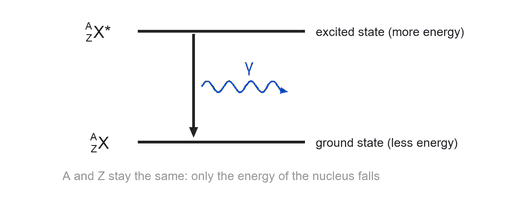
Concept: In γ emission an excited nucleus gives out its extra energy as an electromagnetic wave, so neither A nor Z changes; the element stays the same.
Step 1 — Check the mass number.
γ radiation has no mass number, so the nucleus keeps the same A: A on the left and A on the right.
Step 2 — Check the atomic number.
γ radiation has no charge, so the nucleus keeps the same Z: Z on the left and Z on the right. Since Z does not change, the element stays P.
Step 3 — Match with the options.
Only option (C) keeps both A and Z and keeps the symbol P. (The book leaves out the star that marks the excited state on the left.)
Watch out: A change in Z always means a new element, so a correct γ equation must have the same symbol on both sides.
Why the other options are wrong:
- (A) : It lowers Z by 1 and turns P into another element Q; γ emission cannot change Z.
- (B) : It is really α emission (A falls by 4, Z by 2), and it wrongly gives the γ radiation a mass number 4 and an atomic number 2.
- (D) : It lowers Z by 1 but still calls the nucleus P; a different Z would mean a different element, and γ emission does not change Z at all.
Therefore, the correct representation of γ emission keeps A, Z and the element unchanged, option (C).
- 141 mark
Question 14
Assertion (A) : Out of α, β and γ radiation, α-particles have the maximum penetrating power.
Reason (R) : The α-particles are the heaviest amongst the three.
Solve with AIAnswer
(A) both A and R are true and R is the correct explanation of A
(B) both A and R are True and R is not the correct explanation of A
- Correct
(C) assertion is false but reason is true
(D) assertion is true but reason is false
Answer: (C) assertion is false but reason is true
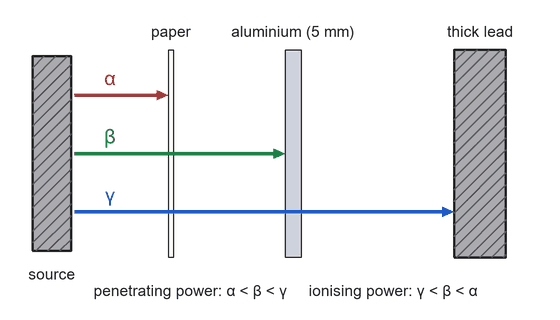
Concept: In an assertion–reason item, judge the assertion (A) and the reason (R) separately as true or false, and then decide whether R correctly explains A. The more strongly a radiation ionises the matter it passes through, the faster it loses its energy, so the less it penetrates.
Step 1 — Judge the assertion.
The assertion is false. α particles have the LEAST penetrating power: a sheet of paper, or a few centimetres of air, stops them. γ radiation is the most penetrating.
Step 2 — Judge the reason.
The reason is true. An α particle, about 4 times the mass of a proton, is the heaviest of the three; a β particle is a light electron and γ radiation has no mass.
Step 3 — See how the two are linked.
Being heavy and doubly charged, an α particle ionises strongly and uses up its energy quickly. That is exactly why it penetrates the least, the opposite of the assertion.
Watch out: Heavy does not mean penetrating; the heavy, strongly ionising α particle is stopped the soonest.
Why the other options are wrong:
- (A) both A and R are true and R is the correct explanation of A: This needs the assertion to be true, but α particles have the least penetrating power.
- (B) both A and R are True and R is not the correct explanation of A: This also needs the assertion to be true, which it is not.
- (D) assertion is true but reason is false: This reverses the two judgements: the assertion is false and the reason is true.
Therefore, the assertion is false but the reason is true, option (C).
- 151 mark
Question 15
Assertion (A) : and are isobars.
Reason (R) : has 6 protons and 8 neutrons in its nucleus, whereas has 7 protons and 7 neutrons in its nucleus.
Solve with AIAnswer
- Correct
(A) both A and R are true and R is the correct explanation of A
(B) both A and R are True and R is not the correct explanation of A
(C) assertion is false but reason is true
(D) assertion is true but reason is false
Answer: (A) both A and R are true and R is the correct explanation of A
Concept: In an assertion–reason item, judge the assertion (A) and the reason (R) separately as true or false, and then decide whether R correctly explains A. Isotopes have the same atomic number Z but different mass numbers A (same element, different numbers of neutrons). Isobars have the same A but different Z (different elements). Isotones have the same number of neutrons (A − Z) but different Z.
Step 1 — Judge the reason.
The reason is true. Carbon-14 has Z = 6, so it has 6 protons and 14 − 6 = 8 neutrons; nitrogen-14 has Z = 7, so it has 7 protons and 14 − 7 = 7 neutrons.
Step 2 — Judge the assertion.
Adding the counts from the reason gives the mass numbers. Both nuclei have 14 nucleons, so the same A, but different atomic numbers (6 and 7), so the assertion is true: they are isobars.

Step 3 — Decide whether R explains A.
The proton and neutron counts in the reason are exactly what show the same mass number with different atomic numbers, so the reason correctly explains the assertion.
Watch out: Isobars have the same A, not the same number of neutrons; here the neutrons (8 and 7) differ.
Why the other options are wrong:
- (B) both A and R are True and R is not the correct explanation of A: The reason does explain the assertion: its counts give the same A = 14 with different Z.
- (C) assertion is false but reason is true: The assertion is true: carbon-14 and nitrogen-14 are isobars.
- (D) assertion is true but reason is false: The reason is true: its numbers of protons and neutrons are correct.
Therefore, both A and R are true and R is the correct explanation of A, option (A).
- 161 mark
Question 16
What is the name given to elements with same mass number and different atomic number ?
Solve with AIWritten solution
Solution:
Concept: Isotopes have the same atomic number Z but different mass numbers A (same element, different numbers of neutrons). Isobars have the same A but different Z (different elements). Isotones have the same number of neutrons (A − Z) but different Z.
Step 1 — Pick out the condition.
The question describes atoms of different elements (different Z) that have the same number of nucleons (same A).
Step 2 — Name it.
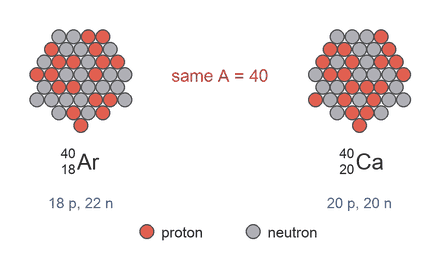
Atoms with the same mass number but different atomic numbers are called isobars ('iso' = same, 'bar' = weight). For example, argon-40 has 18 protons and 22 neutrons, and calcium-40 has 20 protons and 20 neutrons; both have 40 nucleons.
Watch out: Isobars are different elements; isotopes are the same element.
Therefore, elements with the same mass number and different atomic numbers are called isobars.
- 172 marks
Question 17
Arrange the α, β and γ radiations in ascending order of their (i) ionising power, and (ii) penetrating power.
Solve with AIWritten solution
Solution:
Concept: The more strongly a radiation ionises the matter it passes through, the faster it loses its energy, so the less it penetrates. The order for ionising power is therefore the reverse of the order for penetrating power.
(i)
Step 1 — Ionising power, lowest first.
α particles are heavy and carry a charge of +2e, so they knock electrons out of atoms most strongly: about 100 times as strongly as β particles and about 10,000 times as strongly as γ radiation, which has no charge.
(ii)
Step 2 — Penetrating power, lowest first.
α particles are stopped by a sheet of paper, β particles by a few millimetres (about 5 mm) of aluminium, while γ radiation is only weakened by several centimetres of lead.
Watch out: The two orders are opposite; do not write the same order for both.
Therefore, (i) ionising power: γ < β < α, and (ii) penetrating power: α < β < γ.
- 182 marks
Question 18
State the speed of each of α, β and γ radiations.
Solve with AIWritten solution
Solution:
Concept: α and β are particles thrown out of the nucleus at high speed; γ is an electromagnetic wave, so it travels at the speed of light, c = 3 × 10⁸ m s⁻¹.
Step 1 — α particles.
α particles are heavy, so they move comparatively slowly, with speeds of the order of 10⁷ m s⁻¹ (about one-twentieth of the speed of light).
Step 2 — β particles.
β particles are very light electrons. Their speeds vary widely, of the order of 10⁸ m s⁻¹, and the fastest reach about 99% of the speed of light, but never equal it.
Step 3 — γ radiation.
γ radiation is an electromagnetic wave, so it travels at the speed of light.
Watch out: Only γ radiation travels at exactly the speed of light; β particles come close but are always slower.
Therefore, α particles travel at about 10⁷ m s⁻¹, β particles at up to about 99% of the speed of light (of the order of 10⁸ m s⁻¹), and γ radiation at 3 × 10⁸ m s⁻¹.
- 191 mark
Question 19
A certain radioactive nucleus emits a particle that leaves its mass number unchanged, but increases its atomic number by one. Identify the particle and write its symbol.
Solve with AIWritten solution
Solution:
Concept: In β emission a neutron inside the nucleus changes into a proton and an electron, and the electron is thrown out. So A stays the same and Z rises by 1: a new element, one place forward in the periodic table.
Step 1 — Read the change.
The mass number does not change, so no nucleons leave the nucleus. The atomic number rises by 1, so the nucleus has gained one proton.
Step 2 — Explain it.
This happens when a neutron inside the nucleus changes into a proton and an electron. The proton stays, so Z rises by 1, and the electron is thrown out.

Step 3 — Name the particle.
The fast electron thrown out of the nucleus is a beta particle. Its mass number is 0 and its charge number is −1.
Watch out: The β particle comes from the NUCLEUS (a neutron changing into a proton), not from the electron shells.
Therefore, the particle is a beta particle (a fast electron), with symbol or .
- 202 marks
Question 20
What happens to the (i) atomic number, (ii) mass number of the nucleus of an element when (a) an α-particle, (b) a β-particle, and (c) γ radiation, is emitted ?
Solve with AIWritten solution
Solution:
Concept: Look at what each emission takes out of the nucleus: an α particle carries away 2 protons and 2 neutrons; in β emission a neutron inside the nucleus turns into a proton and an electron, and the electron leaves; γ radiation carries away only energy.
Step 1 — α particle.
The α particle carries away 2 protons and 2 neutrons, so the atomic number falls by 2 and the mass number falls by 4.
Step 2 — β particle.
A neutron becomes a proton, so the atomic number rises by 1, while the number of nucleons, and so the mass number, stays the same.
Step 3 — γ radiation.
Only energy leaves, so neither number changes.
Step 4 — Collect the results.
The table puts the three cases side by side.
Emission (i) Atomic number (ii) Mass number (a) α-particle decreases by 2 decreases by 4 (b) β-particle increases by 1 no change (c) γ radiation no change no change 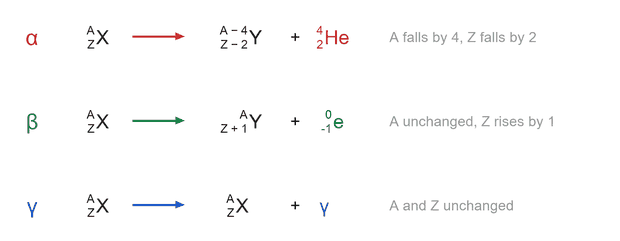
Watch out: In β emission the atomic number INCREASES, although a negative particle leaves.
Therefore, (a) α emission: Z decreases by 2 and A by 4; (b) β emission: Z increases by 1 and A is unchanged; (c) γ emission: neither Z nor A changes.
- 212 marks
Question 21
State whether the following nuclear disintegrations are allowed or not (star indicates an excited state). Give reason if it is not allowed.
(a)
(b)
Solve with AIWritten solution
Solution:
Concept: In every nuclear change the total mass number (A) and the total atomic number (Z) are the same on both sides of the equation. An α particle is , a β particle is , a neutron is and γ radiation has A = 0 and Z = 0. A change is allowed only if both totals balance and each symbol has one atomic number.
(a)
Step 1 — Check the γ emission.
On the left the excited nucleus has mass number A and atomic number Z. On the right the nucleus has A and Z, and γ radiation adds 0 to each, so both totals balance and the element stays X. The nucleus simply gives out its extra energy.
So this disintegration is allowed.
(b)
Step 2 — Check the mass numbers.
The left side has mass number A, but the right side has A from the nucleus plus 4 from the helium nucleus.
Step 3 — Check the symbol.
The product is written as X with atomic number Z − 2, but an element's atomic number is fixed: a nucleus with Z − 2 protons is a different element, not X.
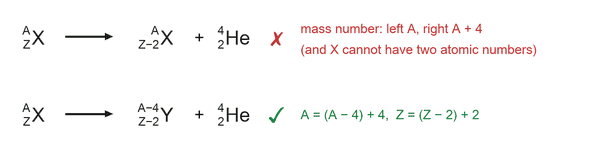
So this disintegration is not allowed. The correct α decay is:
Watch out: After α emission both A and Z must fall, A by 4 and Z by 2, and the element must change.
Therefore, (a) is allowed, and (b) is not allowed because the mass number is not conserved (A on the left, A + 4 on the right) and a nucleus with atomic number Z − 2 cannot still be X.
- 222 marks
Question 22
Complete the following sentences :
(a) The mass number and atomic number of an element are not changed when it emits ..............
(b) The atomic number of a radioactive element is not changed when it emits ..............
(c) During the emission of a beta particle, the .............. number remains same.
Solve with AIWritten solution
Solution:
Concept: In γ emission an excited nucleus gives out its extra energy as an electromagnetic wave, so neither A nor Z changes; the element stays the same. In β emission a neutron inside the nucleus changes into a proton and an electron, and the electron is thrown out. So A stays the same and Z rises by 1: a new element, one place forward in the periodic table.
(a)
Step 1 — Neither number changes.
Only γ radiation leaves both the mass number and the atomic number unchanged, because it has no mass and no charge.
(b)
Step 2 — Atomic number unchanged.
The atomic number changes in α emission (falls by 2) and in β emission (rises by 1), so it stays the same only when γ radiation is emitted.
(c)
Step 3 — β emission.
In β emission a neutron turns into a proton, so the total number of nucleons stays the same: the mass number remains the same, while the atomic number rises by 1.
Watch out: In (b) the answer is not the β particle: β emission changes the atomic number.
Therefore, (a) γ radiation, (b) γ radiation, (c) mass number.
- 234 marks
Question 23
Complete the following nuclear changes :
(a)
(b)
(c)
(d)
(e)
Solve with AIWritten solution
Solution:
Concept: In every nuclear change the total mass number (A) and the total atomic number (Z) are the same on both sides of the equation. An α particle is , a β particle is , a neutron is and γ radiation has A = 0 and Z = 0. Emitting an α particle lowers A by 4 and Z by 2; emitting a β particle keeps A and raises Z by 1 (a neutron turns into a proton); emitting γ radiation changes neither.
(a)
Step 1 — β emission from P.
A β particle has mass number 0 and atomic number −1, so Q keeps the mass number a and its atomic number must be x + 1 for the atomic numbers to balance.
(b)
Step 2 — Find the missing particle.
The missing particle must make up the difference in mass number and in atomic number between uranium and thorium.
A particle with A = 4 and Z = 2 is an α particle (a helium nucleus).
(c)
Step 3 — Follow the nucleus one step at a time.
The α emission lowers A by 4 and Z by 2, giving (234, 90); each β emission then raises Z by 1 and keeps A, giving (234, 91) and then (234, 92).

(d)
Step 4 — Follow the nucleus again.
The α emission gives A − 4 and Z − 2; the γ emission changes nothing; the two β emissions raise Z by 2, back to Z, with the mass number still A − 4.

(e)
Step 5 — Work backwards from X₃.
Undoing an α emission adds 4 to A and 2 to Z; undoing a β emission takes 1 from Z and leaves A unchanged.
Step 6 — Write the completed chain.
Putting the numbers in gives the full chain, which checks forwards as well.

Watch out: A β particle LOWERS the total on the right by 1 (its atomic number is −1), so the daughter's Z goes UP by 1.
Therefore, (a) Q is ; (b) the missing particle is (an α particle); (c) Q = , R = , S = ; (d) X₁ = , X₂ = , X₃ = ; (e) X = , X₁ = , X₂ = .
- 241 mark
Question 24
Why do we usually use isotopes emitting gamma radiations as radioactive tracers in medical science ?
[Hint : gamma radiations are most penetrating]
Solve with AIWritten solution
Solution:
Concept: A radioactive tracer is a small amount of a radio isotope put into the body; its radiation is followed with a detector placed outside the body to see where the substance goes.
Step 1 — See what the detector needs.
The detector is outside the body, so the radiation from the tracer must get out through the tissues and skin to reach it.
Step 2 — Compare the penetrating powers.
α and β radiations are absorbed within the body and would never reach the detector, while γ radiation, the most penetrating, passes out of the body easily.

Step 3 — Note the safety advantage.
γ radiation also ionises weakly, so it does comparatively little damage to the cells it passes through, and only a small amount is needed (for example, to locate a tumour or a blood clot).
Watch out: The reason is penetration out of the body, not that γ radiation is harmless; it must still be used in very small doses.
Therefore, γ-emitting isotopes are used as tracers because γ radiation is the most penetrating, so it comes out of the body and can be detected outside it, while doing comparatively little damage on the way.
- 252 marks
Question 25
Which of the following is the radio isotope in each pair (a), (b) and (c) ?
(a) , (b) , (c) ,
Give reason for your answer.
Solve with AIWritten solution
Solution:
Concept: A nucleus is stable only when its numbers of neutrons and protons are suitably balanced. A radio isotope is an isotope whose nucleus is unstable, most often because it has more neutrons than the stable isotope of that element.
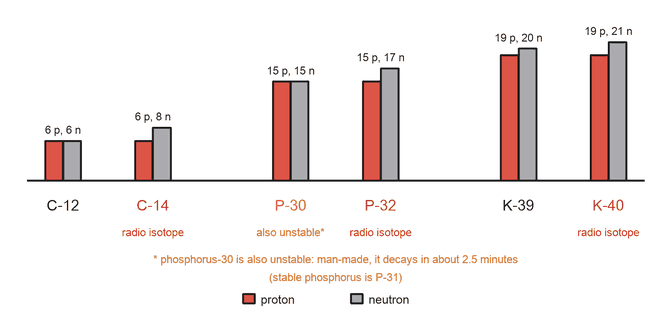
Step 1 — Count the neutrons in each pair.
The number of neutrons is A − Z.
Pair lighter isotope heavier isotope (a) carbon C-12: 6 p, 6 n C-14: 6 p, 8 n (b) phosphorus P-30: 15 p, 15 n P-32: 15 p, 17 n (c) potassium K-39: 19 p, 20 n K-40: 19 p, 21 n Step 2 — Pick the radio isotope in each pair.
In each pair the heavier isotope has more neutrons than the stable isotope of the element (C-12, P-31 and K-39 are stable), so its nucleus is unstable and it decays by emitting β particles.
Step 3 — State the radio isotopes.
So the radio isotopes are carbon-14, phosphorus-32 and potassium-40.
Watch out: Compare with the STABLE isotope of the same element; a radio isotope has the wrong neutron count for its protons.
Note: Strictly, phosphorus-30 is also radioactive: it is a man-made isotope (with too FEW neutrons) that decays in a few minutes, while stable phosphorus is P-31. The book's intended answer for (b), phosphorus-32, the familiar radio isotope used as a tracer, is kept.
Therefore, the radio isotopes are (a) , (b) and (c) , because each has extra neutrons that make its nucleus unstable.
- 263 marks
Question 26
Name the three constituents of an atom and state mass and charge of each. How are they distributed in an atom ?
Solve with AIWritten solution
Solution:
Concept: An atom has a tiny, heavy, positively charged nucleus at its centre, made of protons and neutrons, with light, negatively charged electrons moving around it.
Step 1 — Name the constituents and give their mass and charge.
The three particles that make up an atom are the proton, the neutron and the electron. The table gives the book's values.
Particle Mass Charge Proton kg (about 1 u) C (+e) Neutron kg (about 1 u) zero Electron kg (about 1/1840 of a proton) C (−e) Step 2 — Describe the nucleus.
The protons and neutrons are packed together in the nucleus at the centre. Almost the whole mass of the atom is there, and the nucleus is positively charged because of its protons.
Step 3 — Describe the electrons.
The electrons revolve around the nucleus in definite orbits (shells K, L, M, …). In a neutral atom their number equals the number of protons.
Step 4 — Note the empty space.
The nucleus is about 10⁴ to 10⁵ times smaller than the atom, so most of the atom is empty space.
Watch out: The neutron has almost the same mass as the proton but NO charge; the electron is far lighter than either.
Therefore, an atom is made of protons (about 1.67 × 10⁻²⁷ kg, +e) and neutrons (about 1.67 × 10⁻²⁷ kg, no charge) in the central nucleus, and electrons (9.1 × 10⁻³¹ kg, −e) revolving around it in orbits.
- 272 marks
Question 27
Define the following terms :
(a) atomic number, and (b) mass number.
Solve with AIWritten solution
Solution:
Concept: Both numbers count particles in the nucleus: the atomic number counts only the protons, while the mass number counts all the nucleons (protons + neutrons).
(a)
Step 1 — Define the atomic number.
The atomic number Z of an element is the number of protons in the nucleus of its atom. In a neutral atom it also equals the number of electrons. For example, sodium has 11 protons, so its atomic number is 11.
(b)
Step 2 — Define the mass number.
The mass number A of an atom is the total number of protons and neutrons (nucleons) in its nucleus. For example, sodium has 11 protons and 12 neutrons, so its mass number is 23.
Watch out: Electrons are not counted in the mass number; they are outside the nucleus.
Therefore, (a) the atomic number is the number of protons in the nucleus of an atom, and (b) the mass number is the total number of protons and neutrons in its nucleus.
- 283 marks
Question 28
State the atomic number and mass number of and draw its atomic model.
Solve with AIWritten solution
Solution:
Concept: An atom has a tiny nucleus of protons and neutrons (together called nucleons) with electrons outside it. The atomic number Z is the number of protons; the mass number A is the number of nucleons (protons + neutrons). So the number of neutrons is A − Z, and a neutral atom has Z electrons.
Step 1 — Read the two numbers.
In the upper number is the mass number and the lower number is the atomic number.
Step 2 — Count the particles.
The number of protons is Z, the number of neutrons is A − Z, and a neutral atom has Z electrons.
Step 3 — Arrange the electrons in shells.
The K shell holds at most 2 electrons and the L shell at most 8, so the 11 electrons go 2 in K, 8 in L and the last 1 in M.
Step 4 — Draw the model.
The model shows a nucleus of 11 protons and 12 neutrons, with 2, 8 and 1 electrons in the K, L and M shells.

Watch out: The neutrons are A − Z = 12, not 23 (the mass number counts protons too).
Therefore, sodium has atomic number 11 and mass number 23; its atom has a nucleus of 11 protons and 12 neutrons, with electrons arranged 2, 8, 1.
- 292 marks
Question 29
What are isotopes ? Give one example.
Solve with AIWritten solution
Solution:
Concept: Isotopes have the same atomic number Z but different mass numbers A (same element, different numbers of neutrons). Isobars have the same A but different Z (different elements). Isotones have the same number of neutrons (A − Z) but different Z.
Step 1 — Define isotopes.
Isotopes are atoms of the same element that have the same atomic number but different mass numbers. They have the same number of protons but different numbers of neutrons.
Step 2 — Give an example.
Hydrogen has three isotopes: protium , deuterium and tritium . Each has 1 proton, but they have 0, 1 and 2 neutrons.
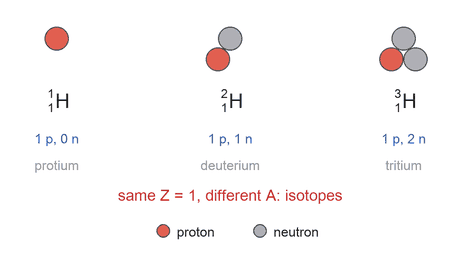
Watch out: Isotopes are the SAME element; the different number is the mass number (the neutrons).
Therefore, isotopes are atoms of the same element with the same atomic number but different mass numbers, for example , and .
- 302 marks
Question 30
What are isobars ? Give one example.
Solve with AIWritten solution
Solution:
Concept: Isotopes have the same atomic number Z but different mass numbers A (same element, different numbers of neutrons). Isobars have the same A but different Z (different elements). Isotones have the same number of neutrons (A − Z) but different Z.
Step 1 — Define isobars.
Isobars are atoms of different elements that have the same mass number but different atomic numbers. They have the same number of nucleons, shared differently between protons and neutrons.
Step 2 — Give an example.
Argon-40 has 18 protons and 22 neutrons, and calcium-40 has 20 protons and 20 neutrons. Both have 40 nucleons, so they are isobars.
Watch out: Isobars are DIFFERENT elements; isotopes are the same element.
Therefore, isobars are atoms of different elements with the same mass number but different atomic numbers, for example and .
- 313 marks
Question 31
Name the atoms of a substance having same atomic number, but different mass numbers. Give one example of such a substance. How do the structures of such atoms differ ?
Solve with AIWritten solution
Solution:
Concept: Isotopes have the same atomic number Z but different mass numbers A (same element, different numbers of neutrons). Isobars have the same A but different Z (different elements). Isotones have the same number of neutrons (A − Z) but different Z.
Step 1 — Name the atoms.
Atoms with the same atomic number but different mass numbers are isotopes of one element.
Step 2 — Give an example.
Chlorine has two isotopes, chlorine-35 and chlorine-37.
Step 3 — Say what is the same.
Both have 17 protons, so both have 17 electrons arranged in the same way. Since chemical properties depend on the electrons, the isotopes behave alike chemically.
Step 4 — Say what is different.
They differ only in the number of neutrons in the nucleus, so their nuclei have different masses.

Watch out: The electrons and protons are the same in isotopes; only the neutrons differ.
Therefore, such atoms are isotopes, for example and ; they have the same number of protons and electrons but different numbers of neutrons (18 and 20).
- 322 marks
Question 32
What is meant by radioactivity ? Name two radioactive substances.
Solve with AIWritten solution
Solution:
Concept: Some nuclei are unstable. They break up on their own, giving out radiation, until a stable nucleus is formed.
Step 1 — Define radioactivity.
Radioactivity is the phenomenon of spontaneous disintegration of the nucleus of an atom, with the emission of α particles, β particles and γ radiation, until a stable nucleus is formed. It is shown mainly by heavy elements, with atomic number more than 82.
Step 2 — Note what does not affect it.
Since it happens in the nucleus, it is not affected by physical or chemical changes such as heating, pressure or chemical combination.
Step 3 — Name two radioactive substances.
Uranium and radium are two common radioactive substances (polonium and thorium are others).
Watch out: The disintegration is spontaneous: nothing has to start it, and it cannot be speeded up or stopped.
Therefore, radioactivity is the spontaneous disintegration of unstable nuclei with the emission of α, β and γ radiations; uranium and radium are two radioactive substances.
- 332 marks
Question 33
A radioactive substance is oxidised. What changes would you expect to take place in the nature of radioactivity ? Explain your answer.
Solve with AIWritten solution
Solution:
Concept: Oxidation is a chemical change: it involves only the outer (orbital) electrons of the atom. Radioactivity is a nuclear process: it comes from the unstable nucleus.
Step 1 — See what oxidation changes.
When the substance is oxidised, its atoms combine with oxygen by sharing or transferring outer electrons. The nucleus takes no part in this.
Step 2 — See where radioactivity comes from.
The radiations come from the unstable nucleus, which is exactly the same before and after oxidation.
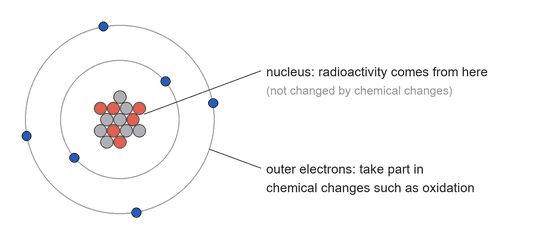
Step 3 — Draw the conclusion.
So the oxide gives out the same radiations (α, β or γ) at the same rate as the free element.
Watch out: A chemical change cannot reach the nucleus, so it cannot change radioactivity.
Therefore, there is no change in the nature (or rate) of the radioactivity, because oxidation changes only the outer electrons, while radioactivity comes from the nucleus.
- 342 marks
Question 34
Explain why alpha and beta particles are deflected in an electric or a magnetic field, but gamma rays are not deflected in such a field.
[Hint : alpha and beta particles are charged, but gamma rays are uncharged]
Solve with AIWritten solution
Solution:
Concept: Electric and magnetic fields push only on charged particles. In an electric field a positive charge is pulled towards the negative plate and a negative charge towards the positive plate; in a magnetic field the force on a moving charge is given by Fleming's left hand rule (forefinger along the field, central finger along the current, thumb gives the force). Uncharged γ radiation goes straight on.
Step 1 — α particles.
α particles carry a positive charge (+2e), so the field exerts a force on them and they are deflected; in an electric field they bend towards the negative plate.
Step 2 — β particles.
β particles carry a negative charge (−e), so they are deflected the opposite way, towards the positive plate, and much more, because they are very light.

Step 3 — γ rays.
γ rays are electromagnetic waves with no charge. No force acts on them, so they pass through the field undeflected.
Watch out: A magnetic field also needs the charge to be moving; the radiations are moving fast, so it deflects α and β.
Therefore, α and β particles are deflected because they are charged (positive and negative), while γ rays are not deflected because they carry no charge.
- 352 marks
Question 35
Is it possible to deflect γ radiations in a way similar to α and β-particles, using the electric or magnetic field ? Give reason.
Solve with AIWritten solution
Solution:
Concept: Electric and magnetic fields push only on charged particles. In an electric field a positive charge is pulled towards the negative plate and a negative charge towards the positive plate; in a magnetic field the force on a moving charge is given by Fleming's left hand rule (forefinger along the field, central finger along the current, thumb gives the force). Uncharged γ radiation goes straight on.
Step 1 — Recall what γ radiation is.
γ radiation is an electromagnetic wave (a stream of photons), like light and X-rays, and it carries no charge.
Step 2 — Apply the rule.
Electric and magnetic fields exert forces only on charged particles. With no charge, γ radiation feels no force, so it goes straight through the field.
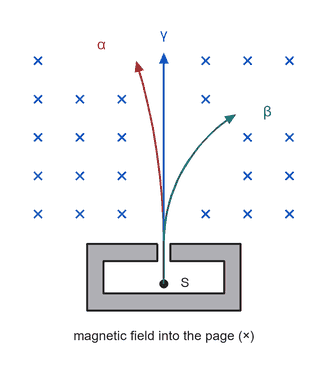
Step 3 — Compare with α and β.
α and β particles are deflected only because they are charged.
Watch out: A very strong field still cannot bend γ radiation; it is the charge, not the field strength, that is missing.
Therefore, no: γ radiations cannot be deflected by an electric or a magnetic field, because they carry no charge.
- 363 marks
Question 36
(a) What is the composition of α, β and γ radiations? (b) Can a hydrogen () nucleus emit an alpha particle ? Give a reason for your answer. (c) Which one α, β or γ radiation has the least penetrating power?
Solve with AIWritten solution
Solution:
Concept: α particles are helium nuclei (charge +2e, about 4 times the mass of a proton); β particles are fast electrons (charge −e); γ radiation is an electromagnetic wave with no charge and no mass. α ionises the most and penetrates the least; γ ionises the least and penetrates the most.
(a)
Step 1 — α radiation.
It is a stream of α particles, each a helium nucleus of 2 protons and 2 neutrons, , with charge +2e.
Step 2 — β radiation.
It is a stream of fast electrons, , with charge −e, thrown out of the nucleus.
Step 3 — γ radiation.
It is a stream of photons: electromagnetic waves of very short wavelength, with no charge and no mass.
(b)
Step 4 — Check what hydrogen has.
To emit an α particle a nucleus must give up 2 protons and 2 neutrons. The hydrogen nucleus has only one proton and no neutron, so it cannot.
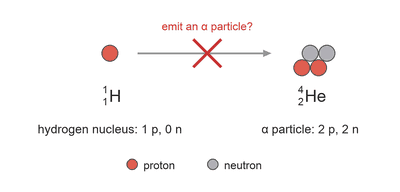
(c)
Step 5 — Least penetrating.
α radiation has the least penetrating power: a sheet of paper stops it.
Watch out: β particles are electrons from the NUCLEUS, not from the electron shells.
Therefore, (a) α = helium nuclei (2 p + 2 n), β = fast electrons, γ = electromagnetic waves (photons); (b) no, because a hydrogen nucleus has only 1 proton and no neutrons, while an α particle needs 2 protons and 2 neutrons; (c) α radiation.
- 372 marks
Question 37
An α-particle captures (i) one electron, (ii) two electrons. In each case, what does it change to ?
Solve with AIWritten solution
Solution:
Concept: An α particle is a helium nucleus with no electrons, , of charge +2e. Each electron it captures cancels one unit of this charge.
(i)
Step 1 — One electron.
With one electron its charge becomes +2e − e = +e, so it is a singly ionised helium ion, He⁺.
(ii)
Step 2 — Two electrons.
With two electrons its charge becomes zero, so it is a neutral helium atom, He.
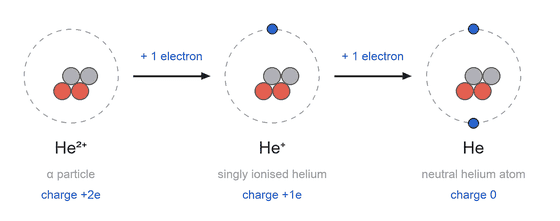
Watch out: One electron is not enough to make it neutral; it needs two.
Therefore, (i) with one electron it becomes a singly charged helium ion, He⁺, and (ii) with two electrons it becomes a neutral helium atom, He.
- 382 marks
Question 38
'Radioactivity is a nuclear phenomenon'. Comment on this statement.
Solve with AIWritten solution
Solution:
Concept: A process is nuclear if it starts in, and changes, the nucleus of the atom; it is chemical if it involves only the outer electrons.
Step 1 — Where the radiations come from.
The α, β and γ radiations are given out by the unstable nucleus, and α or β emission changes the nucleus itself (its Z and/or A), turning the atom into a new element.
Step 2 — What cannot affect it.
Radioactivity is not affected by any physical or chemical change, such as heating, cooling, pressure or chemical combination, because these affect only the outer electrons.
Step 3 — How much energy is involved.
The energy given out is of the order of MeV per nucleus, about a million times the few eV given out per atom in a chemical change.
Watch out: Do not say radioactivity changes the electrons; it changes the nucleus.
Therefore, the statement is correct: radioactivity comes from the nucleus, changes the nucleus, and is not affected by any physical or chemical change, so it is a nuclear phenomenon.
- 393 marks
Question 39
What happens to the position of an element in the periodic table when its nucleus emits (a) an α-particle, (b) a β-particle and (c) γ radiation ? Give reason for your answer.
Solve with AIWritten solution
Solution:
Concept: The position of an element in the periodic table is fixed by its atomic number Z. So follow what each emission does to Z.
(a)
Step 1 — α particle.
An α particle takes away 2 protons, so Z decreases by 2 and the element moves two places back. For example, uranium-238 becomes thorium-234.
(b)
Step 2 — β particle.
A neutron changes into a proton, so Z increases by 1 and the element moves one place forward. For example, thorium-234 becomes protactinium-234.
(c)
Step 3 — γ radiation.
γ radiation has no charge, so Z does not change and the element keeps its place; only the energy of the nucleus falls.
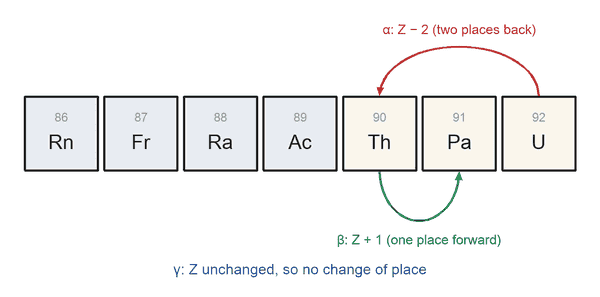
Watch out: β emission moves the element FORWARD (Z rises), even though a negative particle leaves.
Therefore, (a) α emission moves the element two places back, (b) β emission one place forward, and (c) γ emission causes no change of place.
- 403 marks
Question 40
What changes occur in the nucleus of a radioactive element when it emits (a) an alpha particle, (b) a beta particle, (c) gamma radiation ? Give one example, in each case (a) and (b) in support of your answer.
Solve with AIWritten solution
Solution:
Concept: In every nuclear change the total mass number (A) and the total atomic number (Z) are the same on both sides of the equation. An α particle is , a β particle is , a neutron is and γ radiation has A = 0 and Z = 0.
(a)
Step 1 — Alpha particle.
The nucleus throws out 2 protons and 2 neutrons together, so its mass number decreases by 4 and its atomic number by 2: a new element is formed. For example:
The totals balance on both sides.
(b)
Step 2 — Beta particle.
A neutron inside the nucleus changes into a proton and an electron, and the electron is emitted. The atomic number increases by 1 and the mass number stays the same. For example:
The totals balance on both sides.
(c)
Step 3 — Gamma radiation.
The nucleus passes from an excited state to a lower energy state and gives out the extra energy as γ radiation. Its atomic number and mass number do not change.
Watch out: After α or β emission the element changes; after γ emission it does not.
Therefore, (a) α emission lowers A by 4 and Z by 2, (b) β emission keeps A and raises Z by 1 (a neutron becomes a proton), and (c) γ emission changes neither, only the energy of the nucleus.
- 412 marks
Question 41
A nucleus emits 2 α particles and 1 β particle to form a nucleus . Find the atomic number and mass number of X.
Solve with AIWritten solution
Solution:
Concept: In every nuclear change the total mass number (A) and the total atomic number (Z) are the same on both sides of the equation. An α particle is , a β particle is , a neutron is and γ radiation has A = 0 and Z = 0.
Given: emits 2 α particles and 1 β particle and forms .
Step 1 — Write the overall change.
X gives out two α particles and one β particle and becomes R, so all of these together must balance X.
Step 2 — Balance the mass numbers.
The mass number of X equals the total of the mass numbers on the right.
Step 3 — Balance the atomic numbers.
The atomic number of X equals the total of the atomic numbers on the right.
Check: Two α emissions take (230, 88) to (222, 84), and the β emission then raises Z to 85 with A = 222, which is R.

Watch out: The β particle counts as −1 in the atomic-number total, so it LOWERS the sum for X by 1.
Therefore, X has atomic number 88 and mass number 230 ().
- 422 marks
Question 42
What are radio isotopes ? Give one example of a radio isotope. State one use of radio isotopes.
Solve with AIWritten solution
Solution:
Concept: Some isotopes of an element have an unstable nucleus (usually with too many neutrons for its protons), so they are radioactive.
Step 1 — Define radio isotopes.
Radio isotopes are isotopes of elements whose nuclei are unstable and so emit α, β or γ radiations. Some occur in nature and others are made artificially in nuclear reactors.
Step 2 — Give an example.
Cobalt-60, , is a radio isotope (carbon-14 and iodine-131 are others).
Step 3 — State a use.
The γ radiation from cobalt-60 is used in radiotherapy to destroy cancer cells. (Other uses: radio-iodine as a tracer for the thyroid gland, and carbon-14 for carbon dating.)
Watch out: A radio isotope behaves chemically like the stable isotope of the same element; only its nucleus is unstable.
Therefore, radio isotopes are radioactive isotopes of elements, for example cobalt-60, which is used in the treatment of cancer.
- 432 marks
Question 43
Why are the alpha particles not used in radio therapy ?
[Hint : alpha particles cannot penetrate the human skin]
Solve with AIWritten solution
Solution:
Concept: In radiotherapy radiation is aimed at a tumour inside the body to destroy its cells, so the radiation must pass through the skin and the tissue above the tumour.
Step 1 — Recall the penetrating power of α.
α particles have the least penetrating power: a sheet of paper, or the outer dead layer of the skin, stops them.
Step 2 — Apply it to radiotherapy.
So α particles from outside the body cannot reach a tumour inside it; all their energy would be given to the skin, damaging it without treating the tumour.
Step 3 — Name what is used instead.
Radiotherapy therefore uses the highly penetrating γ radiation, for example from cobalt-60.
Watch out: The reason is penetration; α particles are not 'too weak', they ionise strongly but stop at the surface.
Therefore, α particles are not used in radiotherapy because they cannot penetrate the skin to reach the tumour inside the body.
- 442 marks
Question 44
When does the nucleus of an atom tend to become radioactive ?
Solve with AIWritten solution
Solution:
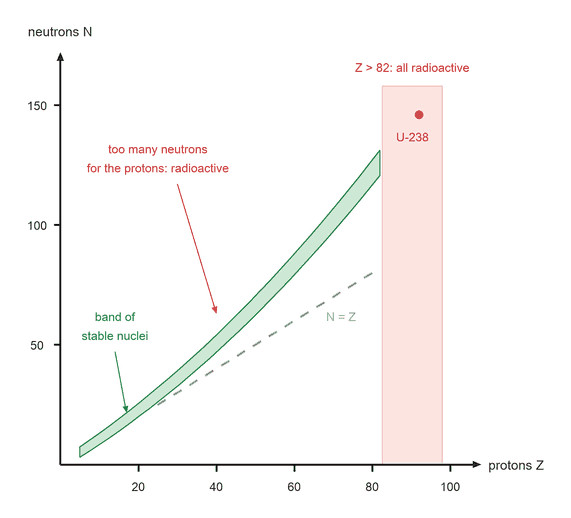
Concept: A nucleus is stable only when its numbers of neutrons and protons are suitably balanced. Light stable nuclei have about as many neutrons as protons; heavier stable nuclei need somewhat more neutrons than protons, up to lead (Z = 82).
Step 1 — Too many neutrons.
A nucleus tends to become radioactive when it has too many neutrons for its number of protons. Carbon-14, with 8 neutrons and 6 protons, is an example among light elements.
Step 2 — Too heavy.
A nucleus also becomes unstable when it is very heavy. All nuclei with atomic number more than 82 are radioactive; uranium-238, for example, has 146 neutrons to 92 protons.
Step 3 — What happens then.
Such a nucleus emits α or β particles (with γ radiation) until a stable nucleus is formed.
Watch out: Being heavy is not the only cause; a light nucleus such as carbon-14 is radioactive because of its extra neutrons.
Therefore, a nucleus tends to become radioactive when the number of neutrons in it is much more than the number of protons, as in all heavy nuclei with atomic number more than 82.
- 452 marks
Question 45
State the medical use of radioactivity.
Solve with AIWritten solution
Solution:
Concept: In medicine, radio isotopes are used either to destroy harmful cells or to trace what happens inside the body; their radiation can also kill germs.
Step 1 — Radiotherapy.
Cancer is treated with radiation: γ rays from cobalt-60 are aimed at a tumour to kill its cells.
Step 2 — Tracers for diagnosis.
Small amounts of radio isotopes such as radio-iodine and radio-sodium are put into the body, and a detector outside follows their radiation to find tumours or blood clots, or to check how the thyroid gland or the blood circulation works.
Step 3 — Sterilisation.
γ rays are used to sterilise syringes, bandages and other medical equipment by killing germs.
Watch out: Only small, controlled doses are used, because the same radiation also harms healthy cells.
Therefore, radioactivity is used in medicine to treat cancer (radiotherapy), to detect diseases with tracers, and to sterilise medical equipment.
- 462 marks
Question 46
Arrange the α, β and γ radiation in ascending order of their biological damage. Give reason.
Solve with AIWritten solution
Solution:
Concept: For a source outside the body, the damage a radiation does inside the body depends on how deep it can penetrate into it.
Step 1 — α radiation.
α particles are stopped by the skin, so they cause the least damage to the body.
Step 2 — β radiation.
β particles can pass through the skin into the tissue below, so they cause more damage.
Step 3 — γ radiation.
γ radiation has the highest penetrating power: it passes right through the body and can damage the internal organs, so it causes the most damage.
Step 4 — Write the order.
Putting these together in ascending order:
Watch out: This order is for a source OUTSIDE the body; an α source taken INSIDE the body is the most harmful, because α ionises the most.
Therefore, in ascending order of biological damage the order is α < β < γ, because their penetrating power increases in the same order.
- 473 marks
Question 47
Name two main sources of nuclear radiations. How are the nuclear radiations harmful ?
Solve with AIWritten solution
Solution:
Concept: Nuclear radiations are harmful because they ionise the atoms and molecules of the living cells they pass through.
Step 1 — Natural source.
Background radiation: cosmic rays from outer space and radiation from radioactive elements in rocks, soil and the air (such as radon gas).
Step 2 — Man-made source.
Nuclear reactors and power plants (leaks, accidents and nuclear waste), the fall-out from nuclear explosions, and radio isotopes used in hospitals and industry.
Step 3 — How they harm.
Ionisation damages or kills the cells and can change their genes. The effects are of three kinds:
- short-term (recoverable): nausea, diarrhoea, sore throat and loss of hair;
- long-term (irrecoverable): leukaemia and cancer;
- genetic: changes (mutations) in the genes, which appear in later generations.
Watch out: The harm comes from ionisation inside the cells, so even an invisible, painless dose can do damage.
Therefore, the two main sources are natural background radiation (cosmic rays, radioactive rocks) and man-made sources (nuclear power plants and their waste, nuclear explosions); they are harmful because they ionise living cells, causing short-term, long-term (cancer) and genetic damage.
- 482 marks
Question 48
State two safety measures to be taken while establishing a nuclear power plant.
Solve with AIWritten solution
Solution:
Concept: A nuclear power plant must keep all its radiation inside, even if something goes wrong.
Step 1 — Shield and contain the reactor.
The reactor must be shielded with thick lead, steel and concrete walls and housed in an airtight, strong concrete building that can withstand earthquakes, fires and explosions, so that no radiation leaks out.
Step 2 — Provide back-up cooling.
There must be a back-up cooling system for the reactor core, so that if one system fails the core is still kept from overheating and melting.
Step 3 — Choose a safe site.
The plant should be built away from thickly populated areas, so that people are exposed as little as possible if an accident does happen.
Therefore, two safety measures are: shield the reactor in a strong, airtight concrete building that no radiation can escape from, and provide a back-up cooling system for the core.
- 492 marks
Question 49
What is meant by nuclear waste ? State one way for the safe disposal of nuclear waste.
Solve with AIWritten solution
Solution:
Concept: Nuclear waste keeps giving out harmful radiation for a very long time, so it must be kept away from people and the environment.
Step 1 — Define nuclear waste.
Nuclear waste is the radioactive material left after use, for example the used fuel rods of nuclear reactors and the radioactive leftovers from laboratories, hospitals and research centres. It cannot be thrown away openly, because it would contaminate soil, water and air.
Step 2 — State a safe way of disposal.
The waste is sealed in thick, strong containers (casks), which are buried deep underground in specially built stores, far from populated areas.
Therefore, nuclear waste is the radioactive material left over after use; it is disposed of safely by sealing it in thick casks and burying them deep underground, far from people.
- 503 marks
Question 50
State three safety precautions that you would take while handling the radioactive substances.
Solve with AIWritten solution
Solution:
Concept: Keep the radiation away from the body: put a shield in between, keep a distance, and measure the dose received.
Step 1 — Use shielding.
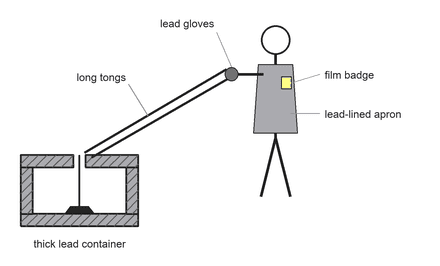
Wear lead-lined aprons and lead gloves, and store the substance in a thick lead container with a narrow opening.
Step 2 — Keep a distance.
Never touch the substance; handle it only with long-handled tongs.
Step 3 — Measure the dose.
Wear a film badge (dosimeter), check it regularly, and make sure no one is exposed beyond the safe limit.
Therefore, three precautions are: wear lead-lined aprons and gloves, handle the substance only with long tongs and keep it in a thick lead container, and wear a film badge to check the radiation received.
- 511 mark
Question 51
Why should a radioactive substance not be touched by hand ?
Solve with AIWritten solution
Solution:
Concept: At very close range all the radiations from a radioactive substance reach the skin, and α and β particles ionise strongly.
Step 1 — See what the radiations do.
A radioactive substance keeps giving out radiation. Held in the hand, its radiations, especially the strongly ionising α and β particles, can burn and damage the skin cells and may cause cancer.
Step 2 — See the extra danger.
Some of the substance can stick to the hand and later get into the body, where it goes on damaging cells from inside.
Therefore, a radioactive substance should not be touched by hand because its radiation can burn and damage the skin and cause cancer; it must be handled with long tongs and lead gloves.
- 523 marks
Question 52
What do you mean by background radiations ? Name its two sources. Is it possible for us to keep ourselves away from it ?
Solve with AIWritten solution
Solution:
Concept: Some radiation is always present around us and even inside us, from natural sources, even when no radioactive source is in sight.
Step 1 — Define background radiation.
Background radiation is the radiation to which we are all exposed all the time, even when there is no visible radioactive source near us.
Step 2 — Name its two sources.
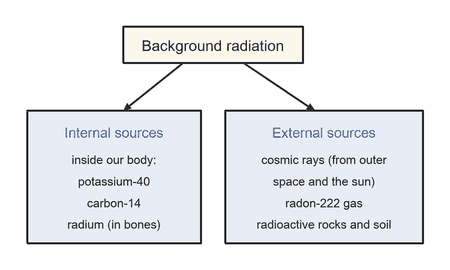
It comes from internal sources, the radio isotopes inside our own body such as potassium-40, carbon-14 and traces of radium, and from external sources, the cosmic rays from outer space and the sun, radon-222 gas, and radioactive elements in rocks and soil.
Step 3 — Decide whether we can avoid it.
No, we cannot. It is present everywhere, even inside our bodies. Its dose is small and within the safe limit, so it does not normally harm us.
Therefore, background radiation is the radiation always present around us; its sources are internal (potassium-40, carbon-14 in our body) and external (cosmic rays, radon-222, radioactive rocks), and we cannot keep away from it.
- 534 marks
Question 53
What is nucleus of an atom ? Compare its size with that of the atom. Name its constitutents. How is the number of these constituents determined by the atomic number and mass number of the atom ?
Solve with AIWritten solution
Solution:
Concept: Almost all the mass of an atom is in its tiny central nucleus, made of protons and neutrons; the electrons move in the large, mostly empty space around it.
Step 1 — Say what the nucleus is.
The nucleus is the tiny, dense, positively charged central part of an atom, in which nearly the whole mass of the atom is concentrated.
Step 2 — Compare its size with the atom.
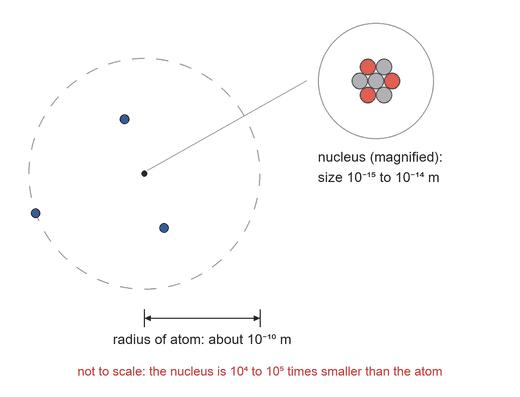
The nucleus is of the order of 10⁻¹⁵ m to 10⁻¹⁴ m across, while the atom is of the order of 10⁻¹⁰ m. Dividing the two sizes shows how many times smaller the nucleus is.
So the nucleus is about 10⁴ to 10⁵ times smaller than the atom, and most of the atom is empty space.
Step 3 — Name its constituents.
The nucleus is made of protons (positive) and neutrons (no charge), together called nucleons.
Step 4 — Find their numbers from Z and A.
For an atom , the atomic number gives the protons and the mass number gives all the nucleons, so the neutrons are the difference.
For example, has 11 protons and 23 − 11 = 12 neutrons.
Watch out: The mass number is not the number of neutrons; subtract Z from it.
Therefore, the nucleus is the tiny, dense, positive centre of the atom, about 10⁴ to 10⁵ times smaller than the atom; it is made of protons and neutrons, with protons = Z and neutrons = A − Z.
- 544 marks
Question 54
A radioactive source emits three type of radiations.
(a) Name the three radiations.
(b) Name the radiations which are deflected by the electric field.
(c) Name the radiation which is most penetrating.
(d) Name the radiation which travels with the speed of light.
(e) Name the radiation which has the highest ionising power.
(f) Name the radiation consisting of the same kind of particles as the cathode rays.
Solve with AIWritten solution
Solution:
Concept: α particles are helium nuclei (charge +2e, about 4 times the mass of a proton); β particles are fast electrons (charge −e); γ radiation is an electromagnetic wave with no charge and no mass. α ionises the most and penetrates the least; γ ionises the least and penetrates the most.
(a)
Step 1 — Name the radiations.
A radioactive source gives out alpha (α), beta (β) and gamma (γ) radiations.
(b)
Step 2 — Deflected by an electric field.
α and β radiations are charged, so the field deflects them: α bends towards the negative plate and β towards the positive plate. γ is not deflected.
(c)
Step 3 — Most penetrating.
γ radiation is the most penetrating; only several centimetres of lead can stop most of it.
(d)
Step 4 — Speed of light.
γ radiation travels at the speed of light, 3 × 10⁸ m s⁻¹, because it is an electromagnetic wave.
(e)
Step 5 — Highest ionising power.
α radiation ionises the most (about 10,000 times as much as γ), because its particles are heavy and doubly charged.
(f)
Step 6 — Same particles as cathode rays.
β radiation, like cathode rays, is a stream of electrons. (β particles come from the nucleus, while cathode rays are electrons given out by the cathode of a discharge tube.)
Watch out: The most penetrating radiation (γ) is the least ionising, and the most ionising (α) the least penetrating.
Therefore, (a) α, β and γ; (b) α and β; (c) γ; (d) γ; (e) α; (f) β.
- 555 marks
Question 55
A radioactive source emits three type of radiations.
(a) Name the radiation of zero mass.
(b) Name the radiation which has the lowest ionising power.
(c) Name the radiation which has the lowest penetrating power.
(d) Give the charge and mass of particles composing the radiation in part (c).
(e) When the particle referred to in part (c) becomes neutral, it is found to be the atom of a rare gas. Name this rare gas and draw a model of its neutral atom.
(f) From which part of the atom do these radiations come ?
Solve with AIWritten solution
Solution:
Concept: α particles are helium nuclei (charge +2e, about 4 times the mass of a proton); β particles are fast electrons (charge −e); γ radiation is an electromagnetic wave with no charge and no mass. α ionises the most and penetrates the least; γ ionises the least and penetrates the most.
(a)
Step 1 — Zero mass.
γ radiation, an electromagnetic wave, has zero mass.
(b)
Step 2 — Lowest ionising power.
γ radiation, which has no charge, has the lowest ionising power.
(c)
Step 3 — Lowest penetrating power.
α radiation has the lowest penetrating power: a sheet of paper stops it.
(d)
Step 4 — Charge and mass of an α particle.
An α particle is a helium nucleus of 2 protons and 2 neutrons. Its charge is that of 2 protons, and its mass is about 4 times that of a proton.
(e)
Step 5 — The rare gas.
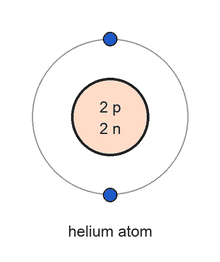
An α particle that picks up 2 electrons becomes a neutral helium atom, so the rare gas is helium. Its model has a nucleus of 2 protons and 2 neutrons, with 2 electrons in the K shell.
(f)
Step 6 — Where they come from.
All three radiations come from the nucleus of the atom.
Watch out: (c) asks about penetrating power, which is lowest for α, even though α ionises the most.
Therefore, (a) γ, (b) γ, (c) α, (d) charge +2e = +3.2 × 10⁻¹⁹ C and mass about 4 proton masses ≈ 6.68 × 10⁻²⁷ kg, (e) helium, (f) the nucleus.
- 564 marks
Question 56
The diagram in Fig. 12.7 shows a radioactive source S placed in a thick lead walled container. The radiations given out are allowed to pass through a magnetic field. The magnetic field (shown as ×) acts perpendicular to the plane of paper inwards. Arrows show the paths of the radiations A, B and C.
(a) Name the radiations labelled A, B and C.
(b) Explain clearly how you used the diagram to arrive at the answer in part (a).
 Solve with AI
Written solution
Solution:
Concept: A magnetic field deflects only charged particles. The direction of the force is given by Fleming's left hand rule: stretch the forefinger, central finger and thumb of the left hand at right angles; with the forefinger along the field and the central finger along the current, the thumb gives the force. For a given push, a lighter particle is deflected more.
(a)
Step 1 — Name the radiations.
From the paths in Fig. 12.7: A is γ radiation, B is α radiation and C is β radiation.

(b)
Step 2 — Use the straight path.
A goes straight on, undeflected, so it carries no charge. It must be γ radiation.
Step 3 — Find the direction of the force on a positive charge.
The radiations move up the page and the field points into the page. For a positive charge the current is along its motion, upwards. With the forefinger into the page and the central finger up the page, the thumb of the left hand points to the left. B bends to the left, so it is positively charged: α.
Step 4 — Use the opposite bend.
C bends the opposite way, to the right, so it is negatively charged: β. C also bends much more sharply than B, as expected, because a β particle (an electron) is about 7300 times lighter than an α particle.
Watch out: For a negative particle the 'current' in Fleming's rule points OPPOSITE to its motion.
Therefore, (a) A is γ radiation, B is α radiation and C is β radiation; (b) A is undeflected (no charge), B bends left (positive, by Fleming's left hand rule) and only slightly (heavy), and C bends right (negative) and sharply (very light).
- 574 marks
Question 57
Fig. 12.8 shows a mixed source R of alpha and beta particles in a thick lead walled container. The particles pass through a magnetic field in a direction perpendicular to the plane of paper inwards as shown by ×. (a) Show in the diagram how the particles get affected. (b) Name the law used in part (a).
[Hint : alpha particles will deflect to the left while beta particles to the right]
 Solve with AI
Written solution
Solution:
Concept: A charged particle moving across a magnetic field feels a force at right angles to both the field and its motion, given by Fleming's left hand rule. Opposite charges are pushed opposite ways, and a lighter particle is deflected more.
(a)
Step 1 — Draw the paths.
The α particles (positive) bend slightly to the left, because they are heavy; the β particles (negative) bend sharply to the right, because they are very light. Both paths are curved (arcs of circles), because the magnetic force always acts at right angles to the motion.
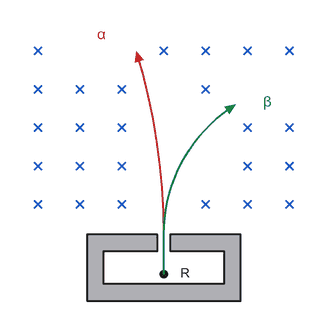
(b)
Step 2 — Name the law.
The law used is Fleming's left hand rule.
Step 3 — Apply it to α.
The forefinger points along the field (into the page) and the central finger along the current, which for the positive α particles is upwards, the way they move. The thumb then points to the left, so α bends left.
Step 4 — Apply it to β.
For the negative β particles the current is opposite to their motion, that is downwards, so the thumb points to the right and β bends right.

Watch out: The β path bends more sharply than the α path; do not draw them as mirror images.
Therefore, (a) α particles are deflected slightly to the left and β particles sharply to the right, and (b) the law used is Fleming's left hand rule.
- 585 marks
Question 58
Fig. 12.9 shows a radioactive source S in a thick lead walled container having a narrow opening. The radiations pass through an electric field between the plates A and B.
(a) Complete the diagram to show the paths of α, β and γ radiations.
(b) Why is the source S kept in a thick lead walled container with a narrow opening ?
(c) Name the radiation which is unaffected by the electrostatic field.
(d) Which radiation is defleced the most. Give reason.
(e) Which among the three radiations causes the least biological damage?
[Hint : α radiations will deflect towards the negative plate, β radiations towards the positive plate and γ radiations remain undeflected (c) γ radiation (d) beta, because of its low mass (e) alpha radiation]
 Solve with AI
Written solution
Solution:
Concept: An electric field pulls a positive charge towards the negative plate and a negative charge towards the positive plate; uncharged radiation goes straight on. For the same kind of push, a lighter particle is deflected more.
(a)
Step 1 — Complete the diagram.
Between the plates, α (positive) bends slightly towards the negative plate B, β (negative) bends more sharply towards the positive plate A, and γ (no charge) goes straight on. The paths are straight below the plates, where there is no field.

(b)
Step 2 — Why a thick lead container with a narrow opening.
The thick lead walls absorb the radiations that strike them, so they cannot escape in other directions and harm people nearby. The narrow opening lets out only a fine beam in one direction, so that the paths in the field can be seen clearly.
(c)
Step 3 — Unaffected radiation.
γ radiation is unaffected by the electrostatic field, because it has no charge.
(d)
Step 4 — Most deflected radiation.
β radiation is deflected the most, because a β particle (an electron) has a very small mass, about 1/7300 of that of an α particle. So the electric force gives it a much larger deflection.
(e)
Step 5 — Least biological damage.
α radiation causes the least biological damage from a source outside the body, because it has the least penetrating power and cannot get through the skin.
Watch out: α goes towards the NEGATIVE plate (opposite charges attract), β towards the positive plate.
Therefore, (a) α bends towards B (−), β bends more towards A (+), γ goes straight; (b) the lead absorbs stray radiation and the narrow opening gives a fine beam; (c) γ; (d) β, because of its very small mass; (e) α.
- 594 marks
Question 59
State following four properties each of α, β and γ radiations : (a) nature, (b) charge, (c) mass, and (d) effect of electric field.
Solve with AIWritten solution
Solution:
Concept: All four properties follow from what each radiation is: a helium nucleus (α), an electron (β) or an electromagnetic wave (γ).
Step 1 — Collect the properties.
The table lists the four properties for each radiation.
Property α radiation β radiation γ radiation (a) Nature stream of helium nuclei, stream of fast electrons from the nucleus electromagnetic waves (photons) (b) Charge +2e ( C) −e ( C) no charge (c) Mass about 4 times the mass of a proton, kg mass of an electron, kg zero (d) Effect of electric field deflected slightly, towards the negative plate deflected more, towards the positive plate not deflected Step 2 — See why the field acts as it does.
The field pushes positive α towards the negative plate and negative β towards the positive plate; uncharged γ goes straight. The very light β particle is deflected the most.
Watch out: The charge of an α particle is +2e, not +e: it has two protons.
Therefore, α: helium nuclei, +2e, about 4 proton masses, deflected slightly to the − plate; β: fast electrons, −e, 9.1 × 10⁻³¹ kg, deflected more to the + plate; γ: electromagnetic waves, no charge, no mass, not deflected.
- 604 marks
Question 60
How are γ radiations produced ? Mention two common properties of the gamma radiations and visible light.
Solve with AIWritten solution
Solution:
Concept: γ radiation is extra energy given out by a nucleus; it is an electromagnetic wave like light, only of much shorter wavelength.
Step 1 — Explain how γ radiation is produced.
After a nucleus gives out an α or a β particle, the daughter nucleus is often left in an excited (higher energy) state. When it drops to its lower energy state, it gives out the extra energy as γ radiation. Its atomic number and mass number do not change.
Step 2 — First common property.
Both γ radiation and visible light are electromagnetic waves, so both travel at the speed of light, 3 × 10⁸ m s⁻¹, in vacuum.
Step 3 — Second common property.
Both carry no charge, so neither is deflected by an electric or a magnetic field. (Both also affect a photographic plate.)
Watch out: γ radiation does not change the element; it only carries away energy.
Therefore, γ radiation is produced when an excited nucleus falls to a lower energy state; like visible light it is an electromagnetic wave travelling at 3 × 10⁸ m s⁻¹ and it is not deflected by electric or magnetic fields.
- 614 marks
Question 61
What kind of change takes place in a nucleus when a β-particle is emitted ? Express it by an equation. State whether (a) atomic number, and (b) mass number are conserved in a radioactive β-decay ?
Solve with AIWritten solution
Solution:
Concept: In β emission a neutron inside the nucleus changes into a proton and an electron, and the electron is thrown out. So A stays the same and Z rises by 1: a new element, one place forward in the periodic table.
Step 1 — Describe the change inside the nucleus.
In β decay a neutron inside the nucleus changes into a proton and an electron. The proton stays in the nucleus and the electron is thrown out as the β particle.
Step 2 — Write the equation for the whole nucleus.
The nucleus keeps its mass number and gains one in atomic number, becoming a new element Y.
For example:
(a)
Step 3 — Atomic number.
The atomic number of the nucleus is not conserved: it rises from Z to Z + 1, so a new element is formed. (The total charge is still balanced, because the β particle carries −1.)
(b)
Step 4 — Mass number.
The mass number is conserved: one neutron has become one proton, so the number of nucleons stays A.
Watch out: The nucleus GAINS a proton in β decay; the electron is created at the moment of decay, not stored in the nucleus.
Therefore, in β decay a neutron changes into a proton and an electron (emitted), ; (a) the atomic number of the nucleus is not conserved (it rises by 1), and (b) the mass number is conserved.
- 624 marks
Question 62
(a) An atomic nucleus A is composed of 84 protons and 128 neutrons. The nucleus A emits an α-particle and is transformed into a nucleus B. What is the composition of B ?
(b) The nucleus B emits a β-particle and is transformed into a nucleus C. What is the composition of C ?
(c) What is the mass number of the nucleus A ?
(d) Does the composition of nucleus C change if it emits the γ radiation ?
Solve with AIWritten solution
Solution:
Concept: An α particle takes away 2 protons and 2 neutrons. In β emission one neutron changes into a proton. γ emission removes only energy.
(a)
Step 1 — Composition of B.
The α particle takes 2 protons and 2 neutrons from A.
(b)
Step 2 — Composition of C.
In β emission one neutron of B turns into a proton.
(c)
Step 3 — Mass number of A.
The mass number is the total number of nucleons.
(d)
Step 4 — Effect of γ emission.
γ radiation has no charge and no mass, so emitting it only lowers the energy of the nucleus; C still has 83 protons and 125 neutrons.
Check: Writing the two decays as equations, both totals balance.
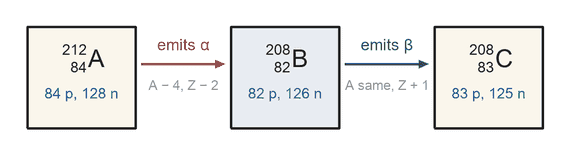
Watch out: In β emission the number of neutrons FALLS by 1 while the protons rise by 1.
Therefore, (a) B has 82 protons and 126 neutrons, (b) C has 83 protons and 125 neutrons, (c) the mass number of A is 212, and (d) no, γ emission does not change the composition of C.
- 634 marks
Question 63
A certain nucleus A (mass number 238 and atomic number 92) is radioactive and becomes a nucleus B (mass number 234 and atomic number 90) by the emission of a particle.
(a) Name the particle emitted.
(b) Explain how you arrived at your answer.
(c) State the change in the form of a reaction.
Solve with AIWritten solution
Solution:
Concept: In every nuclear change the total mass number (A) and the total atomic number (Z) are the same on both sides of the equation. An α particle is , a β particle is , a neutron is and γ radiation has A = 0 and Z = 0.
(a)
Step 1 — Name the particle.
The particle emitted is an alpha (α) particle.
(b)
Step 2 — Find the particle's numbers.
The particle must carry away the difference in mass number and in atomic number between A and B.
A particle with mass number 4 and atomic number 2 is a helium nucleus, , that is, an α particle.
(c)
Step 3 — Write the reaction.
The change is written with both totals balanced (238 = 234 + 4 and 92 = 90 + 2).

Watch out: A fall of 4 in A together with a fall of 2 in Z is the signature of α emission.
Therefore, (a) an α particle is emitted, (b) because the mass number falls by 4 and the atomic number by 2, and (c) .
- 644 marks
Question 64
A nucleus is β-radioactive.
(a) What are the numbers 24 and 11 called ?
(b) Write the equation representing β-decay.
(c) What general name is given to the product nucleus with respect to ?
Solve with AIWritten solution
Solution:
Concept: In β emission a neutron inside the nucleus changes into a proton and an electron, and the electron is thrown out. So A stays the same and Z rises by 1: a new element, one place forward in the periodic table.
(a)
Step 1 — Name the numbers.
In , 24 is the mass number (the number of nucleons) and 11 is the atomic number (the number of protons).
(b)
Step 2 — Write the β decay.
β emission keeps the mass number 24 and raises the atomic number from 11 to 12, which is magnesium.
Both totals balance.

(c)
Step 3 — Name the product.
Magnesium-24 has the same mass number as sodium-24 but a different atomic number, so it is an isobar of sodium-24.
Watch out: β decay always gives an ISOBAR of the parent (same A), never an isotope.
Therefore, (a) 24 is the mass number and 11 the atomic number, (b) , and (c) the product is an isobar of sodium-24.
- 654 marks
Question 65
A nucleus of stable phosphorus has 15 protons and 16 neutrons.
(a) What is its atomic number and mass number ?
(b) The nucleus of radio phosphorus has one neutron more than the stable nucleus. What will be its atomic number and mass number ?
(c) What will be the atomic number and mass number of new nucleus formed by the decay of a β–particle by the radio phosporus in part (b) ?
Solve with AIWritten solution
Solution:
Concept: An atom has a tiny nucleus of protons and neutrons (together called nucleons) with electrons outside it. The atomic number Z is the number of protons; the mass number A is the number of nucleons (protons + neutrons). So the number of neutrons is A − Z, and a neutral atom has Z electrons. In β emission a neutron inside the nucleus changes into a proton and an electron, and the electron is thrown out. So A stays the same and Z rises by 1: a new element, one place forward in the periodic table.
(a)
Step 1 — Stable phosphorus.
The atomic number is the number of protons, and the mass number is protons + neutrons.
(b)
Step 2 — Radio phosphorus.
It has one neutron more, that is 17 neutrons, with the same 15 protons.
It is an isotope of stable phosphorus.
(c)
Step 3 — After β decay.
β emission raises the atomic number by 1 and keeps the mass number, which gives sulphur.
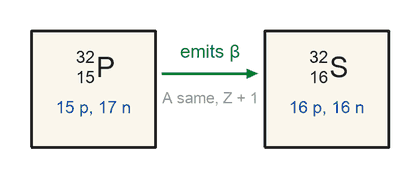
Watch out: The extra neutron changes A, not Z; isotopes keep the same atomic number.
Therefore, (a) Z = 15 and A = 31, (b) Z = 15 and A = 32, and (c) Z = 16 and A = 32 (sulphur-32).
- 664 marks
Question 66
An element P disintegrates by α emission and the new element suffers two further disintegrations, both by β emission, to form an element Q. Explain the fact that P and Q are isotopes.
Solve with AIWritten solution
Solution:
Concept: Isotopes have the same atomic number Z but different mass numbers A (same element, different numbers of neutrons). Isobars have the same A but different Z (different elements). Isotones have the same number of neutrons (A − Z) but different Z. Emitting an α particle lowers A by 4 and Z by 2; emitting a β particle keeps A and raises Z by 1 (a neutron turns into a proton); emitting γ radiation changes neither.
Step 1 — Follow the three emissions.
Let P be . The α emission gives A − 4 and Z − 2; each β emission then raises Z by 1 and keeps A.
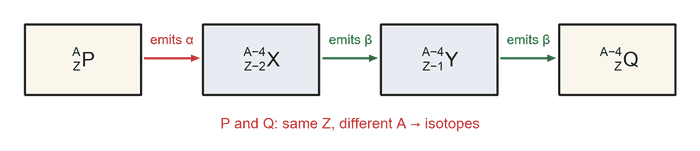
Step 2 — Compare the atomic numbers.
The α emission lowers the atomic number by 2, and the two β emissions raise it by 1 each, so Q is back at Z, the same as P.
Step 3 — Compare the mass numbers.
The mass number falls by 4 in the α emission and does not change in the β emissions, so Q has mass number A − 4, which is different from P's.
Watch out: Having the same atomic number makes P and Q the SAME element, even though they were reached by a chain of decays.
Therefore, P and Q have the same atomic number Z but different mass numbers (A and A − 4), so they are isotopes.
- 671 mark
Question 67
1 amu is equivalent to :
Solve with AIAnswer
(A) 931 eV
(B) 9.31 MeV
- Correct
(C) 931 MeV
(D) 931 keV
Answer: (C) 931 MeV
Concept: Einstein's mass–energy relation E = (Δm)c² says that a mass Δm that disappears in a nuclear change reappears as energy E, where c = 3 × 10⁸ m s⁻¹ is the speed of light. In atomic units, a mass of 1 a.m.u. is equivalent to 931 MeV.
Step 1 — Write the mass of one atomic mass unit.
One atomic mass unit is 1/12 of the mass of a carbon-12 atom.
Step 2 — Convert it into energy in joule.
Put this mass and the speed of light, 3 × 10⁸ m s⁻¹, into E = (Δm)c².
Step 3 — Convert joule into MeV.
One MeV is 1.6 × 10⁻¹³ J, so divide by this.
With the rounded constants this comes to about 934 MeV; with the exact values of the constants it is 931.5 MeV, which is the standard value of about 931 MeV.
Watch out: MeV means a million electron volt; a misplaced power of ten gives the wrong options.
Why the other options are wrong:
- (A) 931 eV: 931 eV is a million times too small, because 1 MeV is 10⁶ eV.
- (B) 9.31 MeV: 9.31 MeV is 100 times too small; the decimal point is in the wrong place.
- (D) 931 keV: 931 keV is a thousand times too small, because 1 MeV is 1000 keV.
Therefore, 1 a.m.u. is equivalent to 931 MeV, option (C).
- 681 mark
Question 68
The mass of an electron is :
Solve with AIAnswer
(A)
(B)
(C)
- Correct
(D)
Answer: (D)
Concept: The electron is by far the lightest particle in an atom: a proton or a neutron is about 1840 times heavier than an electron.
Step 1 — Recall the masses of the three particles.
The book gives these values.
Particle Mass in kg Mass in a.m.u. electron 0.00055 proton 1.00727 neutron 1.00865 Step 2 — Pick the electron's mass.
The electron's mass is the smallest of the three, 9.1 × 10⁻³¹ kg.
Watch out: Two of the options copy the proton's and the neutron's figures with the wrong power of ten.
Why the other options are wrong:
- (A) : 1.6725 × 10⁻²⁷ kg is the mass of a proton, not of an electron.
- (B) : It uses the proton's figure, 1.6725, with the wrong power of ten; no particle has this mass.
- (C) : It uses the neutron's figure, 1.6748, with the wrong power of ten; no particle has this mass.
Therefore, the mass of an electron is 9.1 × 10⁻³¹ kg, option (D).
- 691 mark
Question 69
The particle used in nuclear fission for bombardment is :
Solve with AIAnswer
(A) α particle
(B) proton
(C) β particle
- Correct
(D) neutron
Answer: (D) neutron
Concept: To cause fission, the bombarding particle must get inside a heavy nucleus. The nucleus is positively charged, so it repels every positive particle that comes near it.
Step 1 — Look at the charge of each particle.
α particles (+2e) and protons (+e) are positive, so the uranium nucleus repels them; a β particle is a light electron; a neutron has no charge.
Step 2 — Choose the particle that can enter.
A neutron feels no repulsion, so even a slow neutron can enter a nucleus and make it split. That is why fission is started with neutrons.
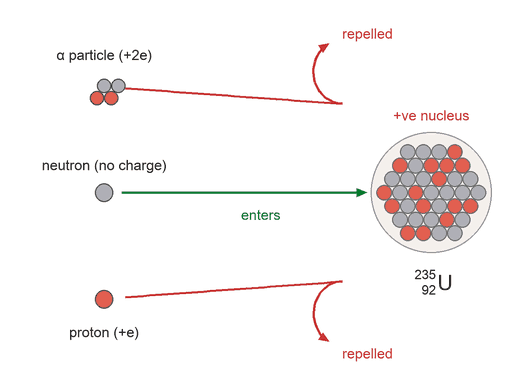
Watch out: A slow neutron is better than a fast one for U-235: it stays near the nucleus longer and is captured more easily.
Why the other options are wrong:
- (A) α particle: An α particle carries a charge of +2e, so the strong repulsion of the nucleus turns it away.
- (B) proton: A proton carries a charge of +e and is also repelled by the nucleus.
- (C) β particle: A β particle is a light electron; it is not used to split heavy nuclei.
Therefore, the particle used for bombardment in nuclear fission is the neutron, option (D).
- 701 mark
Question 70
According to the mass energy equivalence :
Solve with AIAnswer
- Correct
(A)
(B)
(C)
(D)
Answer: (A)
Concept: Einstein's mass–energy relation E = (Δm)c² says that a mass Δm that disappears in a nuclear change reappears as energy E, where c = 3 × 10⁸ m s⁻¹ is the speed of light. In atomic units, a mass of 1 a.m.u. is equivalent to 931 MeV.
Step 1 — Write the relation.
When a mass Δm disappears in a nuclear change, the energy produced is the mass multiplied by the square of the speed of light.
Step 2 — Check the unit.
Mass (kg) times speed squared (m² s⁻²) gives kg m² s⁻², which is the joule, the unit of energy.
Step 3 — See how large it is.
Because c² is huge, a small mass gives a lot of energy: 1 kg gives 9 × 10¹⁶ J.
Watch out: C is SQUARED and MULTIPLIES the mass.
Why the other options are wrong:
- (B) : This has the unit kg m s⁻¹, that of momentum, not of energy.
- (C) : It divides by c² instead of multiplying, so its unit is kg s² m⁻², not the joule.
- (D) : It divides by c² as well, so its unit is also not that of energy.
Therefore, the mass–energy equivalence is E = Δm c², option (A).
- 711 mark
Question 71
In each fission reaction, the ............ remains conserved.
Solve with AIAnswer
(A) mass number
(B) atomic number
(C) mass
- Correct
(D) both (a) and (b)
Answer: (D) both (a) and (b)
Concept: In every nuclear change the total mass number (A) and the total atomic number (Z) are the same on both sides of the equation. An α particle is , a β particle is , a neutron is and γ radiation has A = 0 and Z = 0. The actual mass is NOT conserved: a little of it turns into energy.
Step 1 — Take a fission reaction.
A common fission of uranium-235 is:
Step 2 — Add the mass numbers.
The totals of the mass numbers on the two sides are equal.
Step 3 — Add the atomic numbers.
The totals of the atomic numbers are equal too.

Watch out: Mass number (a count of nucleons) is conserved, but mass is not.
Why the other options are wrong:
- (A) mass number: The mass number is conserved, but so is the atomic number, so (A) alone is incomplete.
- (B) atomic number: The atomic number is conserved, but so is the mass number, so (B) alone is incomplete.
- (C) mass: Mass is not conserved: the products are lighter by about 0.2 u, and this lost mass appears as energy.
Therefore, both the mass number and the atomic number are conserved, option (D).
- 721 mark
Question 72
Which of the following is used as moderator(s) in a nuclear reactor ?
Solve with AIAnswer
(A) Cadmium rods
(B) Graphite
(C) Heavy water
- Correct
(D) Both (b) and (c)
Answer: (D) Both (b) and (c)
Concept: The neutrons set free in fission are very fast, but U-235 is split best by slow neutrons. A moderator slows the neutrons down by collisions, without absorbing many of them.
Step 1 — Check graphite and heavy water.
Graphite and heavy water slow down fast neutrons in collisions and absorb very few of them, so both are used as moderators.
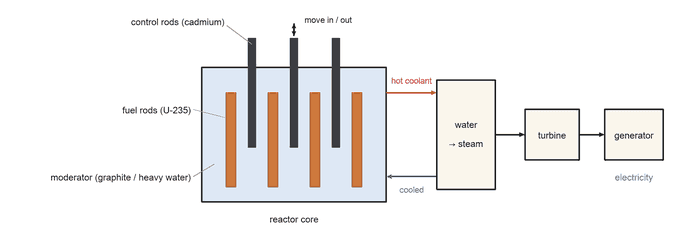
Step 2 — Check cadmium.
Cadmium absorbs neutrons strongly instead of slowing them, so cadmium rods are used as control rods, not as a moderator.
Step 3 — Choose the option.
Since both (b) and (c) are moderators, the answer is the option that names both.
Watch out: Do not confuse the moderator (slows neutrons) with the control rods (absorb neutrons).
Why the other options are wrong:
- (A) Cadmium rods: Cadmium rods absorb neutrons; they are the control rods that keep the rate of fission steady, not a moderator.
- (B) Graphite: Graphite is a moderator, but so is heavy water, so (B) alone is incomplete.
- (C) Heavy water: Heavy water is a moderator, but so is graphite, so (C) alone is incomplete.
Therefore, graphite and heavy water are both used as moderators, option (D).
- 731 mark
Question 73
The source of energy of the sun and stars is obtained from the nuclear fusion of :
Solve with AIAnswer
(A) uranium
(B) thorium
- Correct
(C) hydrogen
(D)
Answer: (C) hydrogen
Concept: In nuclear fusion two light nuclei (such as isotopes of hydrogen) join to form a heavier nucleus, giving out a large amount of energy because the product has slightly less mass. The nuclei are positively charged and repel each other, so fusion happens only at a very high temperature, about 10⁷ K.
Step 1 — Name the fuel.
In the core of the sun (temperature about 10⁷ K), hydrogen nuclei fuse: in effect four hydrogen nuclei form one helium nucleus.
Step 2 — See where the energy comes from.
The helium nucleus formed is a little lighter than the four hydrogen nuclei. This lost mass is given out as energy, which reaches us as heat and light.
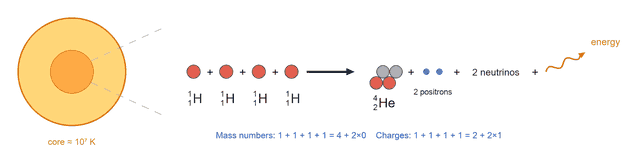
Watch out: The sun runs on FUSION of the lightest element, not on fission of heavy ones.
Why the other options are wrong:
- (A) uranium: Uranium is a heavy element used in fission, not fused in the sun.
- (B) thorium: Thorium is also a heavy element, used as a nuclear fuel for fission, not fusion.
- (D) : Uranium-235 is the fuel of fission reactors and the atom bomb, not of the sun.
Therefore, the energy of the sun and stars comes from the fusion of hydrogen, option (C).
- 741 mark
Question 74
The temperature required for the process of nuclear fusion is nearly :
Solve with AIAnswer
(A) 1000 K
(B) K
(C) K
- Correct
(D) K
Answer: (D) K
Concept: In nuclear fusion two light nuclei (such as isotopes of hydrogen) join to form a heavier nucleus, giving out a large amount of energy because the product has slightly less mass. The nuclei are positively charged and repel each other, so fusion happens only at a very high temperature, about 10⁷ K.
Step 1 — See the problem.
The nuclei that must fuse are all positively charged, so they repel each other strongly as they come close.
Step 2 — See what is needed.
To overcome this repulsion, the nuclei must move extremely fast, that is, have very high kinetic energy, and they get it from their thermal motion only at a very high temperature.
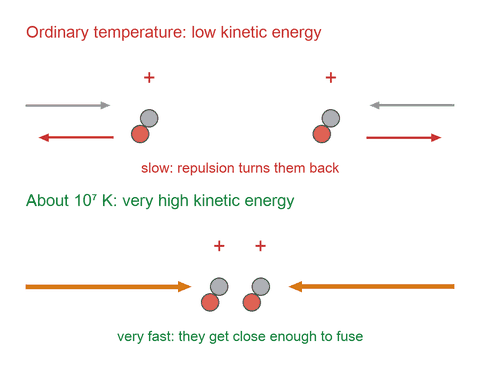
Step 3 — Give the temperature.
This needs a temperature of about 10⁷ K (ten million kelvin), which is why fusion is called a thermonuclear reaction.
Watch out: 10⁷ K is ten MILLION kelvin, far hotter than any flame.
Why the other options are wrong:
- (A) 1000 K: 1000 K is far too low; the nuclei are much too slow to overcome their repulsion.
- (B) K: 10⁴ K is still a thousand times too low.
- (C) K: 10⁵ K is still a hundred times too low.
Therefore, the temperature needed for nuclear fusion is about 10⁷ K, option (D).
- 752 marks
Question 75
Complete the following nuclear fission reactions :
(a)
(b)
Solve with AIWritten solution
Solution:
Concept: In every nuclear change the total mass number (A) and the total atomic number (Z) are the same on both sides of the equation. An α particle is , a β particle is , a neutron is and γ radiation has A = 0 and Z = 0.
(a)
Step 1 — Add up the left side.
Uranium-235 and one neutron give the totals on the left.
Step 2 — Find the mass number of Ba.
The mass numbers on the right must also add up to 236.
Step 3 — Find the atomic number of Kr.
The atomic numbers on the right must add up to 92; neutrons count 0.
Step 4 — Fill the last blank.
The last blank is the energy released in the fission.
(b)
Step 5 — Find the atomic number of La.
The atomic numbers on the right must add up to 92.
Step 6 — Find the number of neutrons.
The mass numbers on the right must add up to 236, and each neutron has mass number 1.
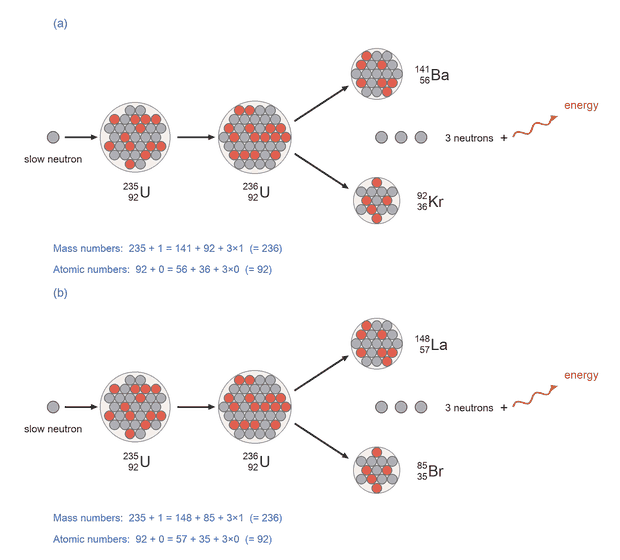
Watch out: Remember the incoming neutron: the left side totals 236, not 235.
Therefore, (a) , and (b) .
- 762 marks
Question 76
Complete the following fusion reactions :
(a)
(b)
Solve with AIWritten solution
Solution:
Concept: In every nuclear change the total mass number (A) and the total atomic number (Z) are the same on both sides of the equation. An α particle is , a β particle is , a neutron is and γ radiation has A = 0 and Z = 0. Helium has atomic number 2 and hydrogen 1.
(a)
Step 1 — Add up the left side.
Helium-3 and deuterium give the totals on the left.
Step 2 — Share the mass number on the right.
The atomic numbers already balance (2 + 1 = 3), so the 5 nucleons must be shared between He and H. Sharing them as 3 and 2 would just give back the starting nuclei, so the products are helium-4 and hydrogen-1 (a proton).
(b)
Step 3 — Add up the left side.
Two deuterium nuclei give the totals on the left.
Step 4 — Find the helium nucleus.
The neutron has A = 1 and Z = 0, so helium takes the rest.
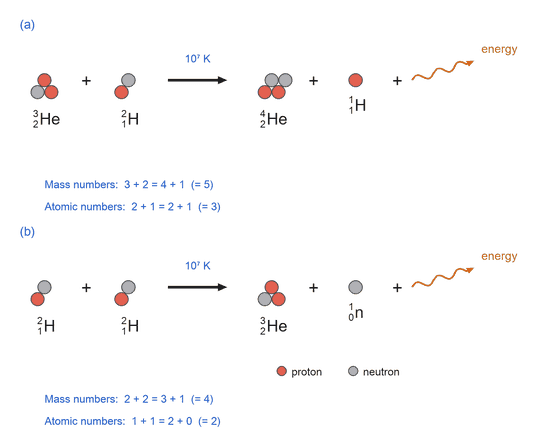
Watch out: The neutron has atomic number 0, so all of Z = 2 goes to helium.
Therefore, (a) , and (b) .
- 772 marks
Question 77
(a) Name the process, nuclear fission or nuclear fusion, in which the energy released per unit mass is more ?
(b) Name the process, fission or fusion which is possible at ordinary temperature.
Solve with AIWritten solution
Solution:
Concept: Compare the energy given by the same mass of fuel, and the temperature each process needs to start.
(a)
Step 1 — Energy per unit mass.
One fusion gives less energy than one fission, but the nuclei are so light that the same mass of fuel holds far more of them. Dividing the energy by the mass taking part shows this.
So fusion releases more energy per unit mass.
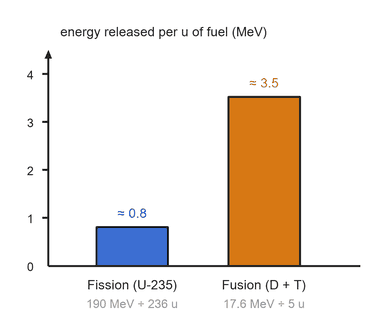
(b)
Step 2 — Ordinary temperature.
Fission is started by a slow neutron, which has no charge and needs no heating, so it takes place at ordinary temperature. Fusion needs about 10⁷ K.
Watch out: Per NUCLEUS fission gives more energy; per unit MASS fusion gives more.
Therefore, (a) nuclear fusion releases more energy per unit mass, and (b) nuclear fission is possible at ordinary temperature.
- 781 mark
Question 78
What is the source of energy of sun or stars ?
Solve with AIWritten solution
Solution:
Concept: In nuclear fusion two light nuclei (such as isotopes of hydrogen) join to form a heavier nucleus, giving out a large amount of energy because the product has slightly less mass. The nuclei are positively charged and repel each other, so fusion happens only at a very high temperature, about 10⁷ K.
Step 1 — Name the process.
The sun and the stars get their energy from nuclear fusion in their core, where the temperature is about 10⁷ K and the pressure is enormous.
Step 2 — Name the fuel and product.
In effect four hydrogen nuclei fuse to form one helium nucleus.
Step 3 — Say where the energy comes from.
The helium formed is a little lighter than the four hydrogen nuclei, and this lost mass is given out as energy (heat and light).
Watch out: The sun does not burn: no chemical burning could keep it shining for billions of years.
Therefore, the source of energy of the sun and stars is the nuclear fusion of hydrogen into helium.
- 791 mark
Question 79
Name the following nuclear reactions :
(a)
(b)
Solve with AIWritten solution
Solution:
Concept: Fission splits a heavy nucleus into two lighter nuclei; fusion joins light nuclei into a heavier one.
(a)
Step 1 — Look at reaction (a).
A heavy nucleus, uranium-235, struck by a neutron, splits into two lighter nuclei (strontium-90 and xenon-143) with 3 neutrons. This is nuclear fission.
(b)
Step 2 — Look at reaction (b).
Two light nuclei, tritium and deuterium, join to form a heavier helium nucleus and a neutron. This is nuclear fusion.
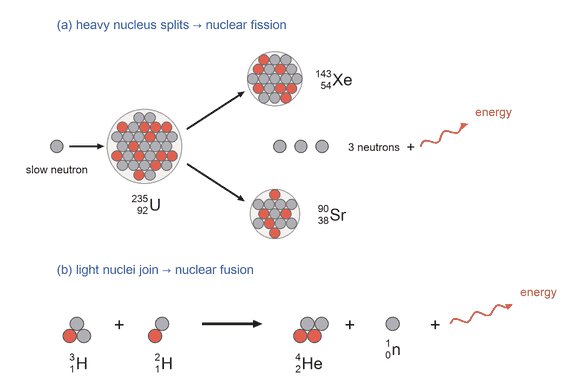
Therefore, (a) is nuclear fission and (b) is nuclear fusion.
- 802 marks
Question 80
What do you mean by nuclear energy ? What is responsible for its release ?
Solve with AIWritten solution
Solution:
Concept: Einstein's mass–energy relation E = (Δm)c² says that a mass Δm that disappears in a nuclear change reappears as energy E, where c = 3 × 10⁸ m s⁻¹ is the speed of light. In atomic units, a mass of 1 a.m.u. is equivalent to 931 MeV.
Step 1 — Define nuclear energy.
Nuclear energy is the energy released from the nucleus of an atom in a nuclear change, such as radioactive decay, nuclear fission or nuclear fusion.
Step 2 — Say what is responsible for its release.
In such a change the total mass of the products is slightly less than the total mass of the reactants. This loss of mass Δm (the mass defect) is converted into energy.
Step 3 — Give an example.
In the fission of one uranium-235 nucleus the products are lighter by about 0.2 u, and this appears as about 0.2 × 931 MeV ≈ 186 MeV of energy.
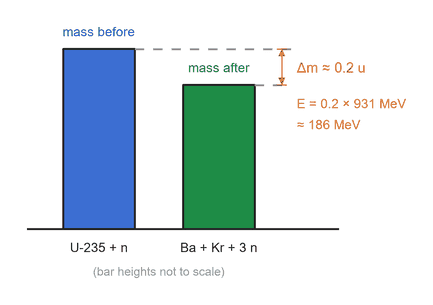
Watch out: The mass is not destroyed; it reappears as energy.
Therefore, nuclear energy is the energy released from the nucleus in a nuclear change, and it is released because of the loss of mass, which is converted into energy by E = (Δm)c².
- 812 marks
Question 81
Write down the Einstein's mass-energy equivalence relation, explaining the meaning of each symbol used in it.
Solve with AIWritten solution
Solution:
Concept: Einstein showed that mass and energy are interchangeable: a mass that disappears reappears as energy.
Step 1 — Write the relation.
The energy released equals the loss in mass multiplied by the square of the speed of light.
Step 2 — Explain each symbol.
Each letter stands for one quantity, given here with its S.I. unit.
- E = the energy released, in joule (J);
- Δm = the loss (decrease) in mass, in kilogram (kg);
- c = the speed of light in vacuum, 3 × 10⁸ m s⁻¹.
Step 3 — See what it means.
Because c² is so large, 9 × 10¹⁶ m² s⁻², even a tiny loss of mass gives a huge amount of energy: 1 kg would give 9 × 10¹⁶ J.
Watch out: Δm is the mass LOST, not the whole mass of the substance.
Therefore, the relation is E = Δm c², where E is the energy released (J), Δm the loss in mass (kg) and c the speed of light (3 × 10⁸ m s⁻¹).
- 823 marks
Question 82
(a) What is a.m.u ? Express 1 a.m.u. in MeV.
(b) Write the approximate mass of a proton, neutron and electron in a.m.u.
Solve with AIWritten solution
Solution:
Concept: Atoms and their particles are so light that their masses are measured in a small unit, the atomic mass unit, which is linked to energy through E = (Δm)c².
(a)
Step 1 — Define the atomic mass unit.
The atomic mass unit (a.m.u. or u) is 1/12 of the mass of one atom of carbon-12.
Step 2 — Express it in MeV.
Converting this mass into energy with E = (Δm)c², and then joule into MeV, gives the energy equivalent.
(With the rounded constants the division gives about 934; the exact constants give 931.5 MeV.)
(b)
Step 3 — Masses of the particles.
In atomic mass units the masses are:
- proton: about 1.00727 u (≈ 1 u);
- neutron: about 1.00865 u (≈ 1 u, a little more than the proton);
- electron: about 0.00055 u, about 1840 times less than a proton.
Watch out: 1 a.m.u. is a MASS; '931 MeV' is the energy equivalent of that mass.
Therefore, (a) 1 a.m.u. is 1/12 of the mass of a carbon-12 atom (1.66 × 10⁻²⁷ kg), equivalent to 931 MeV, and (b) proton ≈ 1.00727 u, neutron ≈ 1.00865 u, electron ≈ 0.00055 u.
- 833 marks
Question 83
What is nuclear fission ? Name the substance used for it. Write one fission reaction.
Solve with AIWritten solution
Solution:
Concept: In nuclear fission a heavy nucleus such as , struck by a slow neutron, splits into two lighter nuclei of nearly equal size, giving out 2 or 3 neutrons and a large amount of energy (about 200 MeV per nucleus) because the products have slightly less mass.
Step 1 — Define nuclear fission.
Nuclear fission is the process in which a heavy nucleus, when bombarded with a slow neutron, splits into two lighter nuclei of nearly equal size, releasing 2 or 3 neutrons and a large amount of energy.
Step 2 — Name the substance used.
Uranium-235, , is used for fission (plutonium-239 is also used).
Step 3 — Write a fission reaction.
One common fission of uranium-235 gives barium and krypton.
Both totals balance on the two sides.
Watch out: Fission needs a neutron to start it; it is not spontaneous like radioactive decay.
Therefore, nuclear fission is the splitting of a heavy nucleus by a slow neutron into two nearly equal lighter nuclei with the release of neutrons and energy; uranium-235 is used, for example .
- 842 marks
Question 84
Write the approximate value of the energy released in the fission of one nucleus of . What is the reason for it ?
Solve with AIWritten solution
Solution:
Concept: Einstein's mass–energy relation E = (Δm)c² says that a mass Δm that disappears in a nuclear change reappears as energy E, where c = 3 × 10⁸ m s⁻¹ is the speed of light. In atomic units, a mass of 1 a.m.u. is equivalent to 931 MeV.
Step 1 — Give the energy.
The fission of one uranium-235 nucleus releases about 200 MeV of energy.
Step 2 — Give the reason.
The products of the fission (the two fragments and the neutrons) are together lighter than the uranium-235 nucleus and the neutron that struck it, by about 0.2 u. This lost mass is converted into energy.
This is close to 200 MeV; the exact value depends on which two fragments are formed.
Step 3 — Say where the energy goes.
Most of it appears as the kinetic energy of the fragments; the rest is carried by the neutrons and γ radiation, and it ends up as heat.
Watch out: The energy comes from the loss of MASS, not from the uranium 'burning'.
Therefore, about 200 MeV is released in the fission of one nucleus, because about 0.2 u of mass is lost and converted into energy by E = (Δm)c².
- 853 marks
Question 85
What do you mean by the chain reaction in nuclear fission ? How is it controlled ?
- 862 marks
Question 86
State two uses of nuclear fission.
- 872 marks
Question 87
Give two differences between the radioactive decay and nuclear fission.
- 883 marks
Question 88
(a) What is nuclear fusion ? Give one example and write its nuclear reaction.
(b) What other name is given to nuclear fusion ? Give reason.
- 892 marks
Question 89
Why is a very high temperature required for the process of nuclear fusion ? State the approximate temperature required.
- 903 marks
Question 90
(a) Write one nuclear fusion reaction.
(b) State the approximate value of energy released in the reaction mentioned in part (a).
(c) Give reason for the release of energy stated in part (b).
- 913 marks
Question 91
(a) State one similiarity in the process of nuclear fission and fusion.
(b) State two differences between the process of nuclear fission and fusion.
- 922 marks
Question 92
Give two examples of nuclear fusion.
- 934 marks
Question 93
(a) Name two isotopes of uranium which are fissionable.
(b) Which of the isotope mentioned in part (a) above is easily fissionable ? Give reason.
(c) State whether the neutron needed for fission reaction of the isotope mentioned in part (b) above, is slow or fast ?
- 942 marks
Question 94
In fission of one uranium-235 nucleus, the loss in mass is 0.2 a.m.u. Calculate the energy released.
- 952 marks
Question 95
When four hydrogen nuclei combine to form a helium nucleus in the interior of sun, the loss in mass is 0.0265 a.m.u. How much energy is released ?
What Class 10 Physics Ch 12 covers
The sections of the chapter, in the order the book takes them. Every question above comes from one of these.
- 01Structure of the Atom and Nucleus
- 02Isotopes, Isobars and Isotones
- 03Radioactivity
- 04Alpha, Beta and Gamma Radiations
- 05Changes Within the Nucleus in Alpha, Beta and Gamma Emission
- 06Uses of Radioactivity – Radio Isotopes
More ways to study this chapter
The same chapter asked three other ways. Practise it, revise it, and see what the board has set on Ch 12 before.
- Competency-Based Questions (CBQ)Case study questions: a situation, and the part of the chapter that answers it.40questionsOpen
- Previous Year QuestionsQuestions that have actually appeared in board papers, each tagged with its year.45questionsOpen
- Practice QuestionsExtra questions per chapter, for when one attempt at a method is not enough.42questionsOpen
Ch 12 in past ICSE papers
The same chapter as the board has actually asked it. These are worded differently from the textbook exercise, which is the point of reading them.
- 12 marks
Board paper question 1
An element decays to after emitting 2 α particles and 1 β particle. Find the atomic number and atomic mass of the element S.
Solve with AIWritten solution
Solution:
Concept: In every nuclear change the total mass number (A) and the total atomic number (Z) are the same on both sides of the equation. An α particle is , a β particle is , a neutron is and γ radiation has A = 0 and Z = 0. Emitting an α particle lowers A by 4 and Z by 2; emitting a β particle keeps A and raises Z by 1 (a neutron turns into a proton); emitting γ radiation changes neither.
Given: S emits 2 α particles and 1 β particle and becomes .
Step 1 — Write the overall change.
S gives out two α particles and one β particle and ends up as R, so we write all of them on the right-hand side.
Step 2 — Balance the mass numbers.
The mass number of S must equal the total mass number on the right; a β particle has mass number 0.
Step 3 — Balance the atomic numbers.
The atomic number of S must equal the total atomic number on the right; a β particle counts as −1.
Check: We go forwards from S to make sure we land on R. Two α emissions take (230, 88) down to (222, 84), and the β emission keeps A and raises Z to 85, which is exactly R. The order of the emissions does not change the final nucleus.

Watch out: The β particle counts as −1 on the right-hand side, so S has Z = 85 + 4 − 1; adding +1 for it would give 90, which is wrong.
Therefore, the element S has atomic number 88 and mass number (atomic mass) 230, so S is written as .
- 22 marks
Board paper question 2
A radioactive substance is oxidized. Will there be any change in the nature of its radioactivity? Give a reason for your answer.
Solve with AIWritten solution
Solution:
Concept: Radioactivity is a nuclear process: it comes from an unstable nucleus. A chemical change (such as oxidation) involves only the outer electrons of the atom, so it cannot change the nucleus, its radiation or its rate of decay.
Step 1 — Say what oxidation changes.
Oxidation is a chemical change: the atoms of the substance join with oxygen by sharing or transferring their outer electrons. Only these outer electrons take part.
Step 2 — Say where radioactivity comes from.
Radioactivity is the spontaneous break-up of an unstable nucleus. The nucleus lies deep inside the atom, and a chemical change does not reach it.
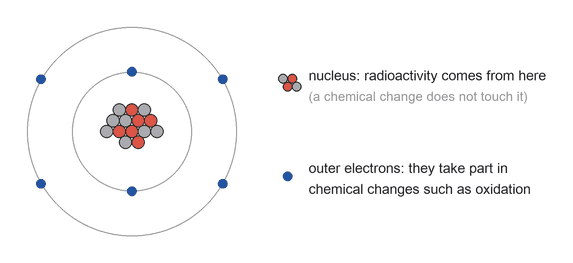
Step 3 — Draw the conclusion.
Because the nucleus is unchanged, it gives out the same kind of radiation (α, β or γ) at the same rate, whether the substance is free or combined as an oxide.
Watch out: The oxide is a new compound, but its radioactive nuclei are the same nuclei as before.
Therefore, no, there is no change in the nature of its radioactivity, because oxidation is a chemical change involving only the outer electrons, while radioactivity is a property of the nucleus.
- 33 marks
Board paper question 3
Arrange α, β and γ rays in ascending order with respect to their
(i) Penetrating power.
(ii) Ionising power.
(iii) Biological effect.
Solve with AIWritten solution
Solution:
Concept: α particles are helium nuclei (charge +2e, about 4 times the mass of a proton); β particles are fast electrons (charge −e); γ radiation is an electromagnetic wave with no charge and no mass. α ionises the most and penetrates the least; γ ionises the least and penetrates the most.
(i) Penetrating power
Step 1 — Compare how far each radiation goes.
α particles are stopped by a sheet of paper (or 3–8 cm of air), β particles by a few millimetres of aluminium, while γ radiation passes through several centimetres of lead and is only greatly reduced, not fully stopped.

(ii) Ionising power
Step 2 — Compare how strongly each ionises.
An α particle is heavy, doubly charged and fairly slow, so it knocks electrons out of very many atoms on its way. Its ionising power is about 100 times that of β particles and 10,000 times that of γ radiation.
(iii) Biological effect
Step 3 — Compare the harm from a source outside the body.
From outside the body, α particles cannot get through the dead outer layer of the skin, β particles reach only a little way into the body, and γ radiation passes right through it, damaging the cells on its way.
Watch out: The order for ionising power is the REVERSE of the order for penetrating power: the more a radiation ionises, the faster it loses its energy.
Note: if the source gets INSIDE the body (breathed in or swallowed), α is the most harmful, because it ionises the most strongly; the order above is for a source outside the body, as the book gives it.
Therefore, in ascending order: (i) penetrating power α < β < γ; (ii) ionising power γ < β < α; (iii) biological effect (source outside the body) α < β < γ.
- 44 marks
Board paper question 4
(i) Represent the change in the nucleus of a radioactive element when a β particle is emitted.
(ii) What is the name given to elements with same mass number and different atomic number?
(iii) Under which conditions does the nucleus of an atom tend to be radioactive?
Solve with AIWritten solution
Solution:
Concept: In β emission a neutron inside the nucleus changes into a proton and an electron, and the electron is thrown out. So A stays the same and Z rises by 1: a new element, one place forward in the periodic table.
(i)
Step 1 — Show what happens inside the nucleus.
In β emission one neutron of the nucleus changes into a proton and an electron, and the electron is thrown out as the β particle.
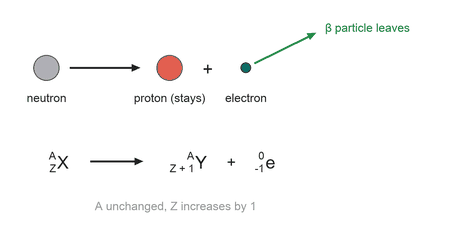
Step 2 — Write the change for the whole nucleus.
The number of nucleons is unchanged, so A stays the same, while the extra proton raises Z by 1. A new element Y, one place ahead in the periodic table, is formed.
For example, sodium-24 changes into magnesium-24:
(ii)
Step 3 — Name the elements.
Atoms with the same mass number but different atomic numbers are called isobars, for example and .
(iii)
Step 4 — State when a nucleus is radioactive.
A light nucleus is stable when it has about as many neutrons as protons; heavier stable nuclei need a few more neutrons than protons (lead-208: 82 protons, 126 neutrons). A nucleus with too many neutrons for its protons, or one that is simply too big (every element with Z > 82), is unstable, and it gives out α or β particles until it becomes stable. For example, carbon-14 (6 protons, 8 neutrons) is radioactive, while carbon-12 (6 protons, 6 neutrons) is stable.
Watch out: In β emission the electron comes from the NUCLEUS (a neutron changing), not from the electron shells.
Therefore, (i) (a neutron becomes a proton; A unchanged, Z up by 1); (ii) isobars; (iii) when the nucleus has too many neutrons for its protons, or is too heavy (Z > 82).
- 52 marks
Board paper question 5
When does the nucleus of an atom tend to be radioactive?
Solve with AIWritten solution
Solution:
Concept: A light nucleus is stable when it has about as many neutrons as protons; heavier stable nuclei need a few more neutrons than protons (lead-208: 82 protons, 126 neutrons). A nucleus with too many neutrons for its protons, or one that is simply too big (every element with Z > 82), is unstable, and it gives out α or β particles until it becomes stable.
Step 1 — Compare neutrons with protons.
The protons in a nucleus repel each other, and the neutrons help to hold the nucleus together. A light stable nucleus has about as many neutrons as protons; a heavier stable nucleus needs a few more neutrons than protons.
Step 2 — Say when the balance fails.
When the number of neutrons is much more than the number of protons (the neutron–proton ratio is too high), the nucleus becomes unstable and gives out α or β particles until it becomes stable.
Step 3 — Give where this happens.
Every element with atomic number more than 82 (beyond lead), such as uranium, radium and polonium, is radioactive. Lighter elements have some radioactive isotopes too, such as carbon-14 (6 protons, 8 neutrons) and cobalt-60 (27 protons, 33 neutrons).
Watch out: A big nucleus is not radioactive just because it is big; it is the unbalanced neutron–proton ratio (and, beyond Z = 82, the sheer size) that makes it unstable.
Therefore, a nucleus tends to be radioactive when its number of neutrons is much more than its number of protons (a high neutron–proton ratio), as in all elements with atomic number more than 82.
- 62 marks
Board paper question 6
(i) What do you understand by the term nuclear fusion?
(ii) Nuclear power plants use the nuclear fission reaction to produce electricity. What is the advantage of producing electricity by fusion reaction?
Solve with AIWritten solution
Solution:
Concept: In nuclear fusion two light nuclei (such as isotopes of hydrogen) join to form a heavier nucleus, giving out a large amount of energy because the product has slightly less mass. The nuclei are positively charged and repel each other, so fusion happens only at a very high temperature, about 10⁷ K.
(i)
Step 1 — Define fusion.
Nuclear fusion is the process in which two light nuclei combine to form a heavier nucleus, releasing a large amount of energy. For example, deuterium and tritium (isotopes of hydrogen) fuse to form helium-4.

Step 2 — Say where the energy comes from.
The products have slightly less mass than the two nuclei that fused. This lost mass Δm appears as energy, given by Einstein's relation.
(ii)
Step 3 — Compare the energy from the same mass of fuel.
One fusion gives less energy than one fission, but the fusing nuclei are so light that a kilogram of fuel holds far more of them.
Step 4 — List the advantages.
So fusion gives about four times as much energy per kilogram of fuel. Its fuel, deuterium, can be taken cheaply and in plenty from sea water, while uranium ores are limited. Fusion also leaves far less radioactive waste than fission, and the waste does not stay dangerous for thousands of years.
Watch out: Fusion is not completely free of radioactivity: tritium is mildly radioactive and the fast neutrons make the reactor walls radioactive, but the waste is far smaller and much shorter-lived than fission waste.
Note: fusion needs a temperature of about 10⁷ K, so it cannot yet be controlled well enough to run a power station; fusion power plants are still being developed.
Therefore, (i) nuclear fusion is the joining of two light nuclei to form a heavier nucleus with the release of a large amount of energy; (ii) fusion gives much more energy from the same mass of fuel, uses a cheap and plentiful fuel (deuterium from sea water) and leaves far less radioactive waste.
All 45 board paper questions for this chapter, solved the same way.
Class 10 Physics Ch 12 questions students ask
How many questions are there in Class 10 Physics Ch 12?
95 questions. Every one is solved step by step on this page.
Are these Class 10 Physics solutions free?
Yes. Every question and its full working is free to read, with no account needed.
Can I download the Class 10 Physics Ch 12 solutions as a PDF?
There is no PDF to download. Every solution is on this page instead, which means it is searchable, always the current syllabus, and readable on a phone. Use your browser's print option if you want it on paper.