
Question 664 marksMedium
An element P disintegrates by α emission and the new element suffers two further disintegrations, both by β emission, to form an element Q. Explain the fact that P and Q are isotopes.
Confirming your payment
Sign up now and get 250 free tokens.
Radioactivity · Question 66 of 95
An element P disintegrates by α emission and the new element suffers two further disintegrations, both by β emission, to form an element Q. Explain the fact that P and Q are isotopes.
Solution:
Concept: Isotopes have the same atomic number Z but different mass numbers A (same element, different numbers of neutrons). Isobars have the same A but different Z (different elements). Isotones have the same number of neutrons (A − Z) but different Z. Emitting an α particle lowers A by 4 and Z by 2; emitting a β particle keeps A and raises Z by 1 (a neutron turns into a proton); emitting γ radiation changes neither.
Step 1 — Follow the three emissions.
Let P be . The α emission gives A − 4 and Z − 2; each β emission then raises Z by 1 and keeps A.
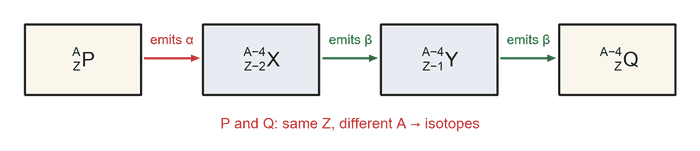
Step 2 — Compare the atomic numbers.
The α emission lowers the atomic number by 2, and the two β emissions raise it by 1 each, so Q is back at Z, the same as P.
Step 3 — Compare the mass numbers.
The mass number falls by 4 in the α emission and does not change in the β emissions, so Q has mass number A − 4, which is different from P's.
Watch out: Having the same atomic number makes P and Q the SAME element, even though they were reached by a chain of decays.
Therefore, P and Q have the same atomic number Z but different mass numbers (A and A − 4), so they are isotopes.