Solution:
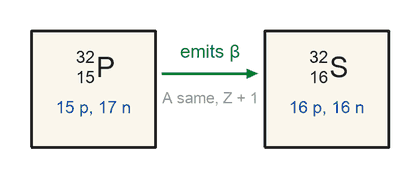
Concept: An atom ZAX has a tiny nucleus of protons and neutrons (together called nucleons) with electrons outside it. The atomic number Z is the number of protons; the mass number A is the number of nucleons (protons + neutrons). So the number of neutrons is A − Z, and a neutral atom has Z electrons. In β emission a neutron inside the nucleus changes into a proton and an electron, and the electron is thrown out. So A stays the same and Z rises by 1: a new element, one place forward in the periodic table.
(a)
Step 1 — Stable phosphorus.
The atomic number is the number of protons, and the mass number is protons + neutrons.
ZA=15=15+16=31
(b)
Step 2 — Radio phosphorus.
It has one neutron more, that is 17 neutrons, with the same 15 protons.
ZA=15=15+17=32
It is an isotope of stable phosphorus.
(c)
Step 3 — After β decay.
β emission raises the atomic number by 1 and keeps the mass number, which gives sulphur.
ZA=15+1=16=32
1532P→1632S+−10e
Watch out: The extra neutron changes A, not Z; isotopes keep the same atomic number.
Therefore, (a) Z = 15 and A = 31, (b) Z = 15 and A = 32, and (c) Z = 16 and A = 32 (sulphur-32).
