Solution:
Concept: An α particle takes away 2 protons and 2 neutrons. In β emission one neutron changes into a proton. γ emission removes only energy.
(a)
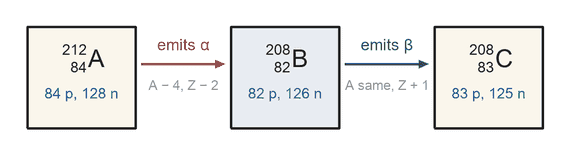
Step 1 — Composition of B.
The α particle takes 2 protons and 2 neutrons from A.
protonsneutrons=84−2=82=128−2=126
(b)
Step 2 — Composition of C.
In β emission one neutron of B turns into a proton.
protonsneutrons=82+1=83=126−1=125
(c)
Step 3 — Mass number of A.
The mass number is the total number of nucleons.
A=84+128=212
(d)
Step 4 — Effect of γ emission.
γ radiation has no charge and no mass, so emitting it only lowers the energy of the nucleus; C still has 83 protons and 125 neutrons.
Check: Writing the two decays as equations, both totals balance.
84212A→82208B+24He
82208B→83208C+−10e
Watch out: In β emission the number of neutrons FALLS by 1 while the protons rise by 1.
Therefore, (a) B has 82 protons and 126 neutrons, (b) C has 83 protons and 125 neutrons, (c) the mass number of A is 212, and (d) no, γ emission does not change the composition of C.
