Solution:
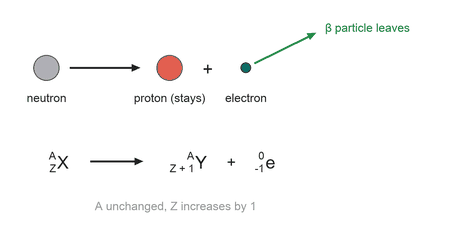
Concept: In β emission a neutron inside the nucleus changes into a proton and an electron, and the electron is thrown out. So A stays the same and Z rises by 1: a new element, one place forward in the periodic table.
(i)
Step 1 — Show what happens inside the nucleus.
In β emission one neutron of the nucleus changes into a proton and an electron, and the electron is thrown out as the β particle.
01n→11p+−10e
Step 2 — Write the change for the whole nucleus.
The number of nucleons is unchanged, so A stays the same, while the extra proton raises Z by 1. A new element Y, one place ahead in the periodic table, is formed.
ZAX→Z+1AY+−10e
For example, sodium-24 changes into magnesium-24:
1124Na→1224Mg+−10e
(ii)
Step 3 — Name the elements.
Atoms with the same mass number but different atomic numbers are called isobars, for example 614C and 714N.
(iii)
Step 4 — State when a nucleus is radioactive.
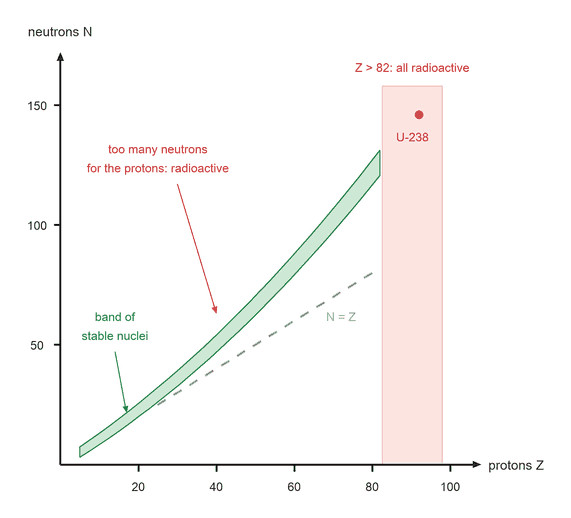
A light nucleus is stable when it has about as many neutrons as protons; heavier stable nuclei need a few more neutrons than protons (lead-208: 82 protons, 126 neutrons). A nucleus with too many neutrons for its protons, or one that is simply too big (every element with Z > 82), is unstable, and it gives out α or β particles until it becomes stable. For example, carbon-14 (6 protons, 8 neutrons) is radioactive, while carbon-12 (6 protons, 6 neutrons) is stable.
Watch out: In β emission the electron comes from the NUCLEUS (a neutron changing), not from the electron shells.
Therefore, (i) ZAX→Z+1AY+−10e (a neutron becomes a proton; A unchanged, Z up by 1); (ii) isobars; (iii) when the nucleus has too many neutrons for its protons, or is too heavy (Z > 82).
