
Opening your dashboard
Class 10 Physics Chapter 12 Radioactivity: Previous Year Questions
45 questions on Chapter 12, each solved step by step. Class 10 Physics, ICSE 2026-27.
45 questions with solutions
1–4 marks · Mixed difficulty
- 12 marks
Question 1
An element decays to after emitting 2 α particles and 1 β particle. Find the atomic number and atomic mass of the element S.
Solve with AIWritten solution
Solution:
Concept: In every nuclear change the total mass number (A) and the total atomic number (Z) are the same on both sides of the equation. An α particle is , a β particle is , a neutron is and γ radiation has A = 0 and Z = 0. Emitting an α particle lowers A by 4 and Z by 2; emitting a β particle keeps A and raises Z by 1 (a neutron turns into a proton); emitting γ radiation changes neither.
Given: S emits 2 α particles and 1 β particle and becomes .
Step 1 — Write the overall change.
S gives out two α particles and one β particle and ends up as R, so we write all of them on the right-hand side.
Step 2 — Balance the mass numbers.
The mass number of S must equal the total mass number on the right; a β particle has mass number 0.
Step 3 — Balance the atomic numbers.
The atomic number of S must equal the total atomic number on the right; a β particle counts as −1.
Check: We go forwards from S to make sure we land on R. Two α emissions take (230, 88) down to (222, 84), and the β emission keeps A and raises Z to 85, which is exactly R. The order of the emissions does not change the final nucleus.

Watch out: The β particle counts as −1 on the right-hand side, so S has Z = 85 + 4 − 1; adding +1 for it would give 90, which is wrong.
Therefore, the element S has atomic number 88 and mass number (atomic mass) 230, so S is written as .
- 22 marks
Question 2
A radioactive substance is oxidized. Will there be any change in the nature of its radioactivity? Give a reason for your answer.
Solve with AIWritten solution
Solution:
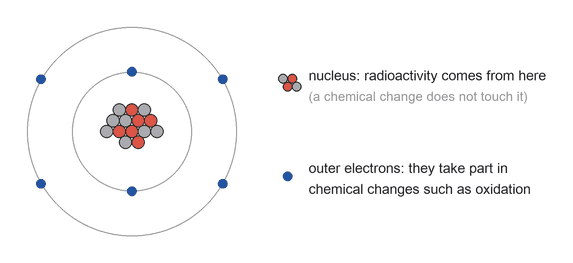
Concept: Radioactivity is a nuclear process: it comes from an unstable nucleus. A chemical change (such as oxidation) involves only the outer electrons of the atom, so it cannot change the nucleus, its radiation or its rate of decay.
Step 1 — Say what oxidation changes.
Oxidation is a chemical change: the atoms of the substance join with oxygen by sharing or transferring their outer electrons. Only these outer electrons take part.
Step 2 — Say where radioactivity comes from.
Radioactivity is the spontaneous break-up of an unstable nucleus. The nucleus lies deep inside the atom, and a chemical change does not reach it.
Step 3 — Draw the conclusion.
Because the nucleus is unchanged, it gives out the same kind of radiation (α, β or γ) at the same rate, whether the substance is free or combined as an oxide.
Watch out: The oxide is a new compound, but its radioactive nuclei are the same nuclei as before.
Therefore, no, there is no change in the nature of its radioactivity, because oxidation is a chemical change involving only the outer electrons, while radioactivity is a property of the nucleus.
- 33 marks
Question 3
Arrange α, β and γ rays in ascending order with respect to their
(i) Penetrating power.
(ii) Ionising power.
(iii) Biological effect.
Solve with AIWritten solution
Solution:
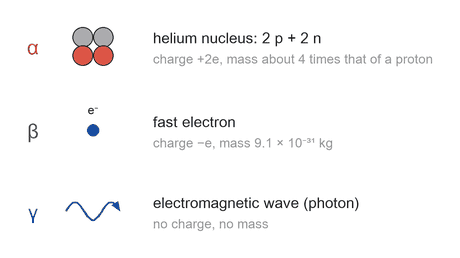
Concept: α particles are helium nuclei (charge +2e, about 4 times the mass of a proton); β particles are fast electrons (charge −e); γ radiation is an electromagnetic wave with no charge and no mass. α ionises the most and penetrates the least; γ ionises the least and penetrates the most.
(i) Penetrating power
Step 1 — Compare how far each radiation goes.
α particles are stopped by a sheet of paper (or 3–8 cm of air), β particles by a few millimetres of aluminium, while γ radiation passes through several centimetres of lead and is only greatly reduced, not fully stopped.

(ii) Ionising power
Step 2 — Compare how strongly each ionises.
An α particle is heavy, doubly charged and fairly slow, so it knocks electrons out of very many atoms on its way. Its ionising power is about 100 times that of β particles and 10,000 times that of γ radiation.
(iii) Biological effect
Step 3 — Compare the harm from a source outside the body.
From outside the body, α particles cannot get through the dead outer layer of the skin, β particles reach only a little way into the body, and γ radiation passes right through it, damaging the cells on its way.
Watch out: The order for ionising power is the REVERSE of the order for penetrating power: the more a radiation ionises, the faster it loses its energy.
Note: if the source gets INSIDE the body (breathed in or swallowed), α is the most harmful, because it ionises the most strongly; the order above is for a source outside the body, as the book gives it.
Therefore, in ascending order: (i) penetrating power α < β < γ; (ii) ionising power γ < β < α; (iii) biological effect (source outside the body) α < β < γ.
- 44 marks
Question 4
(i) Represent the change in the nucleus of a radioactive element when a β particle is emitted.
(ii) What is the name given to elements with same mass number and different atomic number?
(iii) Under which conditions does the nucleus of an atom tend to be radioactive?
Solve with AIWritten solution
Solution:
Concept: In β emission a neutron inside the nucleus changes into a proton and an electron, and the electron is thrown out. So A stays the same and Z rises by 1: a new element, one place forward in the periodic table.
(i)
Step 1 — Show what happens inside the nucleus.
In β emission one neutron of the nucleus changes into a proton and an electron, and the electron is thrown out as the β particle.
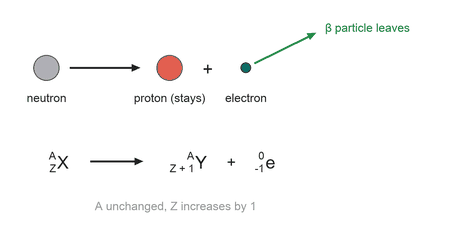
Step 2 — Write the change for the whole nucleus.
The number of nucleons is unchanged, so A stays the same, while the extra proton raises Z by 1. A new element Y, one place ahead in the periodic table, is formed.
For example, sodium-24 changes into magnesium-24:
(ii)
Step 3 — Name the elements.
Atoms with the same mass number but different atomic numbers are called isobars, for example and .
(iii)
Step 4 — State when a nucleus is radioactive.
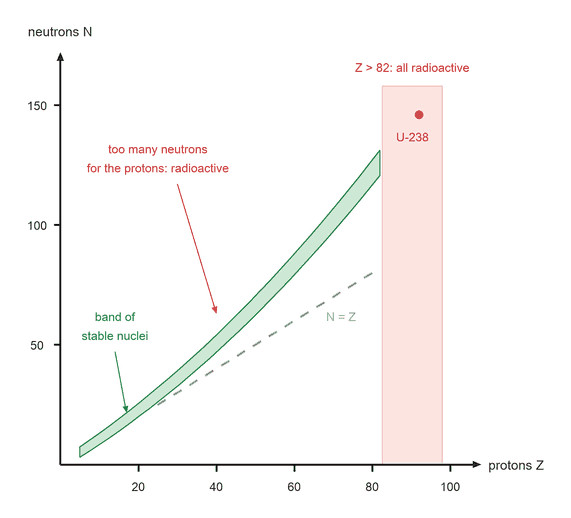
A light nucleus is stable when it has about as many neutrons as protons; heavier stable nuclei need a few more neutrons than protons (lead-208: 82 protons, 126 neutrons). A nucleus with too many neutrons for its protons, or one that is simply too big (every element with Z > 82), is unstable, and it gives out α or β particles until it becomes stable. For example, carbon-14 (6 protons, 8 neutrons) is radioactive, while carbon-12 (6 protons, 6 neutrons) is stable.
Watch out: In β emission the electron comes from the NUCLEUS (a neutron changing), not from the electron shells.
Therefore, (i) (a neutron becomes a proton; A unchanged, Z up by 1); (ii) isobars; (iii) when the nucleus has too many neutrons for its protons, or is too heavy (Z > 82).
- 52 marks
Question 5
When does the nucleus of an atom tend to be radioactive?
Solve with AIWritten solution
Solution:
Concept: A light nucleus is stable when it has about as many neutrons as protons; heavier stable nuclei need a few more neutrons than protons (lead-208: 82 protons, 126 neutrons). A nucleus with too many neutrons for its protons, or one that is simply too big (every element with Z > 82), is unstable, and it gives out α or β particles until it becomes stable.
Step 1 — Compare neutrons with protons.
The protons in a nucleus repel each other, and the neutrons help to hold the nucleus together. A light stable nucleus has about as many neutrons as protons; a heavier stable nucleus needs a few more neutrons than protons.
Step 2 — Say when the balance fails.
When the number of neutrons is much more than the number of protons (the neutron–proton ratio is too high), the nucleus becomes unstable and gives out α or β particles until it becomes stable.
Step 3 — Give where this happens.
Every element with atomic number more than 82 (beyond lead), such as uranium, radium and polonium, is radioactive. Lighter elements have some radioactive isotopes too, such as carbon-14 (6 protons, 8 neutrons) and cobalt-60 (27 protons, 33 neutrons).
Watch out: A big nucleus is not radioactive just because it is big; it is the unbalanced neutron–proton ratio (and, beyond Z = 82, the sheer size) that makes it unstable.
Therefore, a nucleus tends to be radioactive when its number of neutrons is much more than its number of protons (a high neutron–proton ratio), as in all elements with atomic number more than 82.
- 62 marks
Question 6
(i) What do you understand by the term nuclear fusion?
(ii) Nuclear power plants use the nuclear fission reaction to produce electricity. What is the advantage of producing electricity by fusion reaction?
Solve with AIWritten solution
Solution:
Concept: In nuclear fusion two light nuclei (such as isotopes of hydrogen) join to form a heavier nucleus, giving out a large amount of energy because the product has slightly less mass. The nuclei are positively charged and repel each other, so fusion happens only at a very high temperature, about 10⁷ K.
(i)
Step 1 — Define fusion.
Nuclear fusion is the process in which two light nuclei combine to form a heavier nucleus, releasing a large amount of energy. For example, deuterium and tritium (isotopes of hydrogen) fuse to form helium-4.

Step 2 — Say where the energy comes from.
The products have slightly less mass than the two nuclei that fused. This lost mass Δm appears as energy, given by Einstein's relation.
(ii)
Step 3 — Compare the energy from the same mass of fuel.
One fusion gives less energy than one fission, but the fusing nuclei are so light that a kilogram of fuel holds far more of them.
Step 4 — List the advantages.
So fusion gives about four times as much energy per kilogram of fuel. Its fuel, deuterium, can be taken cheaply and in plenty from sea water, while uranium ores are limited. Fusion also leaves far less radioactive waste than fission, and the waste does not stay dangerous for thousands of years.
Watch out: Fusion is not completely free of radioactivity: tritium is mildly radioactive and the fast neutrons make the reactor walls radioactive, but the waste is far smaller and much shorter-lived than fission waste.
Note: fusion needs a temperature of about 10⁷ K, so it cannot yet be controlled well enough to run a power station; fusion power plants are still being developed.
Therefore, (i) nuclear fusion is the joining of two light nuclei to form a heavier nucleus with the release of a large amount of energy; (ii) fusion gives much more energy from the same mass of fuel, uses a cheap and plentiful fuel (deuterium from sea water) and leaves far less radioactive waste.
- 72 marks
Question 7
(i) What are isobars?
(ii) Give one example of isobars.
Solve with AIWritten solution
Solution:
Concept: Isotopes have the same atomic number Z but different mass numbers A (same element, different numbers of neutrons). Isobars have the same A but different Z (different elements). Isotones have the same number of neutrons (A − Z) but different Z.
(i)
Step 1 — Define isobars.
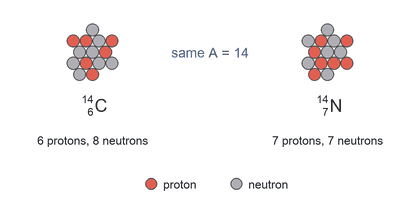
Isobars are atoms of different elements that have the same mass number A but different atomic numbers Z. They have the same total number of nucleons, but different numbers of protons and of neutrons.
(ii)
Step 2 — Give an example and check it.
Carbon-14 and nitrogen-14 both have 14 nucleons, but carbon has 6 protons while nitrogen has 7, so they are isobars.
Another pair is and .
Watch out: Isobars are DIFFERENT elements (Z differs); atoms of the same element with different A are isotopes.
Therefore, (i) isobars are atoms of different elements with the same mass number but different atomic numbers; (ii) an example is and .
- 83 marks
Question 8
The ore of Uranium found in nature contains and . Although both the isotopes are fissionable, it is found out experimentally that one of the two isotopes is more easily fissionable.
(i) Name the isotope of Uranium which is easily fissionable.
(ii) Give a reason for your answer.
(iii) Write a nuclear reaction when Uranium 238 emits an alpha particle to form a Thorium (Th) nucleus.
Solve with AIWritten solution
Solution:
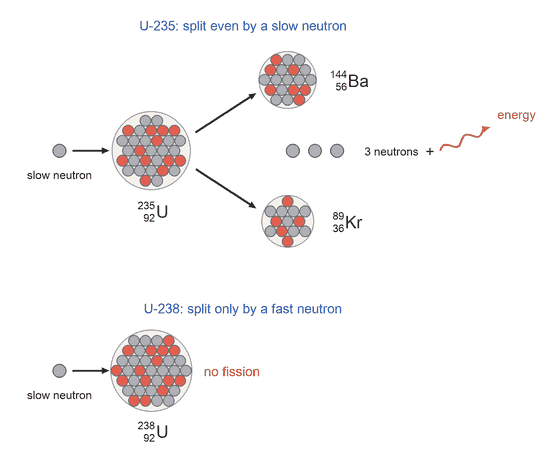
Concept: In nuclear fission a heavy nucleus such as , struck by a slow neutron, splits into two lighter nuclei of nearly equal size, giving out 2 or 3 neutrons and a large amount of energy (about 200 MeV per nucleus) because the products have slightly less mass. In α emission the nucleus throws out 2 protons and 2 neutrons together, so A falls by 4 and Z falls by 2: a new element, two places back in the periodic table.
(i)
Step 1 — Name the isotope.
Of the two isotopes, uranium-235, , is the one that is easily fissionable.
(ii)
Step 2 — Give the reason.
A slow neutron is easily captured by a U-235 nucleus, and the nucleus then splits. A U-238 nucleus can be split only by a fast neutron; a slow neutron striking it is just absorbed without fission. In a natural ore the neutrons soon slow down, so U-235 is the one that keeps on splitting.
(iii)
Step 3 — Find the daughter nucleus.
An α particle carries away 4 from the mass number and 2 from the atomic number.
Atomic number 90 is thorium.
Step 4 — Write the equation.
Both sides now balance: 238 = 234 + 4 and 92 = 90 + 2.
Watch out: U-238 is also fissionable, but only by FAST neutrons; the question is about which one splits easily.
Therefore, (i) uranium-235 is easily fissionable; (ii) it can be split even by slow neutrons, while U-238 needs fast neutrons; (iii) .
- 94 marks
Question 9
Radiations given out from a source when subjected to an electric field in a direction perpendicular to their path are shown in the diagram. The arrows show the path of the radiation A, B and C. Answer the following question in terms of A, B and C.
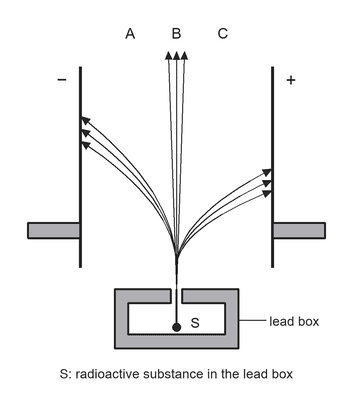
(i) Name the radiation B which is unaffected by the electrostatic field.
(ii) Why does the radiation C deflect more than A?
(iii) Which among the three causes the least biological damage externally.
(iv) Name the radiation which is used in carbon dating.
Solve with AIWritten solution
Solution:
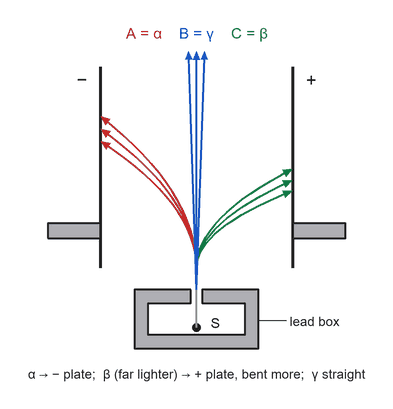
Concept: Electric and magnetic fields push only on charged particles. In an electric field a positive charge is pulled towards the negative plate and a negative charge towards the positive plate; in a magnetic field the force on a moving charge is given by Fleming's left hand rule (forefinger along the field, central finger along the current, thumb gives the force). Uncharged γ radiation goes straight on. Under the same field, a charged particle is deflected more when it is lighter: a β particle (an electron) is about 7300 times lighter than an α particle, so it bends far more, even though its charge is only half as large.
Step 1 — Identify A, B and C from the figure.
A bends towards the negative plate, so it carries a positive charge: it is α radiation. B goes straight, so it has no charge: it is γ radiation. C bends towards the positive plate, so it carries a negative charge: it is β radiation.
(i)
Step 2 — Name B.
B is γ radiation (gamma rays). It is an electromagnetic wave with no charge, so the electric field exerts no force on it.
(ii)
Step 3 — Explain why C bends more than A.
C (β particles) and A (α particles) both feel a force in the field, but a β particle is about 7300 times lighter than an α particle. So the same kind of force changes the direction of the light β particle far more, even though its charge (−e) is only half that of an α particle (+2e).
(iii)
Step 4 — Find the least harmful from outside.
A (α radiation) has the least penetrating power: it cannot get through the outer layer of the skin, so from outside the body it does the least biological damage.
(iv)
Step 5 — Name the radiation in carbon dating.
Carbon dating measures the decay of carbon-14, which decays by β emission, so the radiation used is C (β radiation).
Watch out: A positive particle bends TOWARDS the negative plate; do not mix up the side of the bend with the sign of the plate it moves away from.
Therefore, (i) B is γ radiation; (ii) C (β) deflects more than A (α) because a β particle is very much lighter than an α particle; (iii) A (α radiation) causes the least biological damage externally; (iv) C (β radiation) is used in carbon dating.
- 102 marks
Question 10
Is it possible for a hydrogen () nucleus to emit an alpha particle? Give a reason for your answer.
Solve with AIWritten solution
Solution:
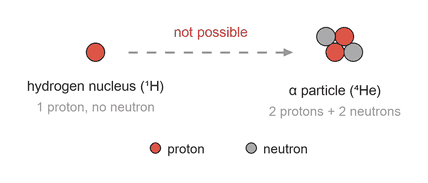
Concept: An α particle is a helium nucleus : it is made of 2 protons and 2 neutrons. A nucleus can give out only particles made of nucleons it already has.
Step 1 — Count the nucleons in hydrogen.
The nucleus has mass number 1 and atomic number 1, so it is a single proton with no neutron.
Step 2 — Compare with an α particle.
To emit an α particle, a nucleus must give up 2 protons and 2 neutrons, that is, a mass number of 4 and an atomic number of 2. The hydrogen nucleus has only 1 nucleon in all.
Step 3 — Draw the conclusion.
So the hydrogen nucleus cannot give out an α particle; it also has no other nucleons to lose.
Therefore, no, a hydrogen nucleus cannot emit an α particle, because it has only one proton and no neutron, while an α particle needs 2 protons and 2 neutrons.
- 112 marks
Question 11
(i) Why is a nuclear fusion reaction called a thermo nuclear reaction?
(ii) Complete the reaction:
Solve with AIWritten solution
Solution:
Concept: In nuclear fusion two light nuclei (such as isotopes of hydrogen) join to form a heavier nucleus, giving out a large amount of energy because the product has slightly less mass. The nuclei are positively charged and repel each other, so fusion happens only at a very high temperature, about 10⁷ K. In every nuclear change the total mass number (A) and the total atomic number (Z) are the same on both sides of the equation. An α particle is , a β particle is , a neutron is and γ radiation has A = 0 and Z = 0.
(i)
Step 1 — Explain the name.
The nuclei that fuse are positively charged, so they repel each other strongly. They can come close enough to fuse only if they move very fast, and they move this fast only at an extremely high temperature, about 10⁷ K. Because the reaction needs such great heat (thermo means heat), fusion is called a thermo-nuclear reaction.
(ii)
Step 2 — Balance the mass numbers.
Let the missing particle be . The mass numbers on both sides must be equal.
Step 3 — Balance the atomic numbers.
The atomic numbers on both sides must also be equal.
A particle with A = 1 and Z = 1 is a proton, the nucleus of hydrogen-1.
Step 4 — Write the completed reaction.
The missing product is .

Watch out: The missing particle has Z = 1, so it is a proton, not a neutron (a neutron has Z = 0).
Therefore, (i) fusion is called a thermo-nuclear reaction because it takes place only at an extremely high temperature (about 10⁷ K); (ii) the missing product is , a proton.
- 123 marks
Question 12
(i) Define nuclear fission.
(ii) Rewrite and complete the following nuclear reaction by filling in the atomic number of Ba and mass number of Kr :
Solve with AIWritten solution
Solution:
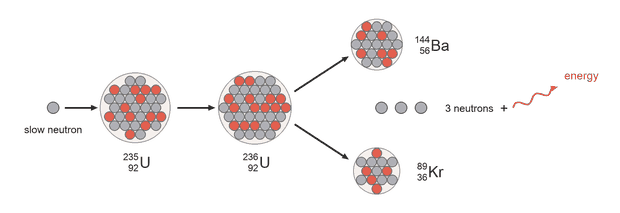
Concept: In nuclear fission a heavy nucleus such as , struck by a slow neutron, splits into two lighter nuclei of nearly equal size, giving out 2 or 3 neutrons and a large amount of energy (about 200 MeV per nucleus) because the products have slightly less mass. In every nuclear change the total mass number (A) and the total atomic number (Z) are the same on both sides of the equation. An α particle is , a β particle is , a neutron is and γ radiation has A = 0 and Z = 0.
(i)
Step 1 — Define fission.
Nuclear fission is the process in which a heavy nucleus, such as uranium-235, struck by a slow neutron, splits into two lighter nuclei of nearly equal size, giving out 2 or 3 neutrons and a large amount of energy (about 200 MeV per nucleus).
(ii)
Step 2 — Find the atomic number of Ba.
The atomic numbers on the left add up to 92 + 0. On the right they are Z (barium), 36 (krypton) and 0 for each neutron.
Step 3 — Find the mass number of Kr.
The mass numbers on the left add up to 235 + 1. On the right they are 144, A (krypton) and 1 for each of the 3 neutrons.
Step 4 — Rewrite the completed reaction.
Both totals now balance: 236 on each side for A and 92 for Z.
Watch out: Count all THREE neutrons on the right (3 × 1 = 3) and the incoming neutron on the left.
Therefore, (i) nuclear fission is the splitting of a heavy nucleus into two lighter nuclei of nearly equal size, with the release of neutrons and a large amount of energy; (ii) the atomic number of Ba is 56 and the mass number of Kr is 89.
- 132 marks
Question 13
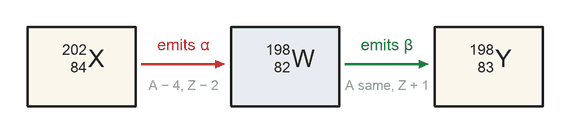
A nucleus of an element emits an alpha particle followed by a beta particle. The final nucleus is . Find a and b.
Solve with AIWritten solution
Solution:
Concept: In α emission the nucleus throws out 2 protons and 2 neutrons together, so A falls by 4 and Z falls by 2: a new element, two places back in the periodic table. In β emission a neutron inside the nucleus changes into a proton and an electron, and the electron is thrown out. So A stays the same and Z rises by 1: a new element, one place forward in the periodic table.
Step 1 — Read the symbol.
The question writes the nucleus as : the atomic number 84 is at the lower left and the mass number 202 at the upper right.
Step 2 — Apply the α emission.
The α particle takes away 4 from A and 2 from Z. We call the new nucleus W.
Step 3 — Apply the β emission.
The β particle leaves A unchanged and raises Z by 1.
Watch out: Do the emissions in order, and remember that β emission RAISES the atomic number.
Therefore, a = 83 and b = 198; the final nucleus is .
- 143 marks
Question 14
(i) Differentiate between nuclear fusion and nuclear fission.
(ii) State one safety precaution in the disposal of nuclear waste.
Solve with AIWritten solution
Solution:
Concept: Fission splits one heavy nucleus; fusion joins two light nuclei. Both release energy because the products have slightly less mass than the starting nuclei. Spent fission fuel stays highly radioactive for thousands of years, so it must be kept away from people and the environment.
(i)
Step 1 — Compare the two processes.
The table compares them point by point.
Nuclear fission Nuclear fusion A heavy nucleus splits into two lighter nuclei of nearly equal size when struck by a neutron. Two light nuclei combine to form a heavier nucleus. It takes place at ordinary temperature. It needs a very high temperature (about 10⁷ K) and pressure. For the same mass of fuel, less energy is released. For the same mass of fuel, about four times as much energy is released. Its products are strongly radioactive and stay so for a very long time. It gives far less radioactive waste, and that waste is short-lived. 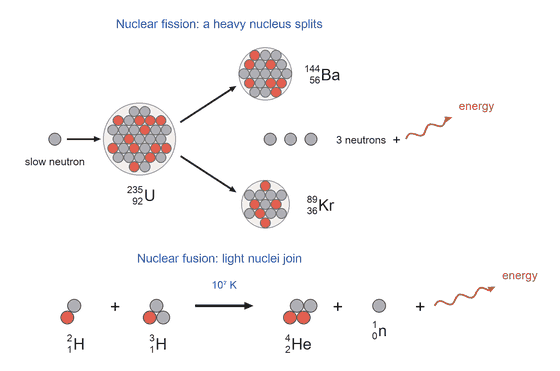
(ii)
Step 2 — State a safety precaution.
Nuclear waste should be sealed in thick, strong containers (for example of steel and concrete) and stored deep underground in specially built stores, far away from where people live, so that its radiation cannot reach water, soil or people.
Watch out: Fusion is not completely free of radioactivity: tritium is mildly radioactive and the fast neutrons make the reactor walls radioactive, but the waste is far smaller and much shorter-lived than fission waste.
Therefore, (i) fission is the splitting of a heavy nucleus at ordinary temperature, while fusion is the joining of light nuclei at about 10⁷ K and gives more energy per unit mass with far less radioactive waste; (ii) nuclear waste should be sealed in thick containers and buried deep underground, far from populated areas.
- 154 marks
Question 15
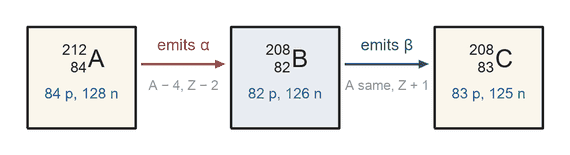
An atomic nucleus A is composed of 84 protons and 128 neutrons. The nucleus A emits an alpha particle and is transformed into a nucleus B.
(i) What is the composition of B?
(ii) The nucleus B emits a beta particle and is transformed into a nucleus C. What is the composition of C?
(iii) What is mass number of the nucleus A?
(iv) Does the composition of C change if it emits gamma radiations?
Solve with AIWritten solution
Solution:
Concept: An α particle takes away 2 protons and 2 neutrons. In β emission one neutron changes into a proton (the electron formed is thrown out). γ emission takes away only energy.
(i)
Step 1 — Find the composition of B.
The α particle takes 2 protons and 2 neutrons out of A.
So B has 82 protons and 126 neutrons (mass number 208).
(ii)
Step 2 — Find the composition of C.
One neutron of B changes into a proton.
So C has 83 protons and 125 neutrons (mass number still 208).
(iii)
Step 3 — Find the mass number of A.
The mass number is the total number of protons and neutrons.
(iv)
Step 4 — Consider γ emission.
γ radiation is an electromagnetic wave with no charge and no mass, so it carries away only energy; the numbers of protons and neutrons in C do not change.
Watch out: In β emission the number of nucleons stays the same: one neutron becomes one proton.
Therefore, (i) B has 82 protons and 126 neutrons; (ii) C has 83 protons and 125 neutrons; (iii) the mass number of A is 212; (iv) no, γ emission does not change the composition of C.
- 161 mark
Question 16
The heaviest nuclear radiation is :
Solve with AIAnswer
(A) x-radiation
- Correct
(B) α-radiation
(C) γ-radiation
(D) β−radiation
Answer: (B) α-radiation
Concept: Compare what each radiation is made of: α radiation is a stream of helium nuclei, β radiation a stream of electrons, and γ radiation and X-rays are electromagnetic waves, which have no mass.
Step 1 — Find the mass of an α particle.
An α particle is a helium nucleus with 2 protons and 2 neutrons, so its mass is about 4 u, about 4 times the mass of a proton.
Step 2 — Compare with the others.
A β particle is an electron, about 7300 times lighter than an α particle. γ rays and X-rays are electromagnetic waves (photons), with no mass at all. So α radiation is the heaviest.
Watch out: X-rays are not a nuclear radiation at all; they come from the electron shells or from fast electrons being stopped.
Why the other options are wrong:
- (A) x-radiation: X-rays are electromagnetic waves with no mass; they are not even given out by the nucleus.
- (C) γ-radiation: γ rays are electromagnetic waves with no mass.
- (D) β−radiation: a β particle is an electron, about 7300 times lighter than an α particle.
Therefore, the heaviest nuclear radiation is α-radiation, option (B).
- 171 mark
Question 17
To study the age of excavated material of archaeological significance we study the rate of decay of an isotope of :
Solve with AIAnswer
(A) Uranium
(B) Cobalt
- Correct
(C) Carbon
(D) Chlorine
Answer: (C) Carbon
Concept: The age of excavated remains of once-living things (wood, bone, cloth) is found by carbon dating, which measures how much radioactive carbon-14 is left in them.
Step 1 — See how carbon-14 gets into living things.
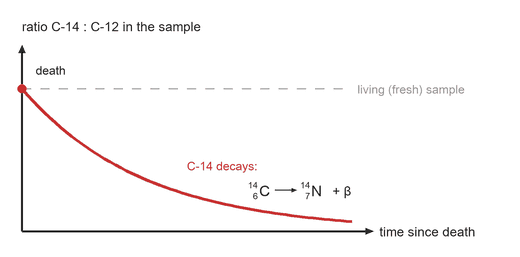
Every living plant or animal keeps taking in carbon (as carbon dioxide or food), and a small, fixed share of it is radioactive carbon-14.
Step 2 — See what happens after death.
After death no new carbon-14 is taken in, and the carbon-14 already present keeps decaying by β emission at a known rate. Measuring how much is left tells how long ago the plant or animal died.
Watch out: The method works only for things that were once alive, because only they took in carbon-14.
Why the other options are wrong:
- (A) Uranium: uranium is used to date old rocks, over billions of years; living things do not take it in, so it cannot date archaeological remains.
- (B) Cobalt: the radio isotope cobalt-60 is used in radiotherapy to treat cancer and to sterilise equipment, not for dating.
- (D) Chlorine: living things do not take in a radioactive chlorine isotope in a fixed share, so chlorine cannot date archaeological remains.
Therefore, the age of excavated material is found from the rate of decay of an isotope of carbon (carbon-14), option (C).
- 184 marks
Question 18
(a) What is nuclear energy?
(b) After emission of a nuclear radiation, the atomic number of the daughter nucleus increases by 1. Identify the nuclear radiation.
(c) Write a nuclear reaction indicating the nuclear change mentioned in (b).
(d) What is the special name given to the parent and daughter nucleus when this radiation is emitted?
Solve with AIWritten solution
Solution:
Concept: Einstein's mass–energy relation E = (Δm)c² says that a mass Δm that disappears in a nuclear change reappears as energy E, where c = 3 × 10⁸ m s⁻¹ is the speed of light. In atomic units, a mass of 1 a.m.u. is equivalent to 931 MeV. In β emission a neutron inside the nucleus changes into a proton and an electron, and the electron is thrown out. So A stays the same and Z rises by 1: a new element, one place forward in the periodic table.
(a)
Step 1 — Define nuclear energy.
Nuclear energy is the energy released from the nucleus of an atom in a nuclear reaction, fission or fusion. The products have slightly less mass than the reactants, and this lost mass Δm is changed into energy.
(b)
Step 2 — Identify the radiation.
A rise of 1 in the atomic number means one extra proton. This happens in β emission, when a neutron changes into a proton and an electron and the electron is thrown out. So the radiation is β radiation, .
(c)
Step 3 — Write the nuclear reaction.
The mass number stays A and the atomic number rises from Z to Z + 1.
For example, sodium-24 changes into magnesium-24:
(d)
Step 4 — Name the pair.
The parent and the daughter have the same mass number but different atomic numbers, so they are called isobars.
Watch out: In β emission the mass number does NOT change, so parent and daughter are isobars, not isotopes.
Therefore, (a) nuclear energy is the energy released from the nucleus in fission or fusion, from a loss of mass; (b) β radiation; (c) ; (d) isobars.
- 193 marks
Question 19
A certain beam of α particles, β particles and γ radiations travel through a region of electric field produced between two oppositely charged parallel plates A(+) and B(–).

(a) Which of the above three has the maximum speed?
(b) Which one deviates the most from its original path?
(c) Which one does not deviate at all when passing through a region of electric or magnetic field?
Solve with AIWritten solution
Solution:
Concept: Electric and magnetic fields push only on charged particles. In an electric field a positive charge is pulled towards the negative plate and a negative charge towards the positive plate; in a magnetic field the force on a moving charge is given by Fleming's left hand rule (forefinger along the field, central finger along the current, thumb gives the force). Uncharged γ radiation goes straight on. Under the same field, a charged particle is deflected more when it is lighter: a β particle (an electron) is about 7300 times lighter than an α particle, so it bends far more, even though its charge is only half as large.
(a)
Step 1 — Compare the speeds.
γ radiation is an electromagnetic wave, so it travels at the speed of light, . β particles reach up to about 99% of this speed, and α particles move at only about (about one-twentieth of it). So γ radiation is the fastest.
(b)
Step 2 — Find the one deviated most.
β particles are negatively charged and very light, so they bend sharply towards the positive plate A. The heavy α particles bend only a little, towards the negative plate B.

(c)
Step 3 — Find the one not deviated.
γ radiation carries no charge, so neither an electric nor a magnetic field exerts any force on it, and it goes straight on.
Watch out: β particles are the lightest, so they deviate the MOST; γ has no charge, so it does not deviate at all.
Therefore, (a) γ radiation has the maximum speed; (b) β particles deviate the most; (c) γ radiation does not deviate at all.
- 201 mark
Question 20
Which of the following radiations suffer maximum deflection in a magnetic field?
Solve with AIAnswer
(A) Alpha radiations
- Correct
(B) Beta radiations
(C) Gamma radiations
(D) X-radiations
Answer: (B) Beta radiations
Concept: Electric and magnetic fields push only on charged particles. In an electric field a positive charge is pulled towards the negative plate and a negative charge towards the positive plate; in a magnetic field the force on a moving charge is given by Fleming's left hand rule (forefinger along the field, central finger along the current, thumb gives the force). Uncharged γ radiation goes straight on. Under the same field, a lighter charged particle is deflected more.
Step 1 — Pick out the charged radiations.
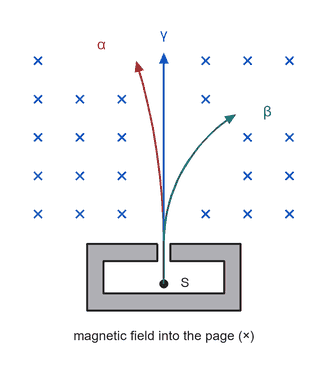
α and β particles are charged, so the magnetic field deflects both, in opposite directions (by Fleming's left hand rule). γ rays and X-rays have no charge.
Step 2 — Compare their masses.
A β particle (an electron) is about 7300 times lighter than an α particle, so its path bends far more sharply. β radiation suffers the maximum deflection.
Watch out: Both α and β are deflected; the question asks which one is deflected the MOST.
Why the other options are wrong:
- (A) Alpha radiations: α particles are deflected, but only slightly, because they are heavy.
- (C) Gamma radiations: γ rays have no charge, so they are not deflected at all.
- (D) X-radiations: X-rays are electromagnetic waves with no charge, so they are not deflected either.
Therefore, β radiation suffers the maximum deflection in a magnetic field, option (B).
- 212 marks
Question 21
How is the radioactivity of a radio isotope affected if it undergoes a chemical change? Give a reason for your answer.
Solve with AIWritten solution
Solution:
Concept: Radioactivity is a nuclear process: it comes from an unstable nucleus. A chemical change (such as oxidation) involves only the outer electrons of the atom, so it cannot change the nucleus, its radiation or its rate of decay.
Step 1 — Say what a chemical change involves.
In a chemical change atoms form or break bonds by sharing or transferring their outer (valence) electrons. Only the outer electrons take part.
Step 2 — Say where radioactivity comes from.
Radioactivity is the spontaneous break-up of an unstable nucleus. No chemical change reaches the nucleus, and neither do physical changes such as heating or pressure.
Step 3 — Draw the conclusion.
So the radio isotope gives out the same kind of radiation at the same rate, whatever compound it is in.
Watch out: A chemical change makes a new substance, but the radioactive nuclei inside it are the same as before.
Therefore, the radioactivity of the radio isotope remains unaffected, because a chemical change involves only the outer electrons, while radioactivity is a nuclear property.
- 223 marks
Question 22
(a) Complete the following nuclear changes:
(b) Name the nuclear radiation which has the highest ionizing power.
Solve with AIWritten solution
Solution:
Concept: In α emission the nucleus throws out 2 protons and 2 neutrons together, so A falls by 4 and Z falls by 2: a new element, two places back in the periodic table. In β emission a neutron inside the nucleus changes into a proton and an electron, and the electron is thrown out. So A stays the same and Z rises by 1: a new element, one place forward in the periodic table. α particles are helium nuclei (charge +2e, about 4 times the mass of a proton); β particles are fast electrons (charge −e); γ radiation is an electromagnetic wave with no charge and no mass. α ionises the most and penetrates the least; γ ionises the least and penetrates the most.
(a)
Step 1 — Read the chain.
P gives out an α particle and becomes Q; Q then gives out a β particle and becomes R.
Step 2 — Find Q (α emission).
The α particle takes away 4 from A and 2 from Z.
Step 3 — Find R (β emission).
The β particle leaves A unchanged and raises Z by 1.

(b)
Step 4 — Name the strongest ioniser.
α radiation has the highest ionising power, about 100 times that of β particles and 10,000 times that of γ radiation, because α particles are heavy, doubly charged and comparatively slow.
Watch out: β emission does not change A; only Z goes up by 1.
Therefore, (a) ; (b) α radiation has the highest ionising power.
- 233 marks
Question 23
(a) Which nuclear radiation will travel undeviated in an electric field?
(b) How can one stop the radiations escaping from a nuclear reactor in a nuclear power plant?
(c) Name one internal source of background radiations.
Solve with AIWritten solution
Solution:
Concept: Electric and magnetic fields push only on charged particles. In an electric field a positive charge is pulled towards the negative plate and a negative charge towards the positive plate; in a magnetic field the force on a moving charge is given by Fleming's left hand rule (forefinger along the field, central finger along the current, thumb gives the force). Uncharged γ radiation goes straight on. Thick, dense materials such as lead, steel and concrete absorb nuclear radiations.
(a)
Step 1 — Find the undeviated radiation.
γ radiation carries no charge, so the electric field exerts no force on it and it travels undeviated.
(b)
Step 2 — Stop the radiation escaping.
The reactor core is shielded by thick walls of lead and steel, and the whole reactor is housed in a strong, airtight building of thick concrete. These thick walls absorb the radiations so that they cannot escape into the surroundings.
(c)
Step 3 — Name an internal source.
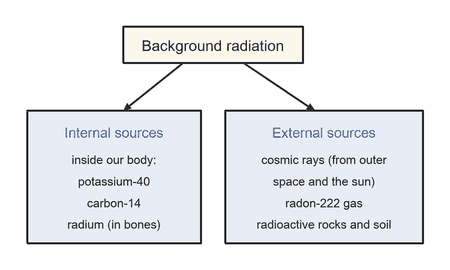
Background radiation also comes from inside our own body. Radioactive potassium-40 is present in our body, along with traces of carbon-14 and radium.
Watch out: An INTERNAL source is inside our body; cosmic rays and radon in the air are external sources.
Therefore, (a) γ radiation travels undeviated; (b) by shielding the reactor with thick lead and steel and housing it in a building with thick concrete walls; (c) radioactive potassium-40 inside our body.
- 241 mark
Question 24
A radioactive nucleus containing 128 nucleons emits a β – particle. After β – emission the number of nucleons present in the nucleus will be :
Solve with AIAnswer
- Correct
(A) 128
(B) 129
(C) 124
(D) 127
Answer: (A) 128
Concept: The number of nucleons (protons + neutrons) is the mass number A. In β emission a neutron inside the nucleus changes into a proton and an electron, and the electron is thrown out. So A stays the same and Z rises by 1: a new element, one place forward in the periodic table.
Step 1 — See what happens to the nucleons.
In β emission one neutron inside the nucleus turns into a proton. One nucleon changes its type, but no nucleon leaves the nucleus.
Step 2 — Count the nucleons after.
The electron that is thrown out is not a nucleon, so the count does not change.
The nucleus now has one neutron fewer and one proton more.
Watch out: The electron given out is created in the decay; it was never one of the 128 nucleons.
Why the other options are wrong:
- (B) 129: β emission adds no nucleon to the nucleus, so the count cannot rise to 129.
- (C) 124: a fall of 4 nucleons happens in α emission, not in β emission.
- (D) 127: the electron given out is not a nucleon, so the count does not fall by 1.
Therefore, the nucleus still has 128 nucleons, option (A).
- 251 mark
Question 25
A radioactive element is placed in an evacuated chamber. Then the rate of radioactive decay will:
Solve with AIAnswer
(A) Decrease
(B) Increase
- Correct
(C) Remain unchanged
(D) Depend on the surrounding temperature
Answer: (C) Remain unchanged
Concept: Radioactivity is a nuclear process: it comes from an unstable nucleus. Physical conditions (temperature, pressure) and chemical changes act only on the outer electrons, so they do not change the rate of radioactive decay.
Step 1 — See what the chamber changes.
Removing the air from the chamber changes only the pressure and the gas around the element.
Step 2 — See what this does to the nuclei.
These conditions do not reach the nucleus, and the decay of each unstable nucleus happens spontaneously. So the rate of radioactive decay remains unchanged.
Watch out: A vacuum changes the surroundings, not the nucleus; nothing outside the nucleus can speed up or slow down its decay.
Why the other options are wrong:
- (A) Decrease: removing the air does not slow down the decay of the nuclei.
- (B) Increase: removing the air does not speed up the decay either.
- (D) Depend on the surrounding temperature: the rate of radioactive decay does not depend on the surrounding temperature at all.
Therefore, the rate of radioactive decay remains unchanged, option (C).
- 263 marks
Question 26
(a) In the following atoms, which one is a radioisotope? Give one use of this isotope.
, , ,
(b) Name the class of the lever shown in the picture below :
 Solve with AI
Written solution
Solution:
Concept: A radio isotope is a radioactive isotope of an element; in a light nucleus this happens when there are more neutrons than the nucleus can hold stably. A lever is a rigid bar turning about a fixed point, the fulcrum F; its class depends on which of the fulcrum, the load L and the effort E is in the middle.
(a)
Step 1 — Count the protons and neutrons.
The neutrons are A − Z for each nucleus.
Step 2 — Pick the radio isotope.
Oxygen-16, nitrogen-14 and helium-4 have equal numbers of protons and neutrons and are stable. Carbon-14 has 6 protons but 8 neutrons, too many for so light a nucleus, so it is unstable and decays by β emission. Carbon-14 is the radio isotope.
Step 3 — Give a use.
Carbon-14 is used in carbon dating, to find the age of excavated material of archaeological importance, such as old wood, bones and cloth.
(b)
Step 4 — Locate F, L and E on the opener.
The front end of the opener presses on the top of the cap; the opener turns about this point, so it is the fulcrum F. The hook grips the edge of the cap, which resists, so the load L acts there. The hand pulls the far end of the handle upward, so the effort E acts there.

Step 5 — Name the class.
The load lies between the fulcrum and the effort, so the bottle opener is a class II lever. Its effort arm is longer than its load arm, so it works as a force multiplier.
Watch out: The class depends on which point is in the MIDDLE: F in the middle is class I, L in the middle class II, E in the middle class III.
Therefore, (a) (carbon-14) is the radio isotope, used in carbon dating to find the age of archaeological remains; (b) the bottle opener is a class II lever.
- 272 marks
Question 27
Copy and complete the nuclear reaction by filling in the blanks.
Solve with AIWritten solution
Solution:
Concept: In every nuclear change the total mass number (A) and the total atomic number (Z) are the same on both sides of the equation. An α particle is , a β particle is , a neutron is and γ radiation has A = 0 and Z = 0.
Step 1 — Read the symbols.
The question writes each nucleus as : the atomic number at the lower left and the mass number at the upper right.
Step 2 — Find the mass number of Ba.
The mass numbers on the left add up to 235 + 1. On the right they are A (barium), 92 (krypton) and 1 for each of the 3 neutrons.
Step 3 — Find the atomic number of Kr.
The atomic numbers on the left add up to 92 + 0. On the right they are 56 (barium), Z (krypton) and 0 for each neutron.
Step 4 — Write the completed reaction.
This is the fission of uranium-235 by a neutron; a large amount of energy is also released.

Watch out: Count the incoming neutron on the left and all three neutrons on the right.
Therefore, the mass number of Ba is 141 and the atomic number of Kr is 36: and .
- 283 marks
Question 28
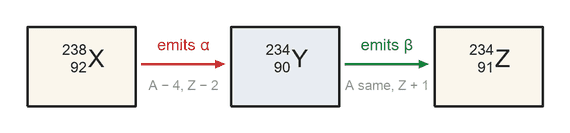
(a) Complete the following radioactive reaction :
(b) Uranium is available in two forms U-235 and U-238. Which of the two isotopes of Uranium is more fissionable?
Solve with AIWritten solution
Solution:
Concept: In α emission the nucleus throws out 2 protons and 2 neutrons together, so A falls by 4 and Z falls by 2: a new element, two places back in the periodic table. In β emission a neutron inside the nucleus changes into a proton and an electron, and the electron is thrown out. So A stays the same and Z rises by 1: a new element, one place forward in the periodic table. Here we know the last nucleus, so we work backwards: undo each emission in turn.
(a)
Step 1 — Find Y, which gives Z by β emission.
β emission keeps A and raises Z by 1, so Y has the same mass number as Z and an atomic number 1 less.
Step 2 — Find X, which gives Y by α emission.
α emission lowers A by 4 and Z by 2, so X has 4 more in A and 2 more in Z than Y.
Step 3 — Write the completed chain.
With Z = 92 and A = 238, X is uranium-238.
(b)
Step 4 — Name the more fissionable isotope.
U-235 can be split even by slow neutrons, whereas U-238 can be split only by fast neutrons. So U-235 is the more fissionable isotope.
Watch out: When working backwards, undoing a β emission LOWERS Z by 1, and undoing an α emission ADDS 4 to A and 2 to Z.
Therefore, (a) ; (b) U-235 is more fissionable.
- 291 mark
Question 29
A radioactive element P emits one α-particle and transforms to a new element Q. What will be the position of the element Q in the periodic table?
Solve with AIAnswer
(A) One group to the left of P
(B) One group to the right of P
(C) Two groups to the right of P
- Correct
(D) Two groups to the left of P
Answer: (D) Two groups to the left of P
Concept: The position of an element in the periodic table is fixed by its atomic number. In α emission the nucleus throws out 2 protons and 2 neutrons together, so A falls by 4 and Z falls by 2: a new element, two places back in the periodic table.
Step 1 — Find the change in atomic number.
After α emission, the atomic number of Q is 2 less than that of P.
Step 2 — Move in the periodic table.
An atomic number 2 less means Q lies two places back, that is, two groups to the left of P. For example, polonium-210 (Z = 84, group 16) gives out an α particle and becomes lead-206 (Z = 82, group 14).

Watch out: Α emission LOWERS Z, so the new element moves to the LEFT; β emission raises Z and moves it to the right.
Why the other options are wrong:
- (A) One group to the left of P: one group to the left needs Z to fall by 1, but α emission lowers Z by 2.
- (B) One group to the right of P: one group to the right happens in β emission, which raises Z by 1.
- (C) Two groups to the right of P: two groups to the right needs Z to rise by 2, but α emission lowers Z.
Therefore, the element Q lies two groups to the left of P, option (D).
- 301 mark
Question 30
Complete the following by choosing the correct answers from the bracket:
The nuclear radiation with lowest ionising power is ............... [α/β/γ]
Solve with AIWritten solution
Solution:
Concept: α particles are helium nuclei (charge +2e, about 4 times the mass of a proton); β particles are fast electrons (charge −e); γ radiation is an electromagnetic wave with no charge and no mass. α ionises the most and penetrates the least; γ ionises the least and penetrates the most.
Step 1 — Recall what makes a radiation ionise.
A radiation ionises a gas by knocking electrons out of its atoms. A heavy, charged, slow particle does this most often; an uncharged wave does it least.
Step 2 — Compare α, β and γ.
γ radiation has no charge and moves at the speed of light, so it ionises very few atoms on its way: about 1/100 as many as β particles and 1/10,000 as many as α particles.
Watch out: Lowest ionising power goes with the HIGHEST penetrating power; both belong to γ.
Therefore, the nuclear radiation with lowest ionising power is γ.
- 313 marks
Question 31
Curium is a radioactive element with the symbol named in honour of Madam Curie. The graph of number of protons vs number of neutrons for some elements are shown below :
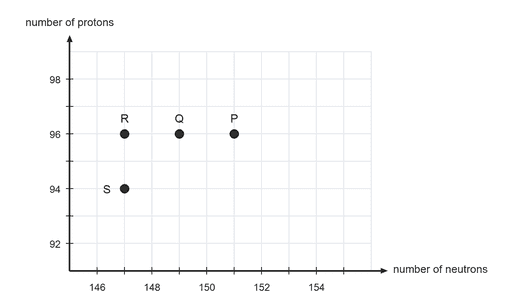
(a) Which point on the graph indicates the element Cm?
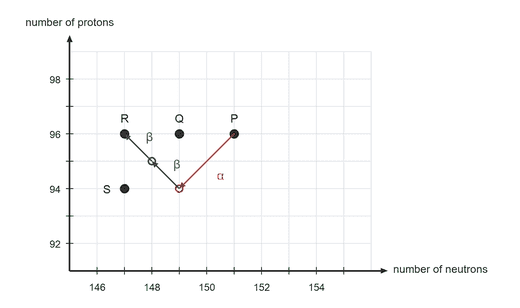
(b) Which point on the graph indicates daughter nucleus after Cm undergoes radioactive decay of 1α followed by 2β?
(c) State the mass number of the daughter nucleus.
Solve with AIWritten solution
Solution:
Concept: On a graph of the number of protons Z against the number of neutrons N, every nucleus is one point, and its mass number is A = Z + N. α emission moves the point by Z − 2 and N − 2; β emission (a neutron turning into a proton) moves it by Z + 1 and N − 1; γ emission does not move it.
(a)
Step 1 — Find the point for Cm.
Curium-247 has 96 protons, and its neutrons are A − Z.
The point at 151 neutrons and 96 protons is P.
(b)
Step 2 — Apply the α emission.
α emission takes 2 protons and 2 neutrons away.
Step 3 — Apply the two β emissions.
Each β emission turns one neutron into a proton.
The point at 147 neutrons and 96 protons is R. Its atomic number is 96 again, so the daughter is another isotope of curium.
(c)
Step 4 — Find the mass number.
The mass number is the number of protons plus the number of neutrons.
Watch out: Read the axes the right way round: neutrons are along the horizontal axis and protons up the vertical axis.
Therefore, (a) P is the element Cm; (b) R is the daughter nucleus; (c) its mass number is 243.
- 323 marks
Question 32
Study the diagram given below and answer the questions that follow :
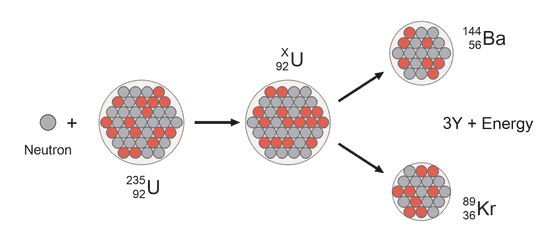
(a) Name the process depicted in the diagram.
(b) What is the value of X?
(c) Identify Y, the missing product of the reaction.
Solve with AIWritten solution
Solution:
Concept: In nuclear fission a heavy nucleus such as , struck by a slow neutron, splits into two lighter nuclei of nearly equal size, giving out 2 or 3 neutrons and a large amount of energy (about 200 MeV per nucleus) because the products have slightly less mass. In every nuclear change the total mass number (A) and the total atomic number (Z) are the same on both sides of the equation. An α particle is , a β particle is , a neutron is and γ radiation has A = 0 and Z = 0.
(a)
Step 1 — Name the process.
A neutron strikes uranium-235, which becomes unstable and splits into two middle-sized nuclei, barium and krypton, with the release of energy. This is nuclear fission.
(b)
Step 2 — Find X.
The uranium-235 nucleus absorbs the neutron (mass number 1) and becomes ; the atomic number stays 92 because a neutron has no charge.
(c)
Step 3 — Balance the mass numbers.
Uranium-236 splits into barium-144, krypton-89 and three particles Y, so the three Y together carry the rest of the mass number.
Step 4 — Balance the atomic numbers.
The atomic numbers must also balance.
A particle with A = 1 and Z = 0 is a neutron.
Watch out: The three neutrons released can go on to split more uranium nuclei: this is how a chain reaction starts.
Therefore, (a) the process is nuclear fission; (b) X = 236; (c) Y is a neutron, .
- 331 mark
Question 33
During β emission the parent and daughter nuclei will be:
Solve with AIAnswer
(A) isomers
(B) isotopes
(C) isotones
- Correct
(D) isobars
Answer: (D) isobars
Concept: Isotopes have the same atomic number Z but different mass numbers A (same element, different numbers of neutrons). Isobars have the same A but different Z (different elements). Isotones have the same number of neutrons (A − Z) but different Z. In β emission a neutron inside the nucleus changes into a proton and an electron, and the electron is thrown out. So A stays the same and Z rises by 1: a new element, one place forward in the periodic table.
Step 1 — Compare the mass numbers.
In β emission the number of nucleons does not change, so the daughter has the same mass number as the parent.
Step 2 — Compare the atomic numbers.
The daughter has one more proton, so its atomic number is one more and it is a different element. Nuclei with the same mass number but different atomic numbers are isobars; for example, sodium-24 gives magnesium-24.
Watch out: Same A and different Z means isobars; same Z and different A means isotopes.
Why the other options are wrong:
- (A) isomers: nuclear isomers are the same nucleus (same A and same Z) in different energy states, but β emission changes Z.
- (B) isotopes: isotopes have the same atomic number, but β emission changes the atomic number.
- (C) isotones: isotones have the same number of neutrons, but in β emission the number of neutrons falls by 1.
Therefore, the parent and daughter nuclei in β emission are isobars, option (D).
- 341 mark
Question 34
Complete the following by choosing the correct answers from the bracket:
In a nuclear reactor, the fission reaction is initiated by bombardment with ............... [a proton / a neutron / an α particle].
Solve with AIWritten solution
Solution:
Concept: In nuclear fission a heavy nucleus such as , struck by a slow neutron, splits into two lighter nuclei of nearly equal size, giving out 2 or 3 neutrons and a large amount of energy (about 200 MeV per nucleus) because the products have slightly less mass.
Step 1 — Compare the charges.
The nucleus is positively charged. A proton and an α particle are also positive, so the nucleus repels them strongly. A neutron has no charge, so it is not repelled and can easily enter the nucleus.
Step 2 — Describe what follows.
A slow neutron absorbed by a uranium-235 nucleus makes it unstable, and it splits. The 2 or 3 neutrons given out go on to split more nuclei and keep the chain reaction going.
Therefore, in a nuclear reactor, the fission reaction is initiated by bombardment with a neutron.
- 352 marks
Question 35
Define background radiation. Give one internal source of this radiation.
Solve with AIWritten solution
Solution:
Concept: Some nuclear radiation is present around us and inside us all the time, even when no radioactive source is in sight.
Step 1 — Define background radiation.
The radiations (such as α, β and γ) to which we are all exposed all the time, even in the absence of any visible radioactive source, are called background radiation.
Step 2 — Name an internal source.
Some background radiation comes from inside our own body. Radioactive potassium-40 is present in our body, along with traces of carbon-14 and radium.
Step 3 — Contrast with external sources.
External sources are outside the body: cosmic rays from outer space and the sun, radon-222 gas in the air, and radioactive rocks and soil.
Watch out: An INTERNAL source is inside the body; cosmic rays and radon in the air are external.
Therefore, background radiation is the radiation to which we are exposed all the time even without a visible radioactive source; one internal source is radioactive potassium-40 in our body.
- 363 marks
Question 36
Astatine (At) is a radioactive element. Study the graph given below showing the number of protons vs the number of neutrons of radioactive nuclei.

(a) Identify the mass number of the nucleus Astatine (At).
(b) Which line on the graph (l, m, n, or q) will never pass through the position of the daughter nuclei, regardless of any number of α, β, or γ emissions?
(c) Give a reason for your choice in (b).
Solve with AIWritten solution
Solution:
Concept: On a graph of the number of protons Z against the number of neutrons N, every nucleus is one point, and its mass number is A = Z + N. α emission moves the point by Z − 2 and N − 2; β emission (a neutron turning into a proton) moves it by Z + 1 and N − 1; γ emission does not move it.
(a)
Step 1 — Read At from the graph.
The point for astatine is at 85 protons and 126 neutrons, so its mass number is their sum.
So the nucleus is .
(b)
Step 2 — See how each emission moves the point.
α emission lowers the number of neutrons by 2, β emission lowers it by 1 (a neutron becomes a proton), and γ emission leaves it unchanged. No emission ever raises the number of neutrons.
Step 3 — Test each line.
Line m is the line of 127 neutrons, one more than At has, so no daughter can ever lie on it. The other lines can be reached: one β emission gives 86 protons and 125 neutrons (on lines n and l), and one α emission gives 83 protons (on line q).

(c)
Step 4 — Give the reason.
Every daughter has 126 neutrons or fewer, because the number of neutrons never increases in α, β or γ emission; line m needs 127 neutrons.
Watch out: A line of constant PROTON number can be reached (β raises Z, α lowers it); the line out of reach is the one needing MORE neutrons.
Therefore, (a) the mass number of astatine is 211; (b) line m; (c) line m stands for 127 neutrons, but no α, β or γ emission ever increases the number of neutrons, so a daughter of At (126 neutrons) can never reach it.
- 373 marks
Question 37
Study the diagram and answer the questions that follow:
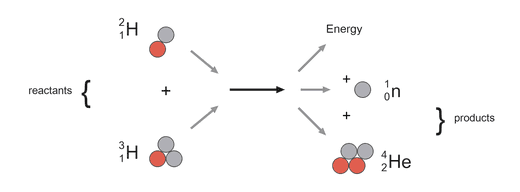
(a) Name the nuclear process displayed in the diagram.
(b) Is it possible to conduct this process at room temperature?
(c) Mass of reactants ............... mass of the products.
[Fill in the blank using <, > or =]
Solve with AIWritten solution
Solution:
Concept: In nuclear fusion two light nuclei (such as isotopes of hydrogen) join to form a heavier nucleus, giving out a large amount of energy because the product has slightly less mass. The nuclei are positively charged and repel each other, so fusion happens only at a very high temperature, about 10⁷ K. Einstein's mass–energy relation E = (Δm)c² says that a mass Δm that disappears in a nuclear change reappears as energy E, where c = 3 × 10⁸ m s⁻¹ is the speed of light. In atomic units, a mass of 1 a.m.u. is equivalent to 931 MeV.
(a)
Step 1 — Name the process.
Hydrogen-2 and hydrogen-3, two light nuclei, join to form helium-4 and a neutron, giving out energy. This is nuclear fusion.
(b)
Step 2 — Consider room temperature.
The two nuclei are positively charged and repel each other strongly. They can come close enough to fuse only when they move extremely fast, which needs a temperature of about 10⁷ K and a very high pressure. At room temperature they are far too slow, so the process is not possible there.
(c)
Step 3 — Compare the masses.
The energy given out comes from mass that disappears, so the products together have less mass than the reactants, by about 17.6 MeV worth of mass for each fusion.
Watch out: The energy comes FROM the lost mass, so the reactants must be the heavier side.
Therefore, (a) nuclear fusion; (b) no, fusion needs an extremely high temperature (about 10⁷ K); (c) mass of reactants > mass of the products.
- 381 mark
Question 38
An atom of lithium contains 3 electrons, 3 protons and 4 neutrons. Its mass number is:
Solve with AIAnswer
(A) 3
(B) 4
- Correct
(C) 7
(D) 10
Answer: (C) 7
Concept: An atom has a tiny nucleus of protons and neutrons (together called nucleons) with electrons outside it. The atomic number Z is the number of protons; the mass number A is the number of nucleons (protons + neutrons). So the number of neutrons is A − Z, and a neutral atom has Z electrons.
Step 1 — Pick out the nucleons.
The protons and neutrons are in the nucleus, so they are the nucleons; the electrons are outside the nucleus and are not counted.
Step 2 — Add them.
The mass number is the number of protons plus the number of neutrons.
So the atom is .
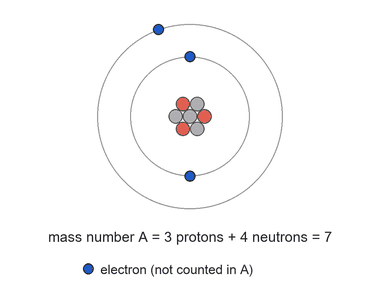
Watch out: Do not add the electrons; they are not nucleons.
Why the other options are wrong:
- (A) 3: 3 is the atomic number (the number of protons), not the mass number.
- (B) 4: 4 is the number of neutrons alone.
- (D) 10: 10 wrongly adds the 3 electrons as well (3 + 3 + 4); electrons are not nucleons.
Therefore, the mass number of the lithium atom is 7, option (C).
- 391 mark
Question 39
Complete the following by choosing the correct answers from the bracket:
............... radiation deviates minimum in a magnetic field [Alpha / Beta].
Solve with AIWritten solution
Solution:
Concept: Electric and magnetic fields push only on charged particles. In an electric field a positive charge is pulled towards the negative plate and a negative charge towards the positive plate; in a magnetic field the force on a moving charge is given by Fleming's left hand rule (forefinger along the field, central finger along the current, thumb gives the force). Uncharged γ radiation goes straight on. Under the same field, a heavier charged particle is deflected less.
Step 1 — Compare the two particles.
Both α and β particles are charged, so a magnetic field deflects both, in opposite directions.
Step 2 — Compare their masses.
An α particle is about 7300 times as heavy as a β particle (an electron), so its path bends only slightly, while the light β particles bend sharply.
Watch out: Both are deflected; the question asks which one is deflected LEAST.
Therefore, Alpha radiation deviates minimum in a magnetic field.
- 402 marks
Question 40
Give two differences between nuclear fission and nuclear fusion.
Solve with AIWritten solution
Solution:
Concept: Fission splits one heavy nucleus; fusion joins two light nuclei. Both release energy because the products have slightly less mass than the starting nuclei.
Step 1 — Compare what happens to the nuclei.
In nuclear fission a heavy nucleus (such as uranium-235), struck by a neutron, splits into two lighter nuclei of nearly equal size. In nuclear fusion two light nuclei (such as isotopes of hydrogen) combine to form a heavier nucleus.
Step 2 — Compare the conditions needed.
Fission takes place at ordinary temperature and pressure, because the neutron that starts it has no charge. Fusion takes place only at a very high temperature (about 10⁷ K) and very high pressure, because the positive nuclei repel each other.
Step 3 — Note further differences.
For the same mass of fuel, fusion releases about four times as much energy as fission. Fission products are strongly radioactive for a very long time, while fusion leaves far less radioactive waste.
Watch out: Fusion is not completely free of radioactivity: tritium is mildly radioactive and the fast neutrons make the reactor walls radioactive, but the waste is far smaller and shorter-lived.
Therefore, (1) fission splits a heavy nucleus into two lighter nuclei, while fusion joins two light nuclei into a heavier one; (2) fission takes place at ordinary temperature, while fusion needs a very high temperature (about 10⁷ K).
- 414 marks
Question 41
(a)
(1) Which element is used in the lining of the special aprons worn by workers in nuclear power plants?
(2) Why is this element preferred?
(b) emits a nuclear radiation which does not alter the mass number but is deflected by a magnetic field.
(1) Name the type of nuclear radiation emitted by .
(2) Write the equation for this radioactive decay.
Solve with AIWritten solution
Solution:
Concept: Dense materials made of heavy atoms, such as lead, absorb nuclear radiations strongly. Emitting an α particle lowers A by 4 and Z by 2; emitting a β particle keeps A and raises Z by 1 (a neutron turns into a proton); emitting γ radiation changes neither.
(a)
Step 1 — Name the element.
The special aprons (and gloves) worn by workers are lined with lead.
Step 2 — Say why lead is used.
Lead is a very dense metal with a high atomic number, so its atoms absorb radiation far more strongly than other common materials; even penetrating γ rays and X-rays are greatly reduced by it. A lead lining therefore keeps most of the radiation from reaching the worker's body.
(b)
Step 3 — Identify the radiation.
The radiation leaves the mass number unchanged, so it is either β or γ. It is deflected by a magnetic field, so it is charged; γ radiation has no charge. So it is β radiation.
Step 4 — Write the equation.
β emission keeps A = 24 and raises Z from 11 to 12, which is magnesium.
Both sides balance: 24 = 24 + 0 and 11 = 12 + (−1).
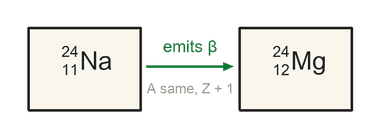
Watch out: γ radiation also leaves A unchanged, but it is NOT deflected by a magnetic field; the deflection rules it out.
Therefore, (a)(1) lead; (2) lead is very dense with a high atomic number, so it absorbs the radiations strongly; (b)(1) β radiation; (2) .
- 421 mark
Question 42
When the nuclear radiation is subjected to a magnetic field, the direction of deflection is governed by:
Solve with AIAnswer
(A) Fleming's Right Hand Rule
- Correct
(B) Fleming's Left Hand Rule
(C) Clock Rule
(D) Right Hand Thumb Rule
Answer: (B) Fleming's Left Hand Rule
Concept: A charged particle moving through a magnetic field behaves like an electric current in the field, and the force on a current in a magnetic field is given by Fleming's left hand rule.
Step 1 — Use the left hand rule.
Stretch the forefinger, the middle finger and the thumb of the left hand at right angles to each other. The forefinger points along the field, the middle finger along the current, and the thumb then gives the force, that is, the direction of deflection.
Step 2 — Apply it to the radiations.
For a positive α particle the current is along its motion; for a negative β particle the current is opposite to its motion. So α and β are deflected in opposite directions, and uncharged γ radiation is not deflected.
Watch out: The LEFT hand rule gives a force (motors, moving charges); the RIGHT hand rule gives an induced current (generators).
Why the other options are wrong:
- (A) Fleming's Right Hand Rule: Fleming's right hand rule gives the direction of the induced current in electromagnetic induction, not the force on a moving charge.
- (C) Clock Rule: the clock rule tells the polarity (north or south) of a face of a current-carrying coil.
- (D) Right Hand Thumb Rule: the right hand thumb rule gives the direction of the magnetic field around a current-carrying wire.
Therefore, the direction of deflection is governed by Fleming's left hand rule, option (B).
- 431 mark
Question 43
Complete the following by choosing the correct answers from the bracket:
and are the examples of ............... [isobars / isotopes].
Solve with AIWritten solution
Solution:
Concept: Isotopes have the same atomic number Z but different mass numbers A (same element, different numbers of neutrons). Isobars have the same A but different Z (different elements). Isotones have the same number of neutrons (A − Z) but different Z.
Step 1 — Compare the mass numbers.
Both nuclei have mass number 40.
Step 2 — Compare the atomic numbers.
Argon has 18 protons and calcium has 20, so they are different elements.
Same mass number with different atomic numbers is the mark of isobars.

Watch out: Isotopes need the SAME atomic number; here the atomic numbers differ.
Therefore, and are the examples of isobars.
- 442 marks
Question 44
A uranium nucleus () undergoes an alpha emission followed by 2 beta emissions.
Calculate the atomic number and mass number of the daughter nucleus formed.
Solve with AIWritten solution
Solution:
Concept: In α emission the nucleus throws out 2 protons and 2 neutrons together, so A falls by 4 and Z falls by 2: a new element, two places back in the periodic table. In β emission a neutron inside the nucleus changes into a proton and an electron, and the electron is thrown out. So A stays the same and Z rises by 1: a new element, one place forward in the periodic table.
Step 1 — Apply the α emission.
The α particle takes away 4 from A and 2 from Z.
Step 2 — Apply the first β emission.
A β emission keeps A and raises Z by 1.
Step 3 — Apply the second β emission.
The second β emission again keeps A and raises Z by 1.

Step 4 — Name the daughter.
The atomic number is 92 again, the same as the parent, so the daughter is uranium-231, an isotope of uranium 4 nucleons lighter.
Watch out: Two β emissions raise Z by 2 and exactly cancel the fall of 2 from the α emission; A still falls by 4.
Therefore, the daughter nucleus has atomic number 92 and mass number 231 ().
- 454 marks
Question 45
Scientists unearthed an ancient scroll for determining the age of a fossil. The process involved collecting from the fossil and comparing it with a fresh sample. Scientist found that the ratio of : decreased as compared to the fresh sample.
(a) Name the process.
(b) and are collectively known as ...............
(c) Why did the ratio decrease in the fossil?
(d) Complete the equation by filling the blanks:
+ ⟶ +
Solve with AIWritten solution
Solution:
Concept: Living things keep taking in carbon, a small fixed share of which is radioactive carbon-14. After death no new carbon is taken in, so the carbon-14 left keeps falling as it decays. In every nuclear change the total mass number (A) and the total atomic number (Z) are the same on both sides of the equation. An α particle is , a β particle is , a neutron is and γ radiation has A = 0 and Z = 0.
(a)
Step 1 — Name the process.
Finding the age of a fossil from its share of carbon-14 is called carbon dating (radio-carbon dating).
(b)
Step 2 — Name the pair.
Carbon-14 and carbon-12 both have atomic number 6 but different mass numbers (8 and 6 neutrons), so they are isotopes of carbon.
(c)
Step 3 — Explain the fall in the ratio.
While the plant or animal was alive, it kept taking in carbon with a fixed share of carbon-14, so its ratio C-14 : C-12 was the same as in a fresh sample. After death no fresh carbon came in. Carbon-14 keeps decaying by β emission into nitrogen-14, while carbon-12 is stable.
So the carbon-14 falls while the carbon-12 stays the same, and the ratio decreases: the older the fossil, the smaller the ratio.
(d)
Step 4 — Balance the mass numbers.
The mass numbers on both sides must be equal; P here stands for a proton, .
Step 5 — Balance the atomic numbers.
The atomic numbers must also be equal.
Atomic number 7 is nitrogen, so X is nitrogen-14.
This is how carbon-14 is formed in the atmosphere, when neutrons from cosmic rays strike nitrogen.
Watch out: Carbon-12 does not decay; only carbon-14 does, and that is why the ratio falls.
Therefore, (a) carbon dating; (b) isotopes; (c) after death the carbon-14 decays and is not replaced, while carbon-12 stays the same, so the ratio falls; (d) X is .